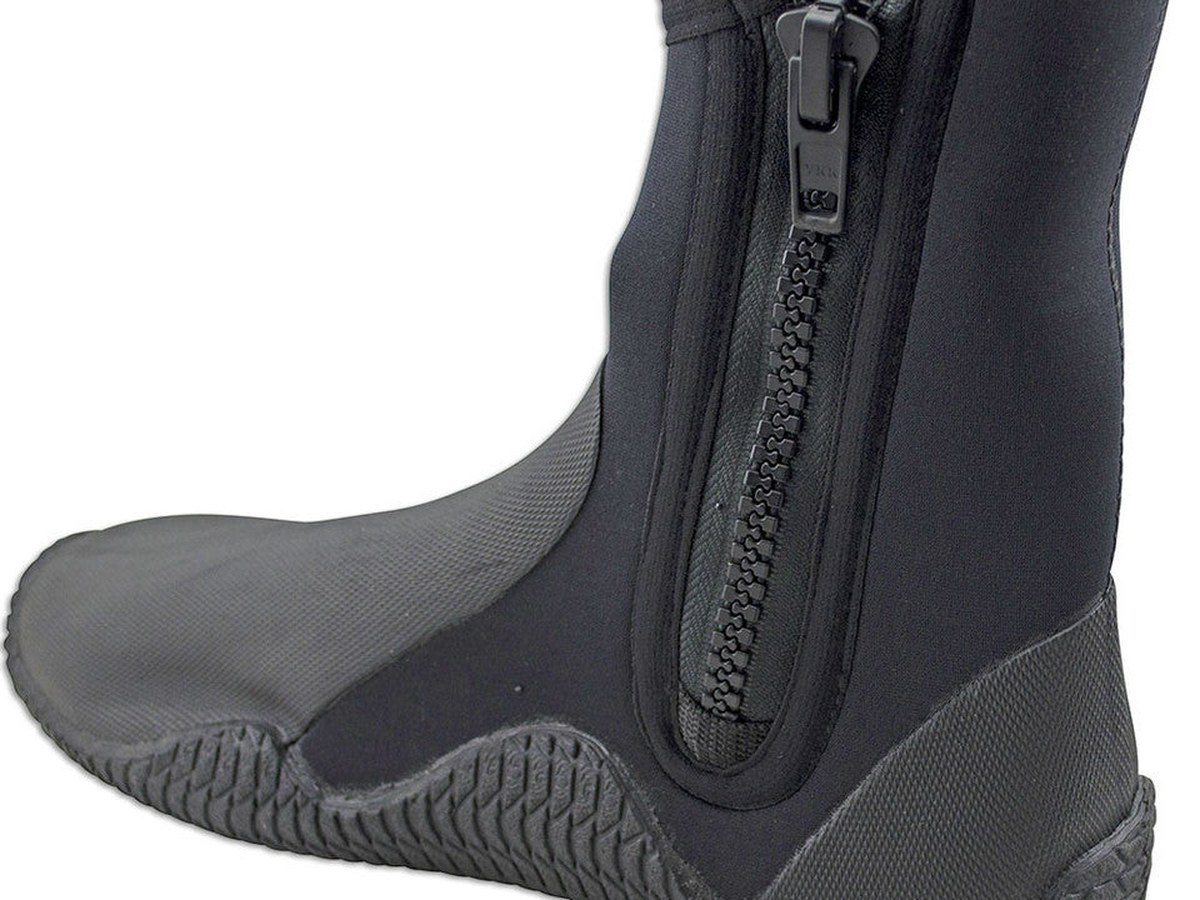
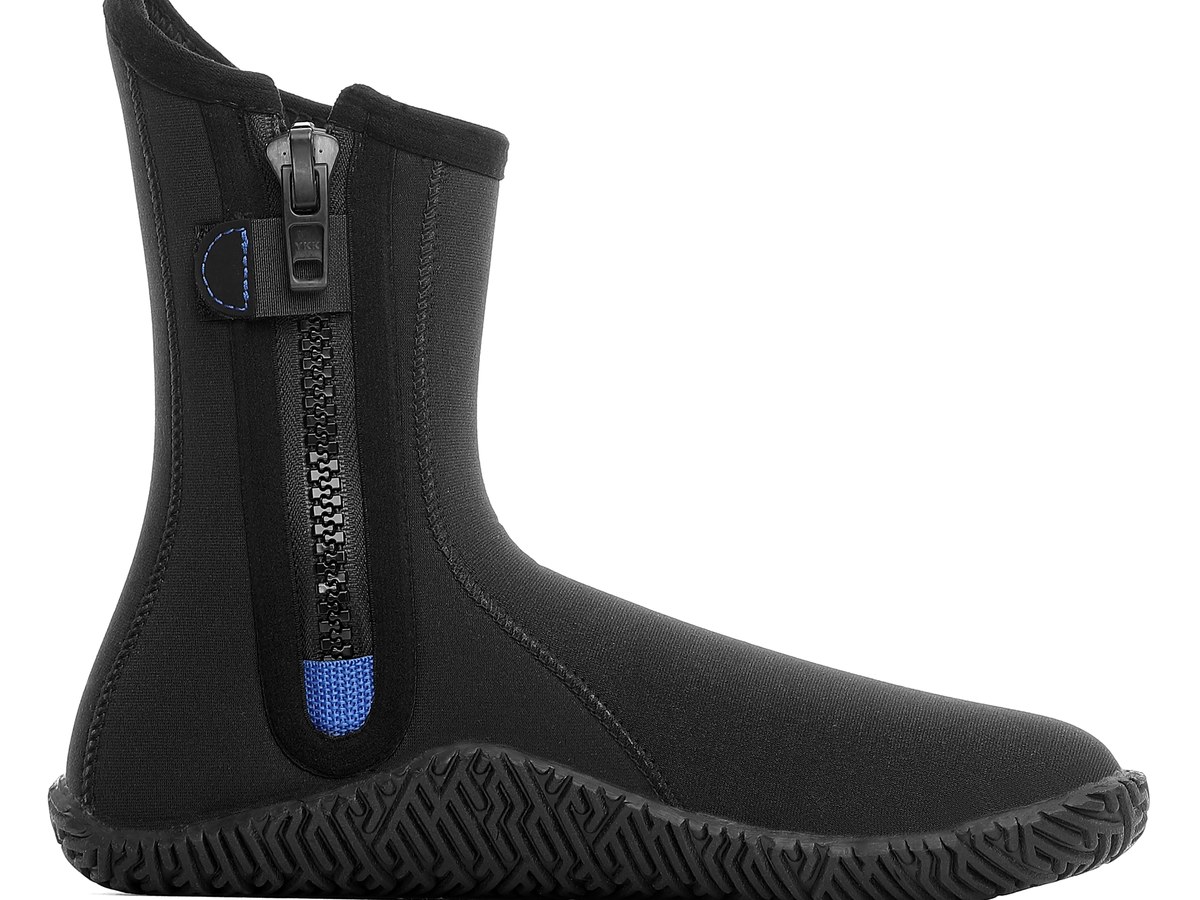
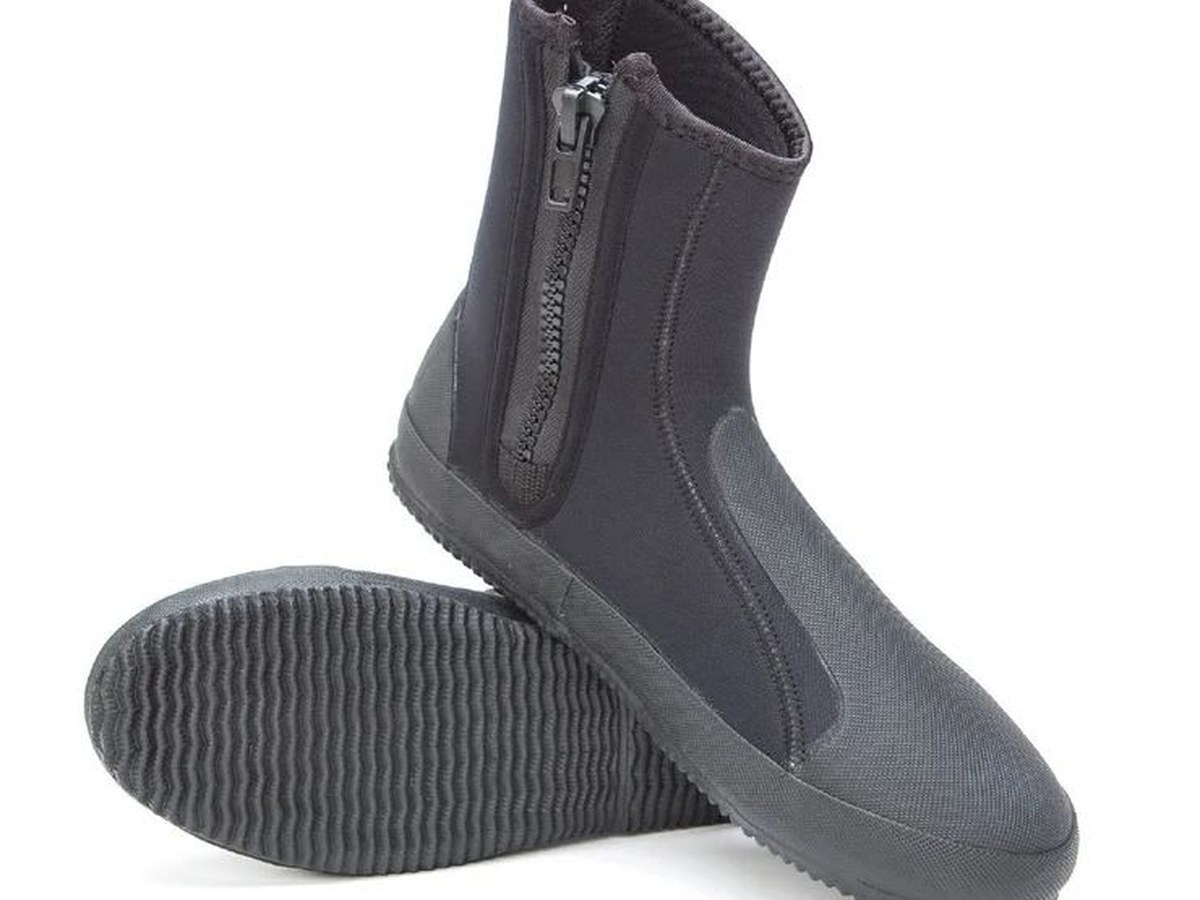
A neoprene dive boot is a soft boot for shore and boat diving, made from laminated neoprene (SBR / SCR / CR foam + fabric), 5 mm thick, with a non-slip rubber sole. Divers pull them on before entering the water, wear them with open-heel fins, and walk back over rocks, sand and decks. They are not walking shoes. Send us your design drawing, the diving conditions and the sizes, and we will confirm the best material and thickness.
We manufacture custom neoprene dive boots in our own factory in China, where we have made neoprene products for 15 years. The upper is cut from laminated neoprene, glued and blind-stitched so water stays out and the seams do not chafe over a full day of diving, and a moulded rubber sole is bonded to the upper for grip on wet decks and shore rock.
The sole is where a dive boot fails first: if it is only glued, the toe edge peels back after repeated walks over rock. We bond the sole to the neoprene upper and stitch around the edge, so the sole stays fixed even when the boot is dragged across a boat ladder or a rocky shore.
The toe and heel are reinforced for walking on shore and climbing boat ladders, and the ankle opening is cut to fit snugly without a struggle to pull on. A heel pull tab helps the diver get the boot on with wet hands, and an ankle zip can be added where you ask for one, for divers who want a faster fit.
Inside, a nylon jersey lining slides on easily over a bare foot or a neoprene sock. Panels are cut to within 2 mm of the pattern, so the boot keeps the same fit from the first pair to the last, and the boot is made to fit inside an open-heel fin without bunching at the toes.
5 mm is the standard for dive boots. It is warm enough for most recreational dive sites, still flexible enough to walk in, and thick enough to protect the foot from rocks, coral and hot sand.
| Thickness | Best for | Trade-off |
|---|---|---|
| 3 mm | Warm water, snorkelling, shore diving on sand | Least warmth; thin protection on sharp rock |
| 5 mm | The standard — most recreational diving, boat and shore | A little stiffer to pull on than a thin boot |
| 7 mm | Cold water, winter diving, long bottom times | Heaviest and stiffest; harder to fit inside a fin |
Measure the foot, not the shoe size. Stand on a sheet of paper, mark the heel and the longest toe, and measure that length — then measure the inside length of the fin pocket the boot must fit into. Send both numbers with your drawing, and we will check the fit before sampling. For the full chart across all uses, see our neoprene sheet thickness guide, and see our custom neoprene dive boots for the sizes we cut.
SBR is the standard choice for dive boots. It is soft, easy to sew into a boot shape, and comfortable against the foot all day. CR resists sun, ozone and salt water better, so we recommend it for boots used every day in the sea and left to dry in the sun on a boat deck. Our CR foam measures 3–5° Shore C hardness, 276.32 kg/m³ density, 860 kPa tensile strength and 550% elongation; our SBR (10–15°) measures 10–15° hardness, 158.34 kg/m³, 256 kPa and 185%. SCR sits between the two: tougher than SBR in outdoor use, easier to sew than CR.
| SBR | CR | |
|---|---|---|
| Cost | The usual choice; keeps the unit cost down for dive schools and fleets | Costs more than SBR; chosen where daily sea use justifies it |
| UV and ozone resistance | Fair; fine for occasional diving and indoor storage | Strong; holds up better in sun and salt air on deck |
| Water use | Water-resistant; glued and blind-stitched seams keep most water out | Water-resistant too, with the same seam limit; chosen for daily salt-water use |
| Best for | Dive schools, rental fleets, holiday diving | Daily diving, dive guides, boat crews |
Either foam is laminated with a nylon jersey lining that slides on easily over a bare foot or a neoprene sock.
Dive brands — your own label, your own colours and your own sole tread, made to your tech pack, for divers who buy boots with your suits.
Dive schools and clubs — matching sets for students and instructors, with size marking that survives repeated washing and boots that survive daily teaching use.
Rental fleets — reinforced toe and heel, numbered sizes for easy hire, built to survive daily use by many different divers on rocks and decks.
Distributors and e-commerce sellers — mixed sizes in one order, retail-ready packaging with hangtag on request, for shops that sell boots to divers who already own fins.
When neoprene is NOT the right choice: a dive boot is made for getting in and out of the water. It is the wrong pick when the brief needs something else:
Do divers keep dive boots on between dives?
Yes. Divers pull the boots on before a shore or boat dive and keep them on for the walk back over rocks, sand and decks, then rinse them and leave them to dry. The reinforced toe and heel are there because the boots are walked in, not just swum in.
Why do shore divers need boots more than boat divers?
Shore divers walk into the water over rock, coral and hot sand, and walk back out the same way. A boot with a rubber sole protects the foot on that walk, while a boat diver who steps straight off a deck can manage with less sole — though most boat divers still wear boots for the deck and the ladder.
What is the minimum order?
200 pieces per design as a general minimum, adjustable to your actual order. Tell us your actual quantity and the size split in the enquiry and we will confirm whether it works for your divers.
Can I get a sample first?
Yes — we support sampling, usually in 5–7 days. Send us your design drawing and sizes and we will confirm the sample cost and time.
How long does bulk production take?
Usually 15–18 days after sample approval, depending on the quantity and customisation. Larger orders or extra custom work can take a little longer, and we will confirm the date with you before bulk production starts.
How do I order?
Send us your design drawing, the sizes you need and the fin type. We confirm the material, thickness and price, then make a sample for your approval before bulk production.
Ready to order? Our minimum order is 200 pieces per design as a general minimum, adjustable to your actual order. We support sampling, usually in 5–7 days, and bulk production usually takes 15–18 days after sample approval. Request a quote for our custom neoprene dive boots and we will confirm the material, thickness and price for your divers.
Request a Quotation
To help us review your inquiry, please send:
Website: https://www.neoprenecustom.com/ Email: kevin@neoprenecustom.com
Send the list above and we will come back with a sample plan and a quote for your dive boots.
Contact: Kevin
Phone: 13417385320
Tel: 0734-87965514
Email: kevin@neoprenecustom.com
Add: Intersection of Zhangjialing Road and Science and Technology Road, Guiyang Industrial Park, Guiyang Town, Qidong County, Hengyang City, Hunan Province./Dongguan Factory(GUANXIN): Shixin Street, Fushan Village, Liaobu Town, Dongguan, Guangdong Province.