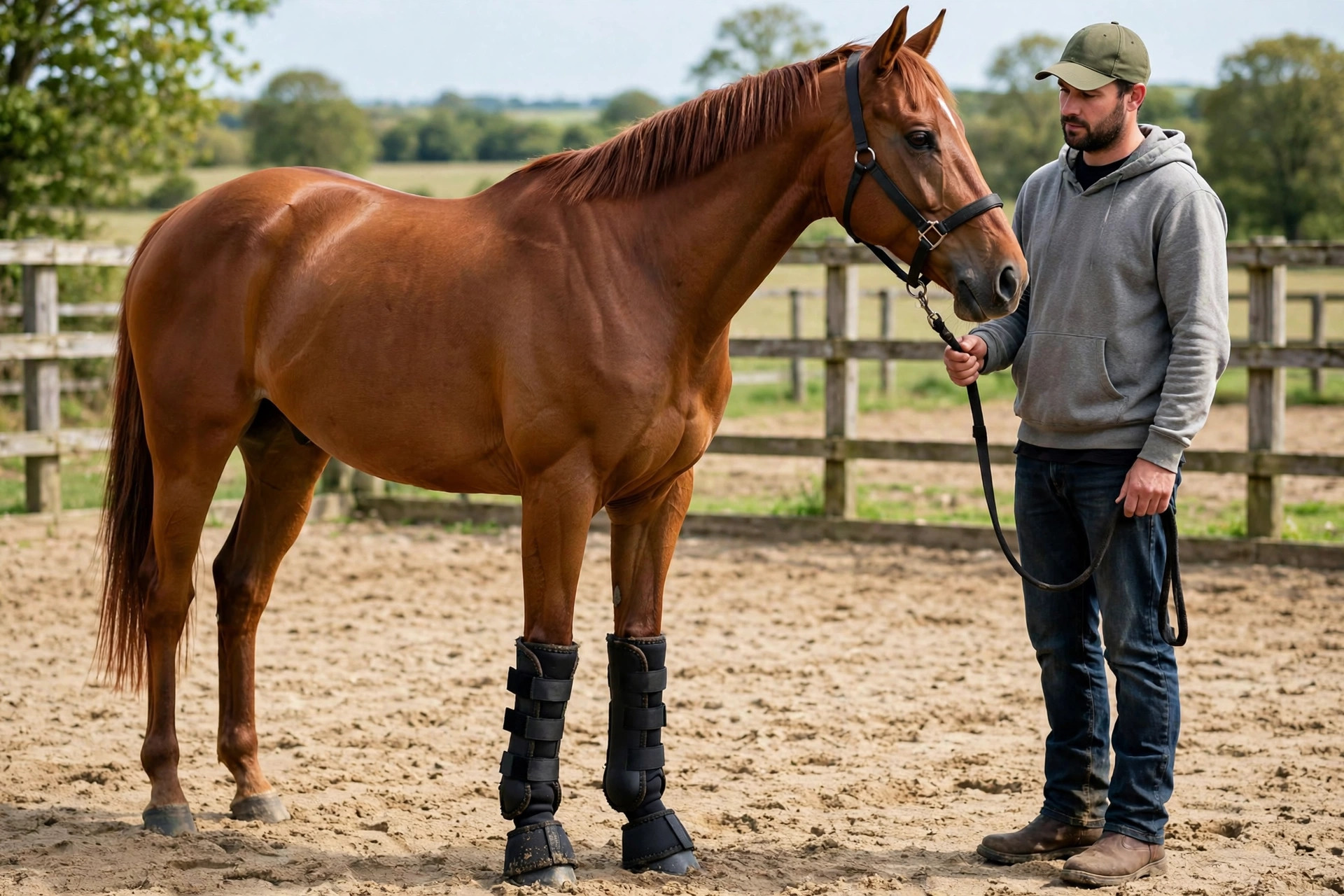
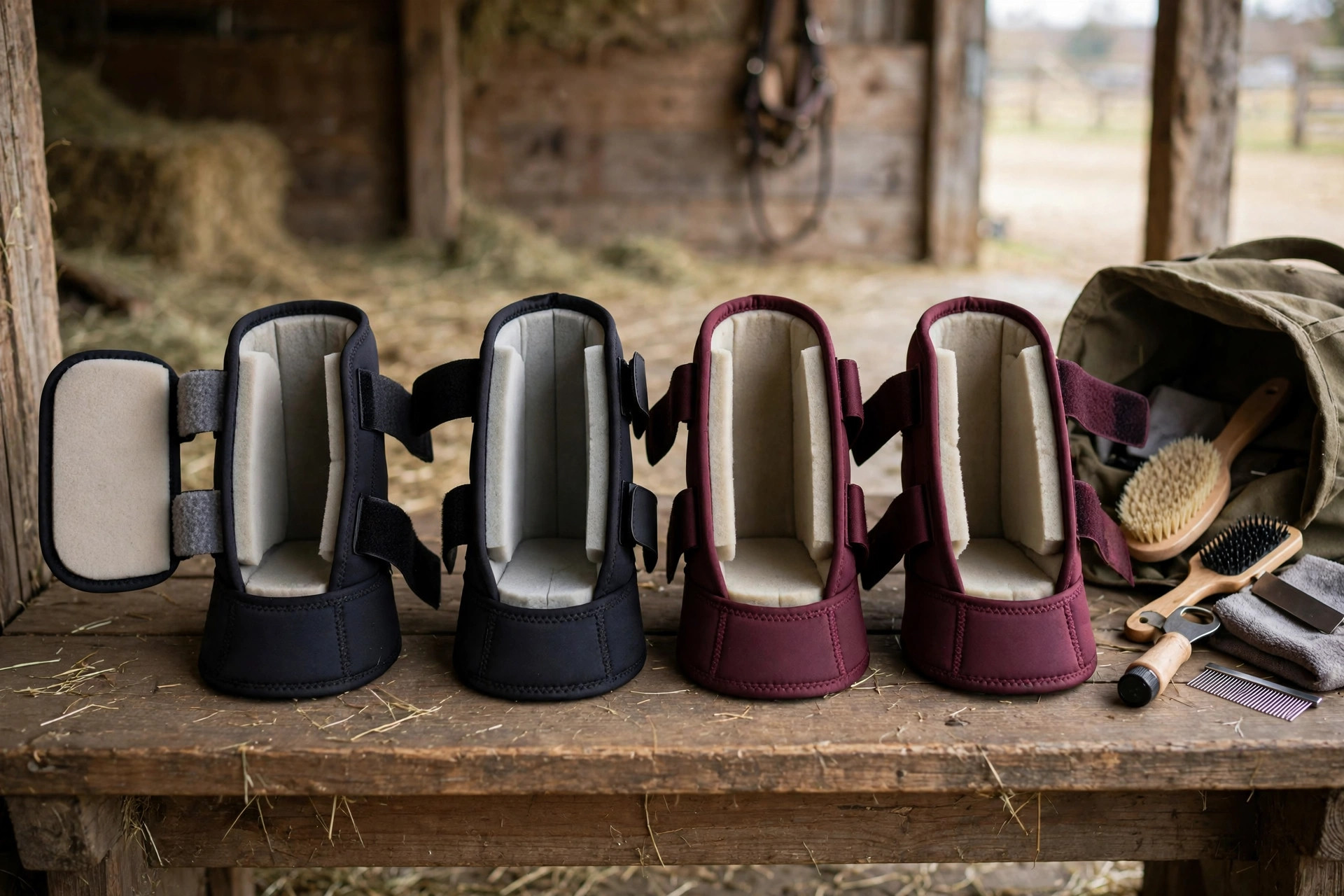
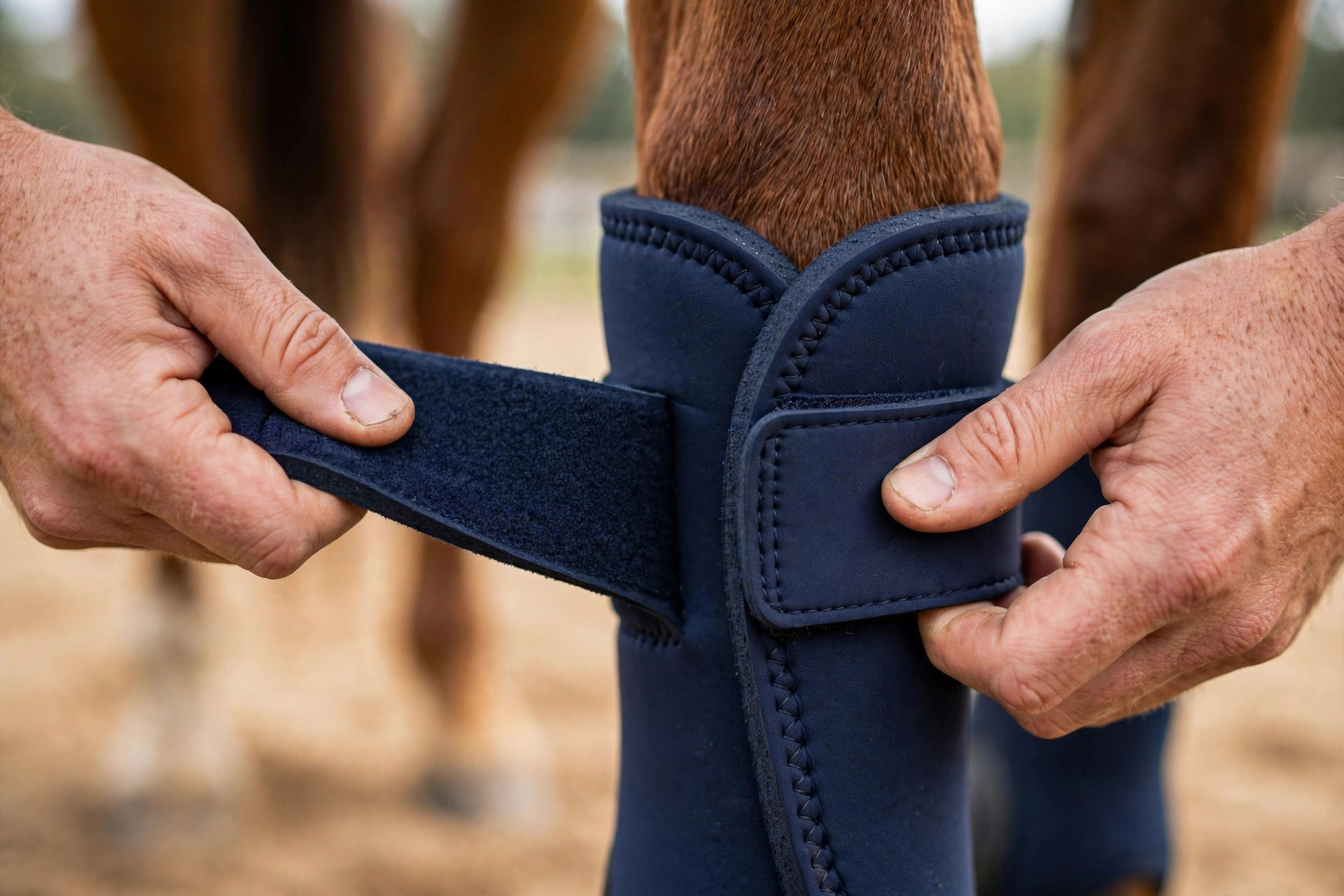
A neoprene horse leg boot is a shaped wrap of laminated neoprene (SBR, SCR or CR foam + fabric) that fastens around the cannon bone with hook-and-loop straps, padding the leg against knocks from the opposite hoof and against brushes, poles and arena surfaces during schooling, jumping and turnout. It covers the cannon bone and the fetlock — the long stretch of the lower leg — which is what sets it apart from a bell boot, which only cups the hoof and coronet band below it. Send us your design drawing and leg measurements, and we will confirm the best material and thickness.
We manufacture custom neoprene horse leg boots in our own factory in China, where we have made neoprene products for 15 years. We shape the panels, laminate the foam and stitch the finished boots under one roof, so a change to the strap layout, the height or the strike padding can be checked on a sample before bulk production starts.
The inside of a horse's lower leg takes the knocks. A tired horse brushes one leg against the other, a young horse catches a pole, and turnout adds the kicks and scuffles of company — and the cannon bone sits just under the skin with very little covering of its own. A foam boot puts a padded, close-fitting layer over that stretch of leg. Neoprene suits the work: it shapes to the leg instead of standing off it, the straps set the tension once and hold it through a session, and the foam absorbs the everyday knock rather than passing it through the way a hard shell can.
Yard practicality is the other half of the story. Neoprene boots rinse clean under a hose, shed mud instead of soaking it up, and dry fast enough to be back on the leg the next morning — no leather to oil, no fleece to pick shavings out of. They are the boots grooms actually reach for daily, which is why they are bought in sets of four and replaced as a wardrobe item, not a once-a-season purchase.
For equestrian brands, the boot is a visible team surface: yard colours, a printed or labelled strap and a matched set across pony, cob and full sizes. The same foam and construction run through the rest of a neoprene tack range — bell boots, girths and saddle pads — so a brand can build one material story across the whole shelf.
5 mm is the most popular thickness for neoprene horse leg boots. It pads the cannon bone properly against brushing and poles while still shaping closely enough to stay put at speed, which is why most of the boots we make are cut in 5 mm. For the full range, see our neoprene sheet thickness guide.
| Thickness | Best for | Trade-off |
|---|---|---|
| 3 mm | Light schooling boots where a close feel and a slim profile matter most | Least padding against a hard knock or a rapped pole |
| 5 mm | The standard boot — schooling, jumping and turnout for most horses | The balanced choice; neither the slimmest nor the most padded |
| 7 mm | Maximum padding — young horses, heavy brushers and rough turnout | Bulkiest on a fine leg, and holds the most warmth on a hot day |
Size the boot by measurement, not by the horse's height alone. Measure the circumference of the cannon bone at its widest point and the height of boot the leg needs, then match them to the size range — pony, cob and full are starting points, not a substitute for the tape. Front and hind legs are shaped differently, with hind boots usually taller, so send the measurements for both and we will pattern the pair accordingly.
SBR is the standard choice for most horse leg boots, because the firmer foam holds the boot's shape strap after strap, stands up to daily yard wear and keeps the price where a set-of-four product needs it. CR (chloroprene rubber) earns its higher price on premium lines — it is softer and considerably more elastic, so it conforms to an individual leg's shape more closely and feels richer in the tack shop. SCR, a blend of the two, sits between them on both feel and cost.
The figures behind the two foams show why they behave differently: our CR foam measures 3–5° Shore C hardness, 276.32 kg/m³ density, 860 kPa tensile strength and 550% elongation, while our SBR foam measures 10–15° Shore C, 158.34 kg/m³, 256 kPa and 185%. CR's elongation is the number that matters here — a CR boot stretches around the leg and settles, while an SBR boot holds a firmer, more defined shape and shrugs off abrasion against arena surfaces.
| SBR | CR | |
|---|---|---|
| Cost | Lower cost; the standard for most leg boots | Costs more than SBR |
| Fit and wear | Firm shape that holds its line and resists yard abrasion | Softer and more elastic; conforms closely to the individual leg |
| Best for | Yard, schooling and turnout ranges bought in sets of four | Premium ranges where fit and feel sell the set |
For sizes, strap layouts and colours, see our neoprene horse leg boots product page.
Equestrian brands — your own boot in your sizes, colours and strap layout, as part of a matched neoprene tack range.
Tack shops and saddlery retailers — sets of four in pony, cob and full, in the colours your local yards ride in.
Stable and yard suppliers — hard-wearing everyday boots in repeatable sizes for working yards and riding schools.
E-commerce sellers — measured size ranges with a clear sizing chart, packed as front pairs, hind pairs or full sets.
When neoprene is NOT the right choice
Tell us which of these your horse leg boots need, and we will build the sample to your drawing.
What is the difference between leg boots and bell boots?
Leg boots wrap the cannon bone and fetlock — the long stretch of the lower leg — and protect it against brushing and knocks. Bell boots sit at the bottom and cup the hoof and coronet band, protecting the heel and the back of the hoof. Many horses wear both, because they protect different places.
Are the boots the same for front and hind legs?
No. Hind boots are usually taller and shaped for the hind cannon and fetlock, so front and hind patterns are cut separately. Order them as front pairs, hind pairs or a full set of four, and measure both ends — hind measurements are not just bigger front ones.
How do I size neoprene horse leg boots?
Measure the circumference of the cannon bone at its widest point and the height of boot the leg needs, then match both numbers to the size range. Pony, cob and full are starting points — the tape decides, because a boot that is loose slides and a boot that is tight marks.
What is the minimum order?
200 pieces per design as a general minimum, adjustable to your actual order.
Can I get a sample first?
Yes — we support sampling, usually in 5–7 days. Send us your design drawing and the leg measurements and size range you need.
How long does bulk production take?
Usually 15–18 days after sample approval, depending on the quantity and customisation.
We make custom neoprene horse leg boots to your measurements, colours and strap layout, and we check the fit against a real leg measurement chart before bulk production. The general minimum order is 200 pieces per design, adjustable to your actual order; sampling is supported, usually in 5–7 days, and bulk production usually takes 15–18 days after sample approval.
Request a Quotation
To help us review your inquiry, please send:
Website: https://www.neoprenecustom.com/ Email: kevin@neoprenecustom.com
A leg boot is judged after a season of mud, not in the tack shop. Send us your measurements and we will make a sample set to work in. For the rest of the tack in the same material, see our neoprene horse girths.
Contact: Kevin
Phone: 13417385320
Tel: 0734-87965514
Email: kevin@neoprenecustom.com
Add: Intersection of Zhangjialing Road and Science and Technology Road, Guiyang Industrial Park, Guiyang Town, Qidong County, Hengyang City, Hunan Province./Dongguan Factory(GUANXIN): Shixin Street, Fushan Village, Liaobu Town, Dongguan, Guangdong Province.