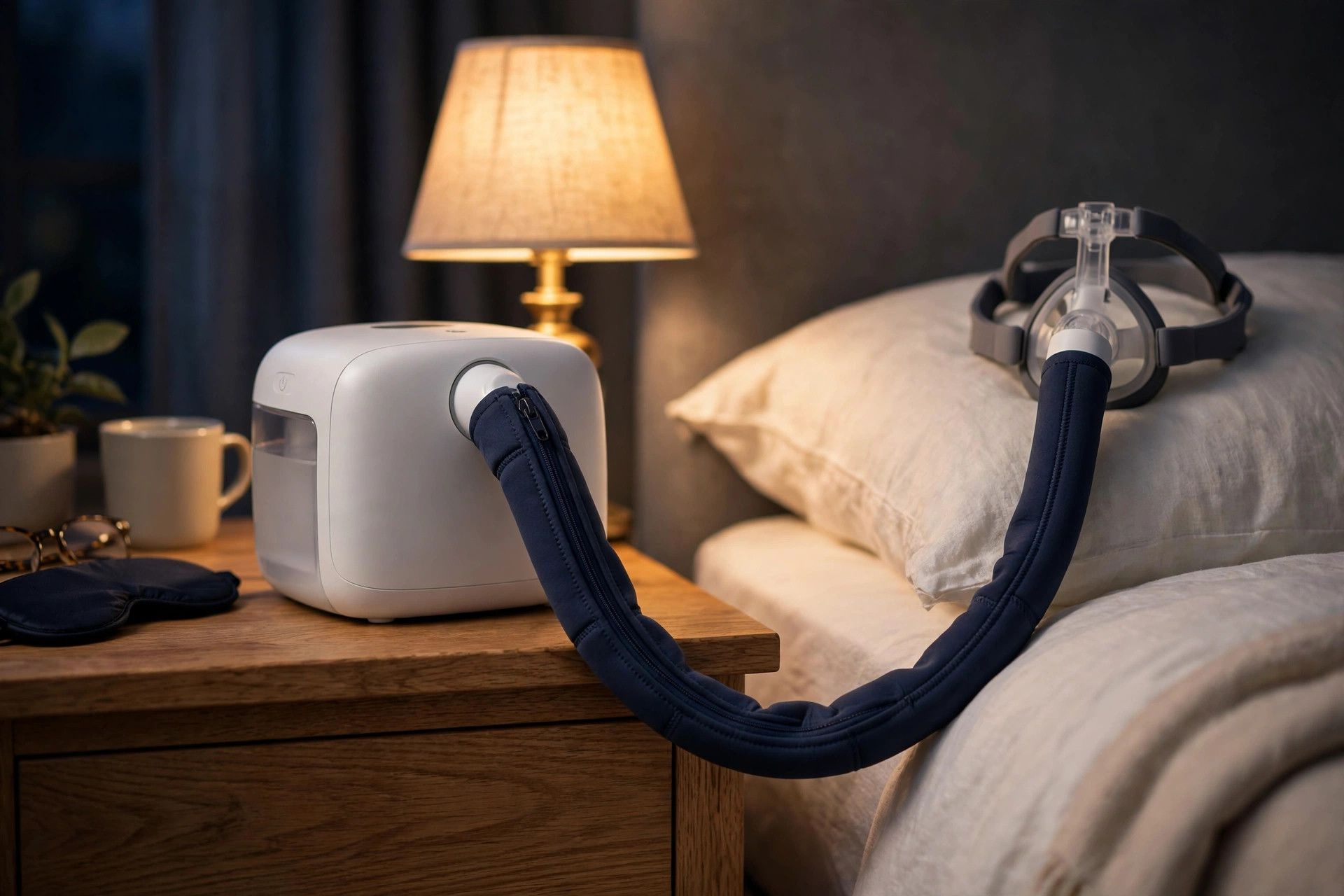
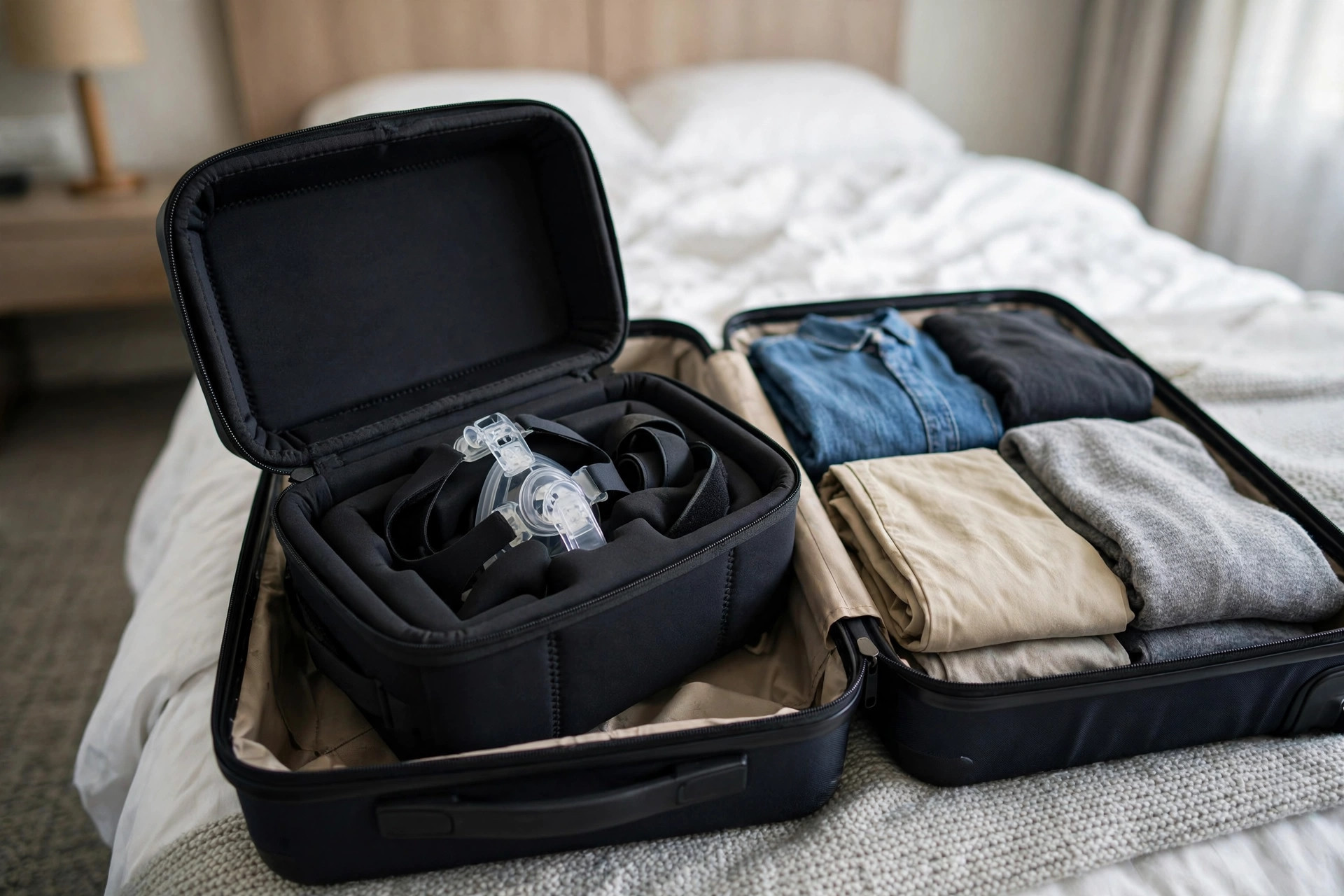
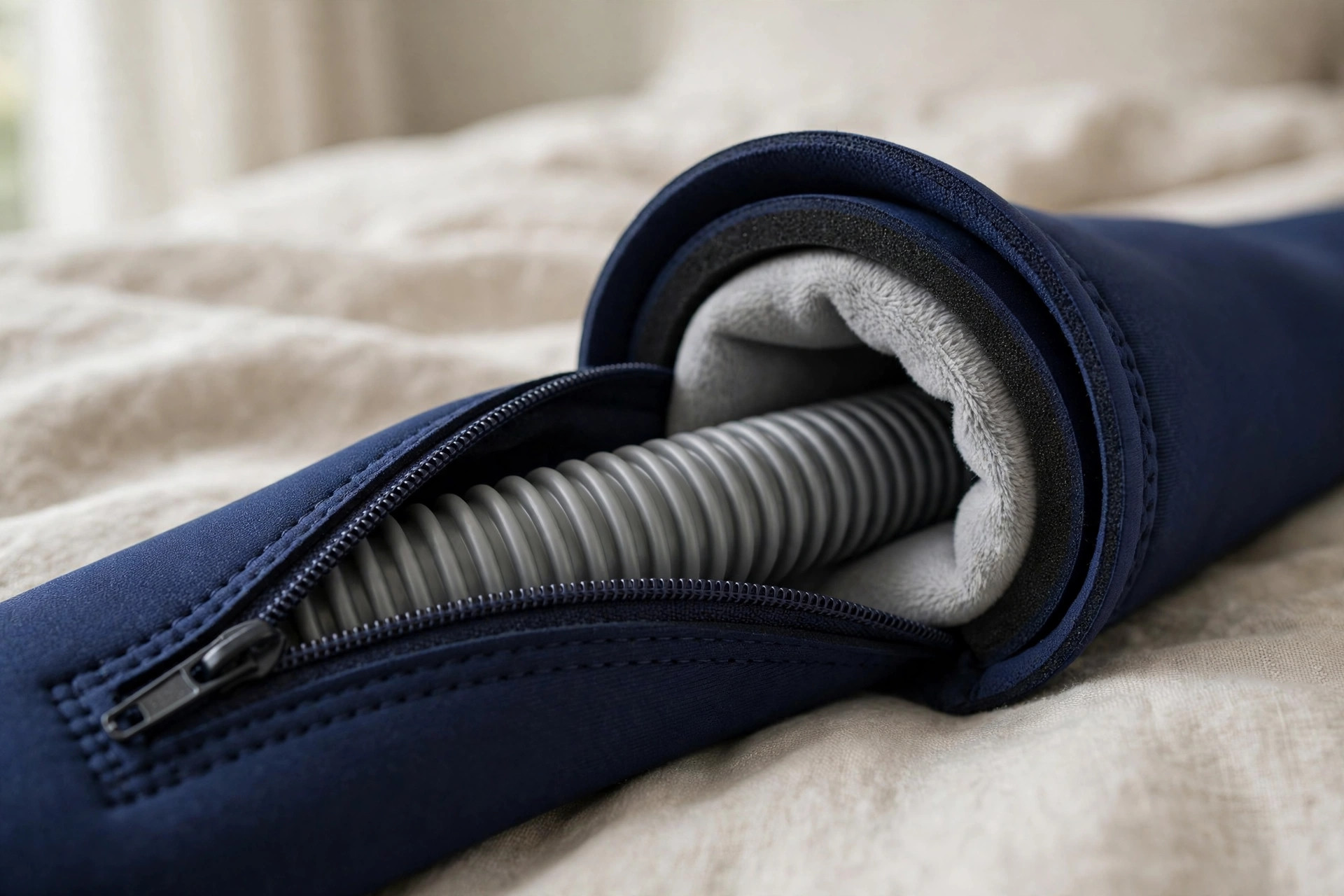
A neoprene CPAP hose cover is a zippered sleeve of laminated neoprene (SBR, SCR or CR foam + fabric) that wraps the air tube between the machine and the mask, and a neoprene mask case is a padded zip case that holds the mask and headgear at home or in a suitcase. The foam sleeve puts a soft, insulating layer around the tube, quietens the sound of the hose moving against the nightstand and keeps cold plastic off the skin; the case cushions the mask's frame and cushion against knocks. These are comfort and protection accessories — covers and cases, not medical devices. Send us your design drawing, hose length and mask model, and we will confirm the best material and thickness.
We manufacture custom neoprene CPAP hose covers and mask cases in our own factory in China, where we have made neoprene products for 15 years. We laminate the foam, cut the sleeves and cases and stitch the finished pieces under one roof, so a change to the length, the fit or the print can be checked on a sample before bulk production starts.
At night, the bare tube is the annoying part of the setup. It drags across the nightstand edge, rattles against the bed frame when the sleeper turns, and lies cold against an arm. A neoprene cover changes all three without touching how the machine works: the foam layer softens the tube's contact with furniture and skin, its weight settles the hose instead of letting it slide, and the fabric face is simply more pleasant to brush against at 3 a.m. The full-length zip is the practical detail — the cover goes on and comes off over the fitted tube in seconds, for washing or for travel, with no threading.
The mask case solves the daytime problem. The mask is the most delicate and most personal part of the equipment — a shaped frame and a soft cushion that pick up damage in a suitcase and dust on a shelf. A padded neoprene case keeps it in its own clean compartment, protected from the shoes and chargers it would otherwise travel against, and at home it gives the mask a defined place on the nightstand instead of an exposed perch. Sleep-care ranges sell the cover and the case as a pair, in matching colours, for exactly this reason.
For brands and distributors, these are small, light, high-attachment-rate accessories: almost every machine user is a candidate for both pieces, they pack flat, and the cover's long surface takes a printed brand or a quiet bedroom-friendly colour equally well.
3 mm is the standard thickness for neoprene CPAP hose covers, and 5 mm is the usual choice for mask cases. A cover has to follow every bend of the tube without fighting it, so it is cut thin and flexible; a case has to stand as a padded wall around the mask, so it is cut thicker. For the full range, see our neoprene sheet thickness guide.
| Thickness | Best for | Trade-off |
|---|---|---|
| 3 mm | Hose covers — flexible enough to follow every bend of the tube | Too soft to hold a case's shape; a cover thickness, not a case thickness |
| 5 mm | Mask cases — padded walls that cushion the frame and cushion in a suitcase | Too stiff for a hose cover; the tube would resist bending |
| 7 mm | Structured travel cases — maximum protection for checked luggage | Bulkiest option; more than a nightstand case needs |
Size the cover to the hose and the case to the mask. The standard hose is 6 ft (about 1.8 m), in standard and slimline diameters, and covers are cut to the length and diameter you specify, with the zip running the full length. Cases are shaped by mask type — nasal masks need a smaller case than full-face masks — so send the mask models your customers use, and we will pattern the case around them.
SBR is the standard choice for most CPAP hose covers and mask cases, because the accessories live indoors, the firmer foam holds the case's shape well and the cost suits an accessory price point. CR (chloroprene rubber) earns its higher price on premium sleep-care lines — it is softer and more elastic, which matters on a cover that rests against skin and bedding all night, and it gives a case a richer hand-feel. SCR, a blend of the two, sits between them on both feel and cost.
The figures behind the two foams show why they feel different: our CR foam measures 3–5° Shore C hardness, 276.32 kg/m³ density, 860 kPa tensile strength and 550% elongation, while our SBR foam measures 10–15° Shore C, 158.34 kg/m³, 256 kPa and 185%. CR is the softer, springier foam; SBR is the firmer, lighter one. On a hose cover that difference is felt every night; on a mask case it is the difference between a wall that flexes and one that stands.
| SBR | CR | |
|---|---|---|
| Cost | Lower cost; the standard for most CPAP accessories | Costs more than SBR |
| Feel against skin and bedding | Firm and light, holds a case's shape well | Softer and more elastic, more pleasant in contact all night |
| Best for | Distributor and e-commerce accessory ranges at a working price | Premium sleep-care lines where comfort feel sells the accessory |
For lengths, case sizes and printing, see our neoprene CPAP hose covers & mask cases product page. The same protective-case thinking runs through our neoprene blood pressure monitor cases and our neoprene stethoscope cases.
Sleep-care accessory brands — covers and cases in your colours and print, sized to the hoses and masks your customers use.
Medical supply and pharmacy distributors — own-label accessory lines that sit on the shelf beside the equipment, packed for retail.
CPAP equipment retailers — the add-on pair your customers ask for at the counter, branded as part of your own range.
E-commerce sellers — light, flat-packing accessories in mixed colours and sizes, ready for the shelf with a barcode label.
When neoprene is NOT the right choice
Tell us which of these your CPAP hose covers and mask cases need, and we will build the sample to your drawing.
Does a hose cover change how the therapy works?
No. The cover wraps the outside of the tube and nothing else — it does not touch the airflow, the pressure or the mask seal. It is a comfort and protection accessory: softer against the skin, quieter against the furniture, and insulating around the tube.
What hose sizes does the cover fit?
The cover is cut to the hose you specify — the standard 6 ft (about 1.8 m) length in standard or slimline diameter covers most machines, and the full-length zip means it fits over the tube's end cuffs without threading. Send the hose type and we will size the sample to it.
How are the cover and case cleaned?
By hand, in cool water with mild soap, then air-dried flat away from direct heat. The full-length zip makes the cover quick to remove and refit, which is why it is the standard closure.
What is the minimum order?
200 pieces per design as a general minimum, adjustable to your actual order.
Can I get a sample first?
Yes — we support sampling, usually in 5–7 days. Send us your design drawing, hose length and the mask model the case must fit.
How long does bulk production take?
Usually 15–18 days after sample approval, depending on the quantity and customisation.
We make custom neoprene CPAP hose covers and mask cases to your hose sizes, mask models, colours and print, and we check the fit on the real tube and mask before bulk production. The general minimum order is 200 pieces per design, adjustable to your actual order; sampling is supported, usually in 5–7 days, and bulk production usually takes 15–18 days after sample approval.
Request a Quotation
To help us review your inquiry, please send:
Website: https://www.neoprenecustom.com/ Email: kevin@neoprenecustom.com
A hose cover is judged at 3 a.m., half asleep. Send us your hose and mask details and we will make a sample your customers can judge the same way. For the wash bag that travels next to the case, see our custom neoprene toiletry bags.
Contact: Kevin
Phone: 13417385320
Tel: 0734-87965514
Email: kevin@neoprenecustom.com
Add: Intersection of Zhangjialing Road and Science and Technology Road, Guiyang Industrial Park, Guiyang Town, Qidong County, Hengyang City, Hunan Province./Dongguan Factory(GUANXIN): Shixin Street, Fushan Village, Liaobu Town, Dongguan, Guangdong Province.