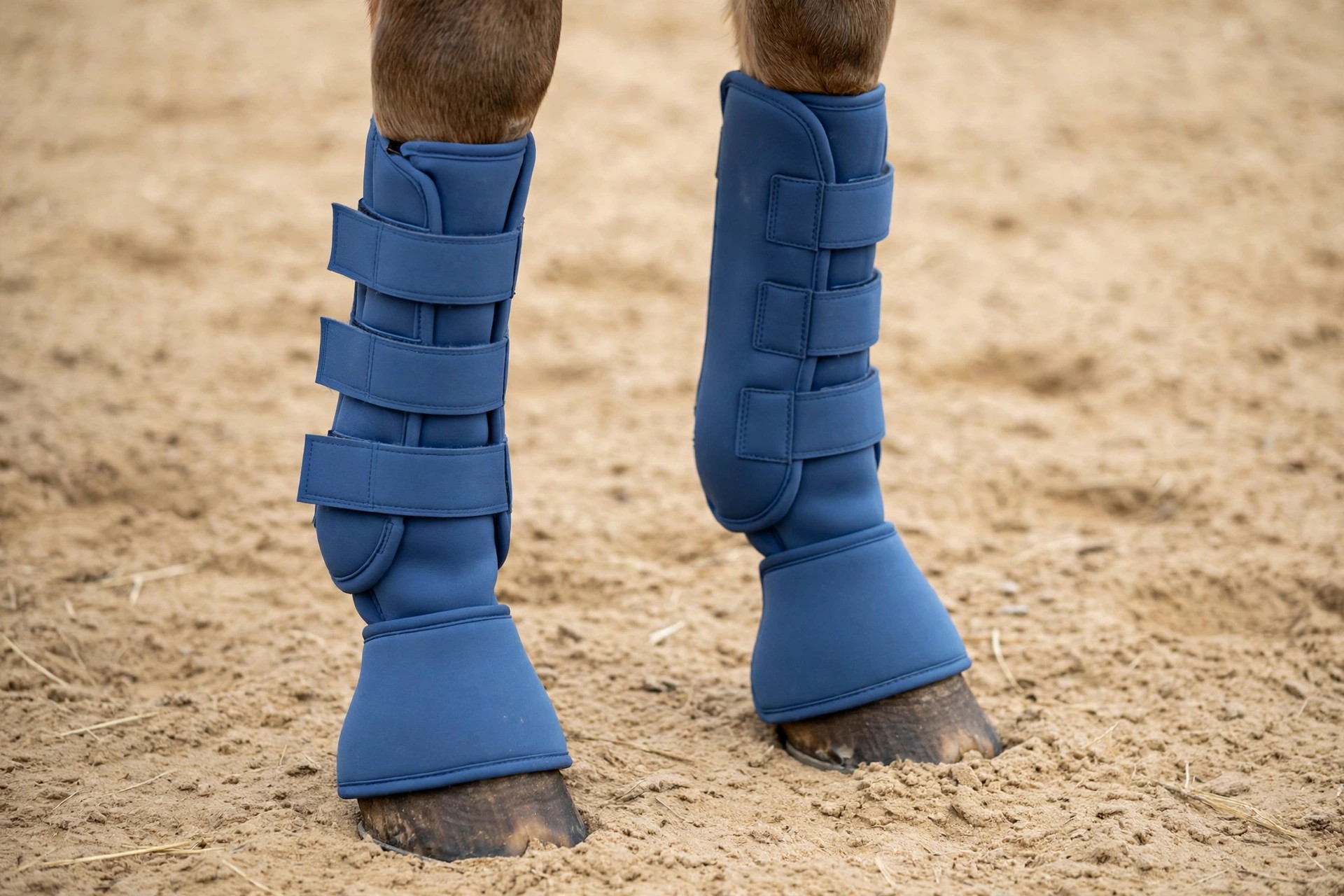
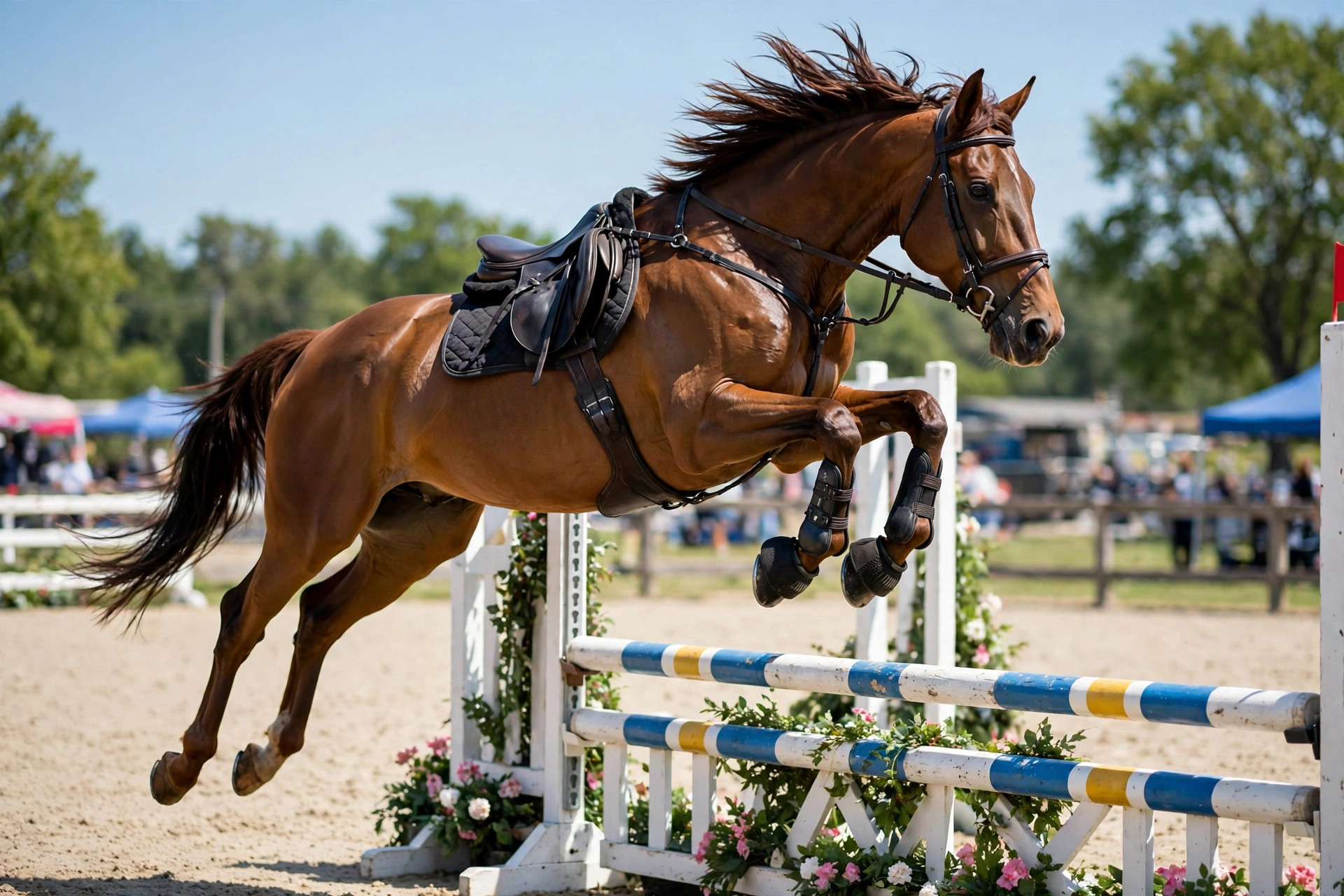
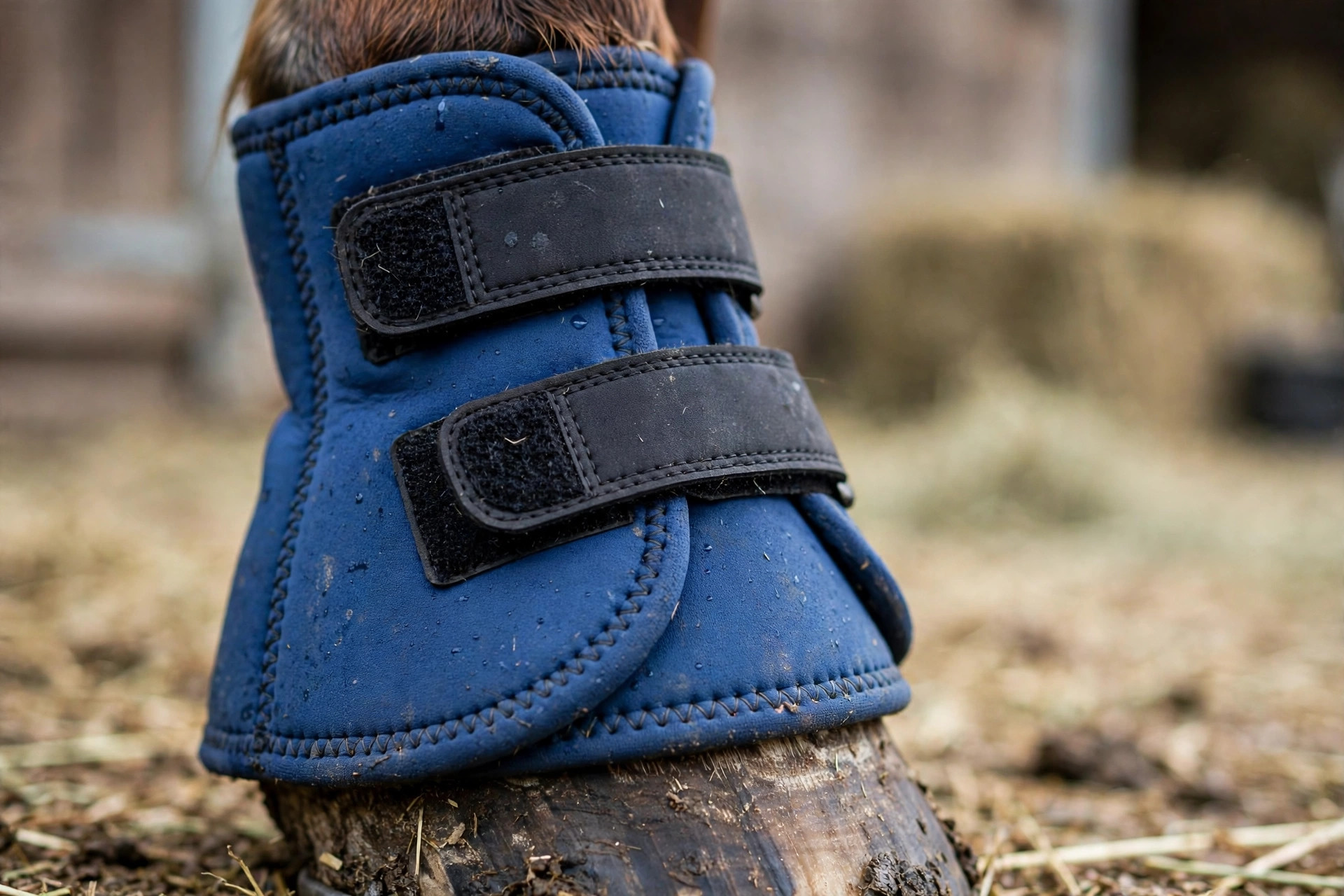
A neoprene horse bell boot is a shaped cup of laminated neoprene (SBR, SCR or CR foam + fabric), usually 5 mm thick, that fits over the coronet band and heel bulbs of a hoof and cushions the strike when a hind toe catches the back of a front heel — the overreach injury that cuts heels and pulls shoes in jumping, schooling and turnout. The cup opens flat, wraps around the pastern and closes with a double hook-and-loop strap, so it goes on in seconds before work and comes off just as fast afterwards. Send us your design drawing and boot size, and we will confirm the best material and thickness.
We manufacture custom neoprene horse bell boots in our own factory in China, where we have made neoprene products for 15 years. We cut the foam, laminate the fabric face and stitch the finished bell boots under one roof, so a change to the cup shape, the strap or the print can be checked on a sample before bulk production starts.
The heel is struck from behind, at speed, by a shod hind toe. The skin over the heel bulbs is thin, the coronet band below it is where new hoof grows from, and a cut there is slow to heal and easy to reopen the next time the horse works. A bell boot puts a padded wall in the way of that strike: the foam spreads the force over the whole cup instead of letting the toe land on one point of skin, and the same cushion sits between the shoe and the ground when the horse is turned out.
Bell boots and leg boots work as one system. The leg boot guards the cannon bone and fetlock up the leg; the bell boot guards the coronet and heel below it, and the two overlap at the pastern so there is no bare gap for a strike to land in. Yards that buy our custom neoprene horse leg boots usually take bell boots in the same foam, the same face fabric and the same colours, so the set matches on the horse and in the catalogue.
A bell boot lives in mud, arena sand and wash bays. It is stepped on, dragged through wet grass and hosed down daily, so the edge binding and the strap take as much wear as the cup itself. We bind the rim so the foam edge does not fray against the ground, and the whole boot rinses clean and dries overnight — no filling to soak up water and stay heavy the next morning.
5 mm is the standard for most neoprene bell boots. It gives real cushioning over the heel bulbs while the cup still flexes with the pastern at every stride, which is why most of the bell boots we make are cut in 5 mm. For the full range, see our neoprene sheet thickness guide.
| Thickness | Best for | Trade-off |
|---|---|---|
| 3 mm | Turnout and light schooling; horses that only brush their heels now and then | Least cushioning against a hard, full-speed overreach strike |
| 5 mm | Most bell boots — schooling, jumping and everyday turnout | Best balance of cushioning, flex and weight |
| 7 mm | Strong overreachers and cross-country work, where the strike lands hardest | Thickest and stiffest cup; costs more than 5 mm |
Measure the coronet, not the hoof alone. Take the circumference where the boot's top edge will sit, just above the coronet band, and check the cup is deep enough to cover the heel bulbs fully while its rim clears the ground by a small margin — a cup that drags in the arena surface wears through at the rim and can be trodden on by the horse itself. Our standard sizes run pony, cob, full and oversize, and we cut to a brand's own size chart on request.
SCR and SBR are the standard choices for most bell boot ranges, and CR is the choice for premium lines and wet-weather yards. SBR (styrene-butadiene rubber) is the firm, light foam that holds the cup's shape at the lowest cost. CR (chloroprene rubber) is softer and more elastic, stays flexible in cold and wet conditions, and springs back after a strike instead of staying dented. A yard boot that works in mud and rain all winter is where CR earns its price.
The numbers show why the two foams feel different: our CR foam measures 3–5° Shore C hardness, 276.32 kg/m³ density, 860 kPa tensile strength and 550% elongation, while our SBR foam measures 10–15° Shore C, 158.34 kg/m³, 256 kPa and 185%. CR is the softer, springier foam; SBR is the firmer, lighter one. SCR sits between the two on cost and stretch, and we use it where a customer wants more give than SBR without paying for CR.
| SBR | CR | |
|---|---|---|
| Cost | Lower cost; the usual choice for everyday and yard lines | Costs more than SBR |
| Mud, wet and cold use | Fair; fine for dry arenas and summer turnout | Better; stays soft and elastic through a wet winter |
| Feel | Firm and light, holds the cup shape | Soft and elastic, springs back after a strike |
For sizes, colours and ordering, see our custom neoprene horse bell boots product page. Brands cutting their own boots can start from the sheet itself — our CR neoprene sheet for equestrian saddle pads lists bell boots among the protective boots made from it.
Equestrian brands — your own logo on a bell boot that matches your leg boot line, made to your sizes and colours.
Tack shops — bell boots in pony to oversize, in the colours riders ask for, with a printed name or pattern, for the boot wall.
Riding schools and competition yards — durable boots in yard colours that go on school horses every day and rinse clean at night.
Online tack stores — a light, flat product that photographs well, ships in a polybag and pairs with leg boots in the same order.
When neoprene is NOT the right choice
Tell us which of these your bell boots need, and we will build the sample to your drawing.
Will a bell boot stay on through a jumping round?
Yes, if it is sized and strapped right. The cup is shaped to the pastern and closed with a double hook-and-loop strap, so it stays shut through jumping, galloping and turnout; a boot that spins or slips is usually a size too big.
How do I choose the size?
Measure the circumference just above the coronet band and match it to the size chart — pony, cob, full or oversize. The cup should cover the heel bulbs fully and clear the ground by a small margin.
How do I clean bell boots?
Rinse the mud off under a tap or hose, and leave them to dry open. The foam does not soak up water, so the boots are light and ready again the next day.
What is the minimum order?
200 pieces per design as a general minimum, adjustable to your actual order.
Can I get a sample first?
Yes — we support sampling, usually in 5–7 days. Send us your design drawing and the horse sizes and boot sizes you need.
How long does bulk production take?
Usually 15–18 days after sample approval, depending on the quantity and customisation.
We make custom neoprene horse bell boots to your size, your print and your face choice, and we check the cup shape and the strap on a sample before bulk production. The general minimum order is 200 pieces per design, adjustable to your actual order; sampling is supported, usually in 5–7 days, and bulk production usually takes 15–18 days after sample approval.
Request a Quotation
To help us review your inquiry, please send:
Website: https://www.neoprenecustom.com/ Email: kevin@neoprenecustom.com
A bell boot is judged by the heels it keeps whole through a season. Send us the horse size and we will make you a sample to try on a real horse. If you are building a full boot line, our guide to sourcing neoprene fabric for saddle pads and horse boots covers the material side.
Contact: Kevin
Phone: 13417385320
Tel: 0734-87965514
Email: kevin@neoprenecustom.com
Add: Intersection of Zhangjialing Road and Science and Technology Road, Guiyang Industrial Park, Guiyang Town, Qidong County, Hengyang City, Hunan Province./Dongguan Factory(GUANXIN): Shixin Street, Fushan Village, Liaobu Town, Dongguan, Guangdong Province.