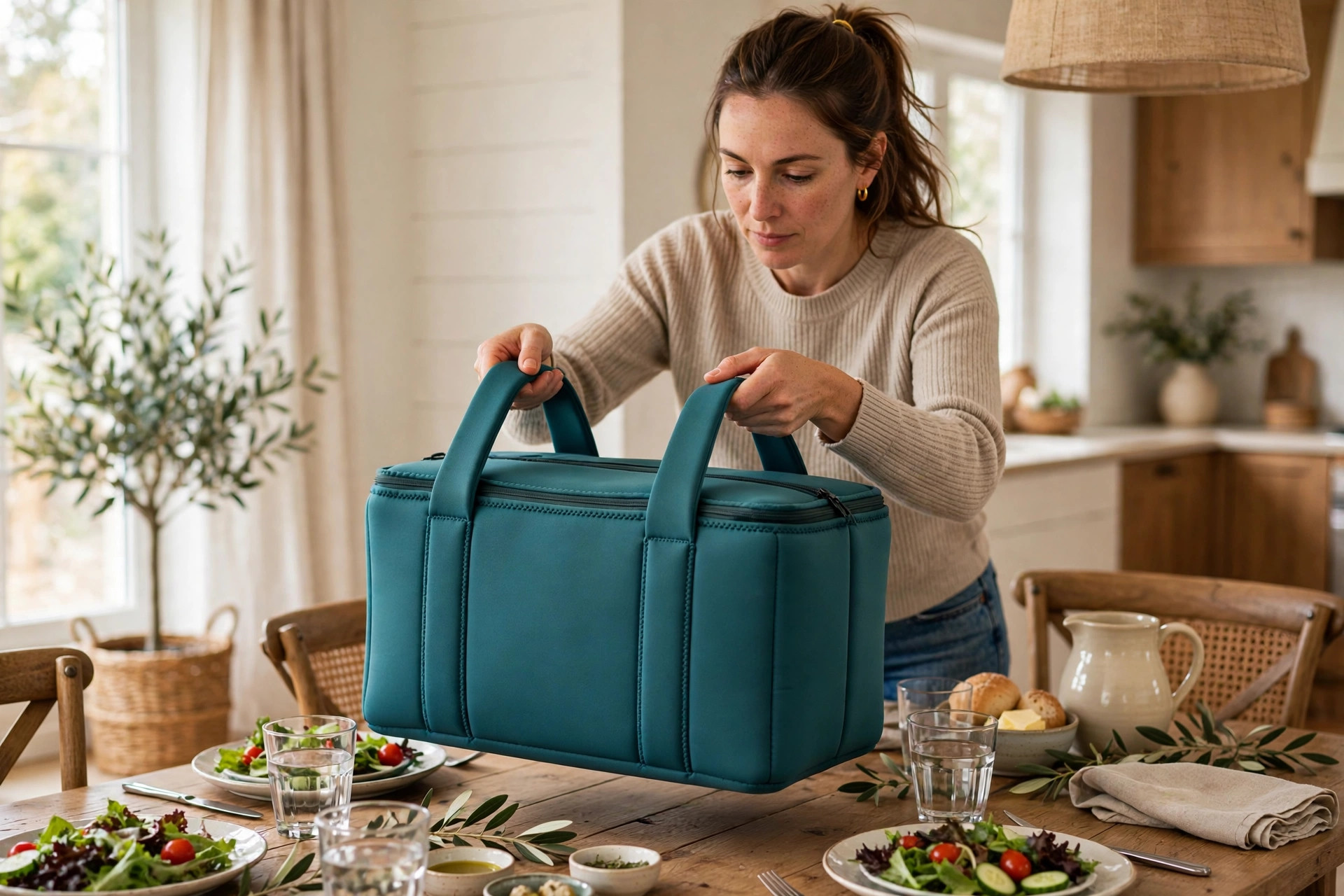
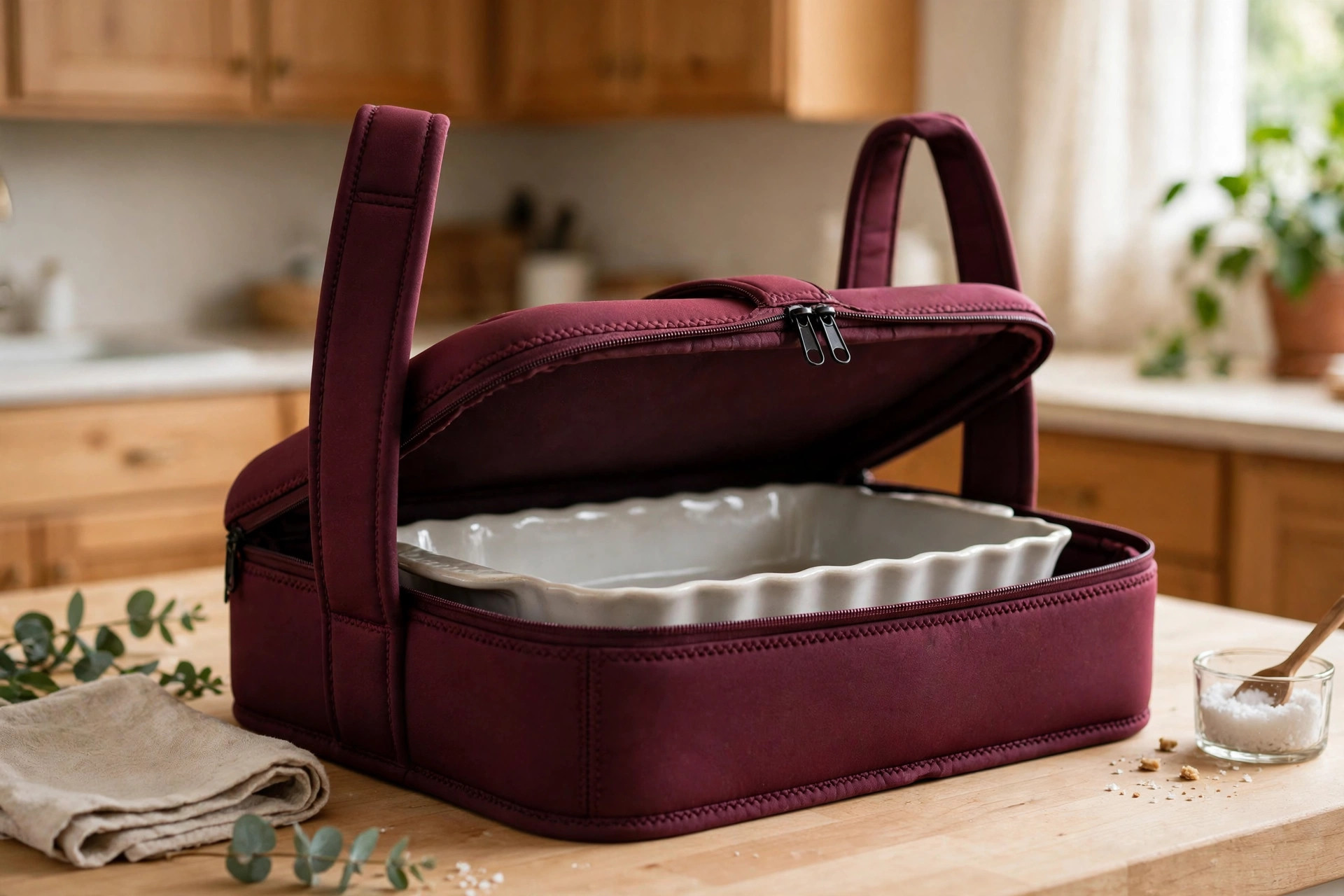
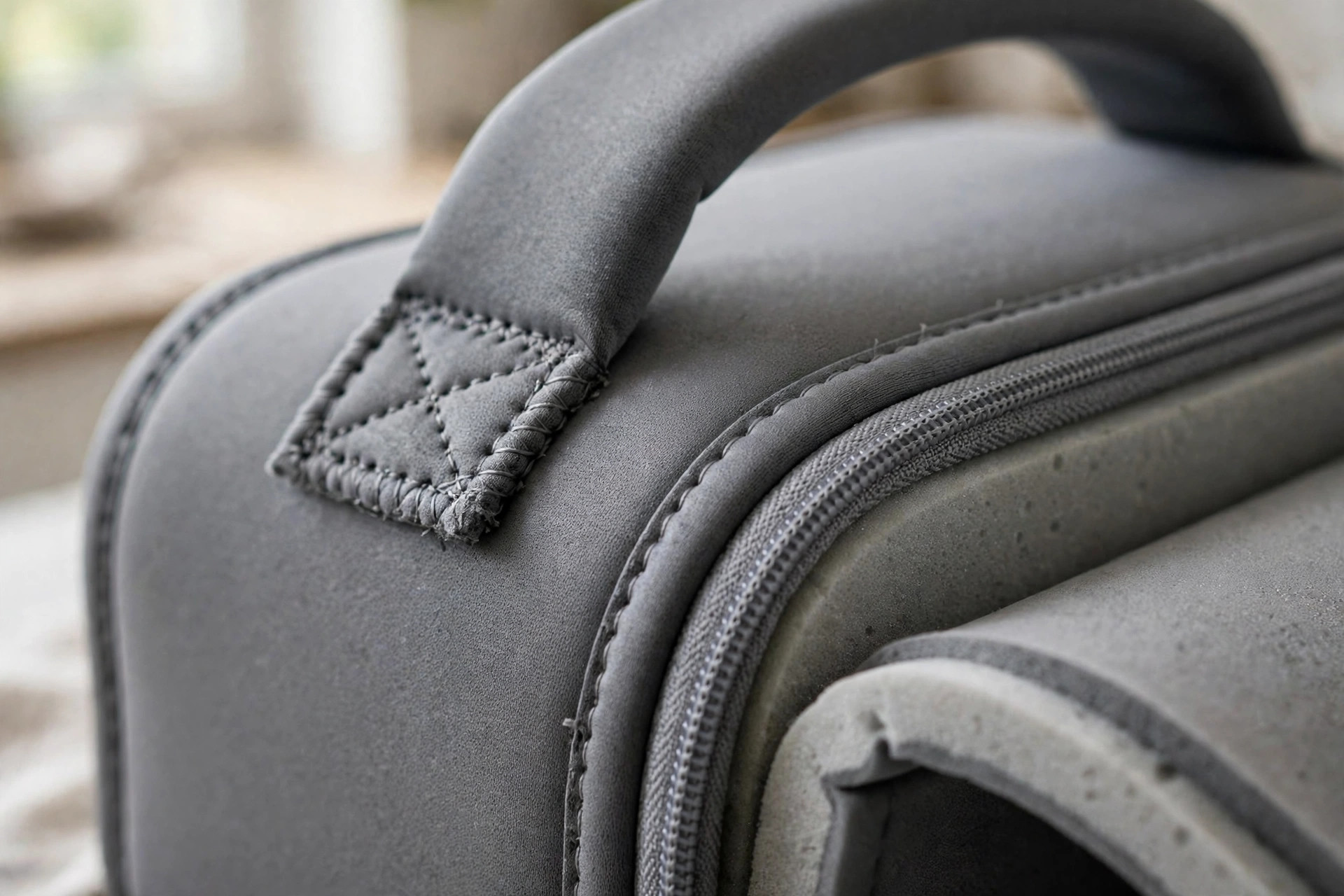
A neoprene casserole carrier is an insulated carry case cut and stitched from laminated neoprene (SBR, SCR or CR foam + fabric), sized to hold a casserole or baking dish flat, with a zip top and two carry handles. The foam wall slows heat loss on the drive over, cushions the dish against bumps and braking, and keeps a hot dish off the car seat — and a cold one from sweating onto it. Send us your design drawing and the dish sizes the carrier must fit, and we will confirm the best material and thickness.
We manufacture custom neoprene casserole carriers in our own factory in China, where we have made neoprene products for 15 years. We laminate the foam, cut the panels and stitch the finished carriers under one roof, so a change to the size, the handle or the print can be checked on a sample before bulk production starts.
The potluck problem is familiar: a dish that leaves the oven perfect arrives lukewarm, slid sideways, with sauce on the car seat. A carrier solves it in three ways at once. The flat, shaped base holds the dish level instead of letting it wander around a bag; the foam wall insulates it for the journey, so it reaches the table close to the temperature it left at; and the two handles carry the weight from above, level, the way a tray would — not dangling from one hand by a towel around the handles of the dish itself. Double-decker versions carry two dishes, one above the other, for the cook who always brings a side as well.
The foam is also protection. Ceramic and glass dishes chip when they knock against each other or against a car door, and a padded wall takes those knocks instead. If a lid lifts and sauce escapes on a corner, the leak stays inside the carrier rather than on upholstery, and the inside wipes clean afterwards. The same insulation thinking runs through our neoprene cooler bags — a carrier is simply that foam shaped around a dish instead of around drinks.
For kitchenware and gift ranges, the outside of the carrier is the point. The flat panels take sublimation printing across the whole surface, so a seasonal pattern, a recipe-themed design or a store's own artwork wraps the carrier the customer carries into every family dinner — a product that gets seen at exactly the gatherings where the next customer is sitting.
5 mm is the most popular thickness for neoprene casserole carriers. It insulates a dish for a typical drive and gives the walls enough body to stand open while the dish is loaded, which is why most of the carriers we make are cut in 5 mm. For the full range, see our neoprene sheet thickness guide.
| Thickness | Best for | Trade-off |
|---|---|---|
| 3 mm | Light single-dish carriers for short trips across town | Least insulation and the softest walls; folds flattest in a drawer |
| 5 mm | The standard carrier — one or two dishes, everyday potluck and family use | The balanced choice; neither the lightest nor the warmest |
| 7 mm | Long drives and double-decker carriers where insulation and structure matter most | Bulkiest to store and the highest cost of the three |
Size the carrier to the dish, including the parts people forget: the handles of the dish itself, the knob on the lid and the height with the lid on. The standard rectangular carrier is built around the common 9 × 13 inch baking dish, with square versions for 8 × 8 and 9 × 9 inch dishes and oval patterns for oval bakers. Send the outside dimensions of the dishes your customers cook in, and we will allow the clearance the foam needs to zip without forcing.
SBR is the standard choice for most casserole carriers, because the firmer foam holds the carrier's boxy shape, stands open for loading and keeps the price where a kitchen range needs it. CR (chloroprene rubber) earns its higher price on premium and gift lines — it is softer and more elastic, so it drapes over an awkward lid knob or an irregular baker more forgivingly, and it feels richer in the hand. SCR, a blend of the two, sits between them on both feel and cost.
The figures behind the two foams show why they behave differently: our CR foam measures 3–5° Shore C hardness, 276.32 kg/m³ density, 860 kPa tensile strength and 550% elongation, while our SBR foam measures 10–15° Shore C, 158.34 kg/m³, 256 kPa and 185%. CR is the softer, stretchier foam — useful when a carrier must flex around a dish that is not a perfect rectangle — while SBR is the firmer one that holds a printed panel flat and crisp.
| SBR | CR | |
|---|---|---|
| Cost | Lower cost; the standard for most carriers | Costs more than SBR |
| Shape and fit | Firm walls that hold the boxy shape and stand open for loading | Softer and more elastic; drapes over lid knobs and irregular dishes |
| Best for | Kitchenware and seasonal ranges at a working price | Premium and gift lines where feel and fit come first |
For sizes, double-dish versions and printing, see our neoprene casserole carriers product page. For the weekday version of the same insulation, our neoprene cooler lunch bags carry the packed lunch instead of the family dish.
Kitchenware and bakeware brands — a carrier sized to your own dishes, sold alongside them or as the giftable accessory in the range.
Gift and seasonal retailers — printed carriers for holiday and hosting seasons, when the product is bought to be given and carried.
Promotional and community suppliers — branded carriers for fundraisers, church and school events, and company picnics.
E-commerce sellers — standard dish sizes in your own colours and print, packed ready for the shelf.
When neoprene is NOT the right choice
Tell us which of these your casserole carriers need, and we will build the sample to your drawing.
How long does a neoprene casserole carrier keep food warm?
The foam wall slows heat loss rather than adding heat, so a dish that goes in hot arrives serving-warm after a typical drive instead of going cold on the way. It is insulation for the journey — not a heater, and not a certified hot-holding box for commercial service.
Does it fit a standard 9 × 13 inch baking dish?
Yes. The standard rectangular carrier is built around the 9 × 13 inch dish, with allowance for the dish's handles and the lid knob. Square and oval versions cover the other common dish sizes, and we can cut to your dish's exact outside dimensions.
Can one carrier hold two dishes?
Yes. The double-decker version carries two dishes stacked with a foam divider between them, and the thicker 7 mm wall is the usual choice for it, because the load and the insulation job are both bigger.
What is the minimum order?
200 pieces per design as a general minimum, adjustable to your actual order.
Can I get a sample first?
Yes — we support sampling, usually in 5–7 days. Send us your design drawing and the dish sizes the carrier must fit.
How long does bulk production take?
Usually 15–18 days after sample approval, depending on the quantity and customisation.
We make custom neoprene casserole carriers to your dish sizes, your colours and your print, and we test the fit with a real dish before bulk production. The general minimum order is 200 pieces per design, adjustable to your actual order; sampling is supported, usually in 5–7 days, and bulk production usually takes 15–18 days after sample approval.
Request a Quotation
To help us review your inquiry, please send:
Website: https://www.neoprenecustom.com/ Email: kevin@neoprenecustom.com
A carrier is judged in the car park, with a hot dish in both hands. Send us the dishes your customers cook in and we will size a sample around them. For the drinks that travel with the dish, see our neoprene growler sleeves.
Contact: Kevin
Phone: 13417385320
Tel: 0734-87965514
Email: kevin@neoprenecustom.com
Add: Intersection of Zhangjialing Road and Science and Technology Road, Guiyang Industrial Park, Guiyang Town, Qidong County, Hengyang City, Hunan Province./Dongguan Factory(GUANXIN): Shixin Street, Fushan Village, Liaobu Town, Dongguan, Guangdong Province.