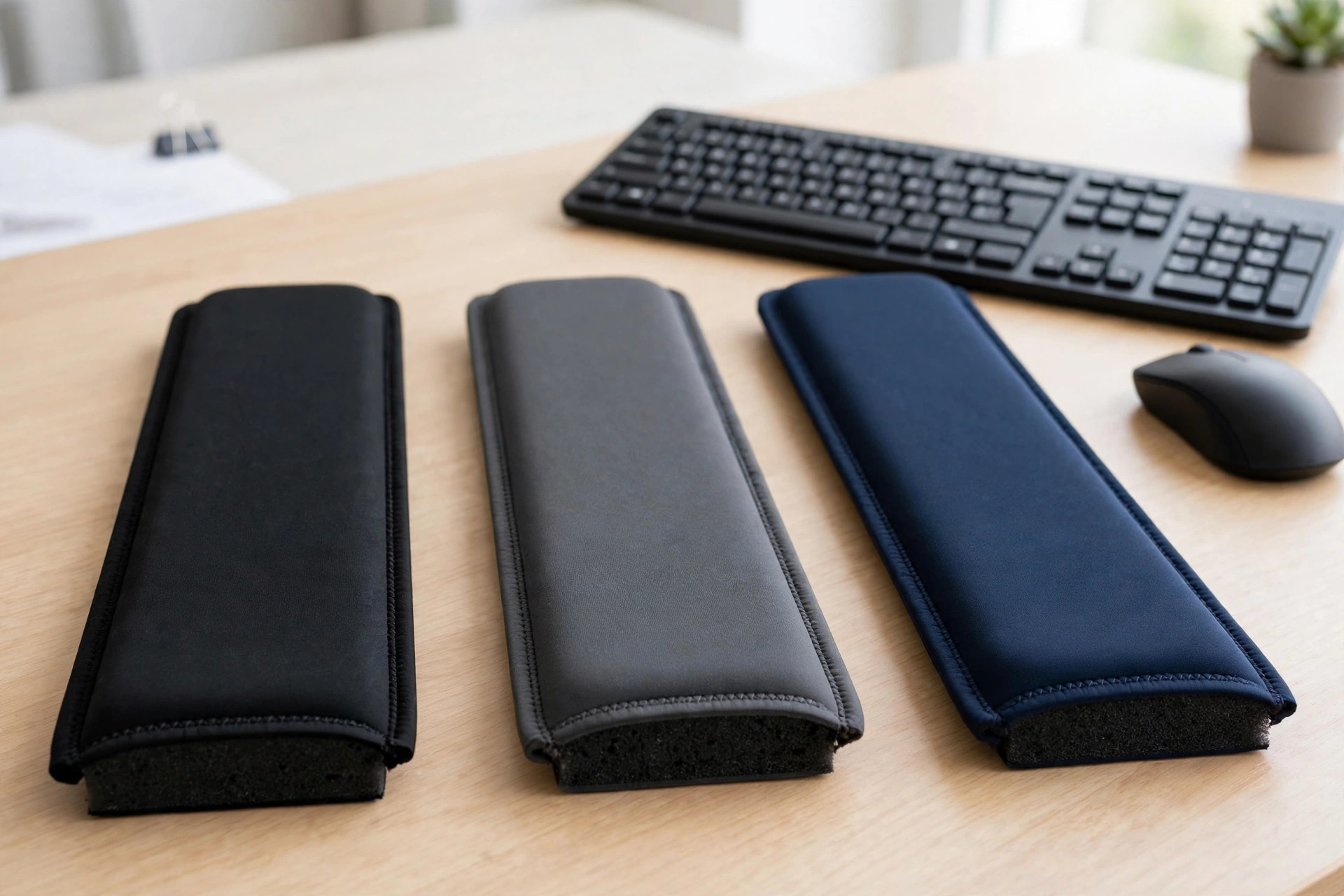
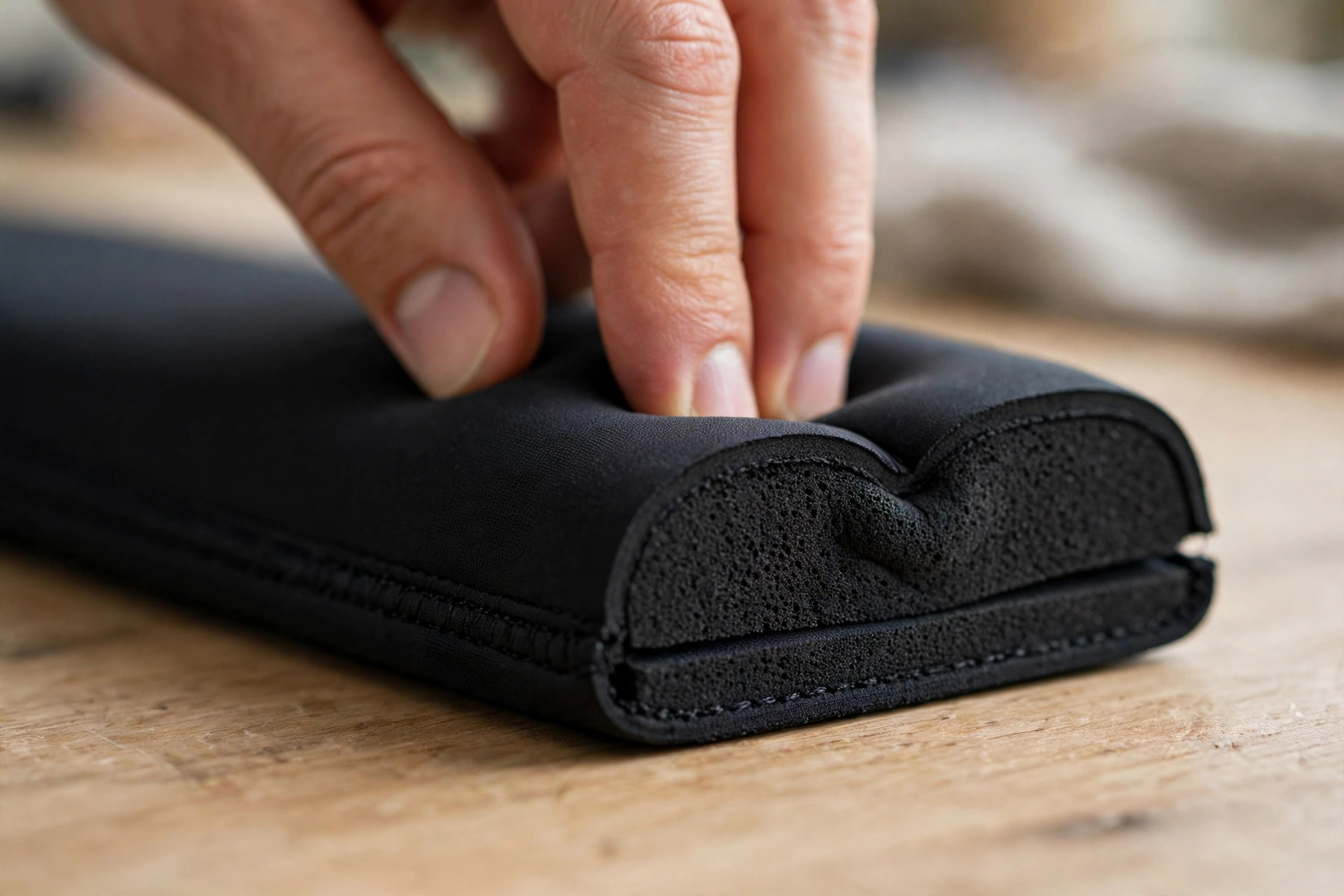
A neoprene keyboard wrist rest is a long padded bar cut from laminated neoprene (SBR, SCR or CR foam + fabric), placed along the front edge of a keyboard so the wrists and the heels of the hands rest on foam instead of the desk edge while typing. The closed-cell foam spreads the contact along the bar instead of letting it sit on one hard line, the fabric face lets the hands slide as they move across the keys, and the bar stays where it is put. Send us your design drawing, keyboard layout and rest dimensions, and we will confirm the best material and thickness.
We manufacture custom neoprene keyboard wrist rests in our own factory in China, where we have made neoprene products for 15 years. We laminate the foam, cut the bars and stitch the finished rests under one roof, so a change to the length, the profile or the print can be checked on a sample before bulk production starts.
The problem a wrist rest solves is the desk edge. Hour after hour, the heel of the hand presses on the same hard line where the desk ends, and by mid-afternoon that line is the thing you notice. A foam bar moves the contact onto a soft, wide surface. Neoprene suits the job better than the usual fillings: it is one solid piece of foam, so there is no gel pouch to split and leak and no loose fill to migrate to the ends, and the closed-cell surface does not drink coffee spills — a splash wipes off and the rest is back in service. It also springs back to its profile after every session instead of packing down flat over a season of use.
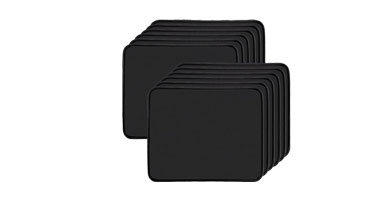
A wrist rest is not a desk mat, and the two are often confused. Our neoprene desk mats are thin flat sheets that cover the desk under the whole setup — keyboard, mouse and notebook. A wrist rest is a raised cushion that does one job at one line: the front edge of the keyboard. Many desk ranges sell both, and the rest is usually paired with a matching neoprene mouse pad cut from the same foam and printed with the same artwork, so the set looks like a set.
For brands, the bar is a long, flat print carrier that sits in front of the user all day. The jersey face takes sublimation printing along the full length, so gaming artwork, a company identity or a desk-set pattern runs unbroken from end to end, and the print is on the surface the customer looks at every working hour — which is why wrist rests turn up in gaming setups, branded office kits and welcome packs as often as in ergonomic ranges.
5 mm is the most popular thickness for neoprene keyboard wrist rests. It lifts the wrist roughly level with a standard keyboard's key line and gives a soft landing without the wobble of a tall cushion, which is why most of the rests we make are cut in 5 mm. For the full range, see our neoprene sheet thickness guide.
| Thickness | Best for | Trade-off |
|---|---|---|
| 3 mm | Low-profile and laptop-style keyboards — a slim rest that matches a low key line | Least cushioning; too low for a tall mechanical keyboard |
| 5 mm | The standard desk rest — everyday office and gaming keyboards | The balanced choice; neither the slimmest nor the softest landing |
| 8 mm | Tall mechanical keyboards and users who want the deepest cushion | Can sit too high against a low keyboard — check the key line on a sample |
Size the rest to the keyboard, not the other way round. Lengths follow the standard layouts — roughly 440 mm for full-size boards, 360 mm for tenkeyless and 300 mm for compact boards — with widths of 80–100 mm so the heel of the hand lands on foam, not on the bar's edge. Send the keyboard models your customers use, or the finished length and width you want, and we will set the cut and the edge profile to suit.
SBR is the standard choice for most keyboard wrist rests, because a desk bar's working life is indoors at room temperature, where the firmer, lighter, lower-cost foam does everything the job asks and holds its profile well. CR (chloroprene rubber) earns its higher price on premium desk ranges — its softer, springier feel is the first thing a customer notices when they pick the rest up. SCR, a blend of the two, sits between them where a brand wants a softer hand-feel than SBR at a lower cost than CR.
The figures behind the two foams show why they feel different: our CR foam measures 3–5° Shore C hardness, 276.32 kg/m³ density, 860 kPa tensile strength and 550% elongation, while our SBR foam measures 10–15° Shore C, 158.34 kg/m³, 256 kPa and 185%. CR is the softer, springier foam; SBR is the firmer, lighter one. Under the wrist, that means a CR rest gives a little more as the hand settles, while an SBR rest feels firmer and keeps a crisper edge line on the desk.
| SBR | CR | |
|---|---|---|
| Cost | Lower cost; the standard for most wrist rests | Costs more than SBR |
| Feel under the wrist | Firm and supportive, holds a crisp profile on the desk | Softer and springier, gives as the hand settles |
| Best for | Office, gaming and promotional ranges at a working price | Premium desk sets where the hand-feel sells the product |
For lengths, profiles and printing, see our neoprene keyboard wrist rests product page.
Office and ergonomic accessory brands — your own rest in your lengths and print, made to your drawing as part of a desk range.
Gaming peripheral brands — full-length printed rests matched to your keyboards, in the layouts your customers play on.
Corporate gift and promotional suppliers — branded rests for welcome packs and office kits, printed with a company identity.
E-commerce sellers — mixed lengths and colours in one order, packed ready for the shelf with a barcode label.
When neoprene is NOT the right choice
Tell us which of these your keyboard wrist rests need, and we will build the sample to your drawing.
How is a neoprene wrist rest different from a desk mat?
A desk mat is a thin flat sheet that covers the desk under the whole setup. A wrist rest is a thick, raised cushion bar that sits only along the keyboard's front edge, where the wrists actually rest — the two do different jobs and are often sold as a matching set.
Will the wrist rest slide around the desk?
No, not in normal use. The foam bar has enough weight and surface grip to stay where it is put, and a textured anti-slip base is available on request for very smooth glass or polished desks.
Can you print our artwork along the full length?
Yes. Sublimation prints full-colour artwork unbroken from end to end, screen print puts a bold logo at the centre or corner, and a woven label can be sewn at one end for a quieter finish.
What is the minimum order?
200 pieces per design as a general minimum, adjustable to your actual order.
Can I get a sample first?
Yes — we support sampling, usually in 5–7 days. Send us your design drawing and the keyboard layouts and rest dimensions you need.
How long does bulk production take?
Usually 15–18 days after sample approval, depending on the quantity and customisation.
We make custom neoprene keyboard wrist rests to your keyboard layouts, your colours and your print, and we check the height against a real keyboard on a sample before bulk production. The general minimum order is 200 pieces per design, adjustable to your actual order; sampling is supported, usually in 5–7 days, and bulk production usually takes 15–18 days after sample approval.
Request a Quotation
To help us review your inquiry, please send:
Website: https://www.neoprenecustom.com/ Email: kevin@neoprenecustom.com
A wrist rest is judged at four in the afternoon, not in the first five minutes. Send us your keyboard layouts and we will make you a sample to type on for a week. For the case that carries the laptop to the desk, see our neoprene laptop sleeves.
Contact: Kevin
Phone: 13417385320
Tel: 0734-87965514
Email: kevin@neoprenecustom.com
Add: Intersection of Zhangjialing Road and Science and Technology Road, Guiyang Industrial Park, Guiyang Town, Qidong County, Hengyang City, Hunan Province./Dongguan Factory(GUANXIN): Shixin Street, Fushan Village, Liaobu Town, Dongguan, Guangdong Province.