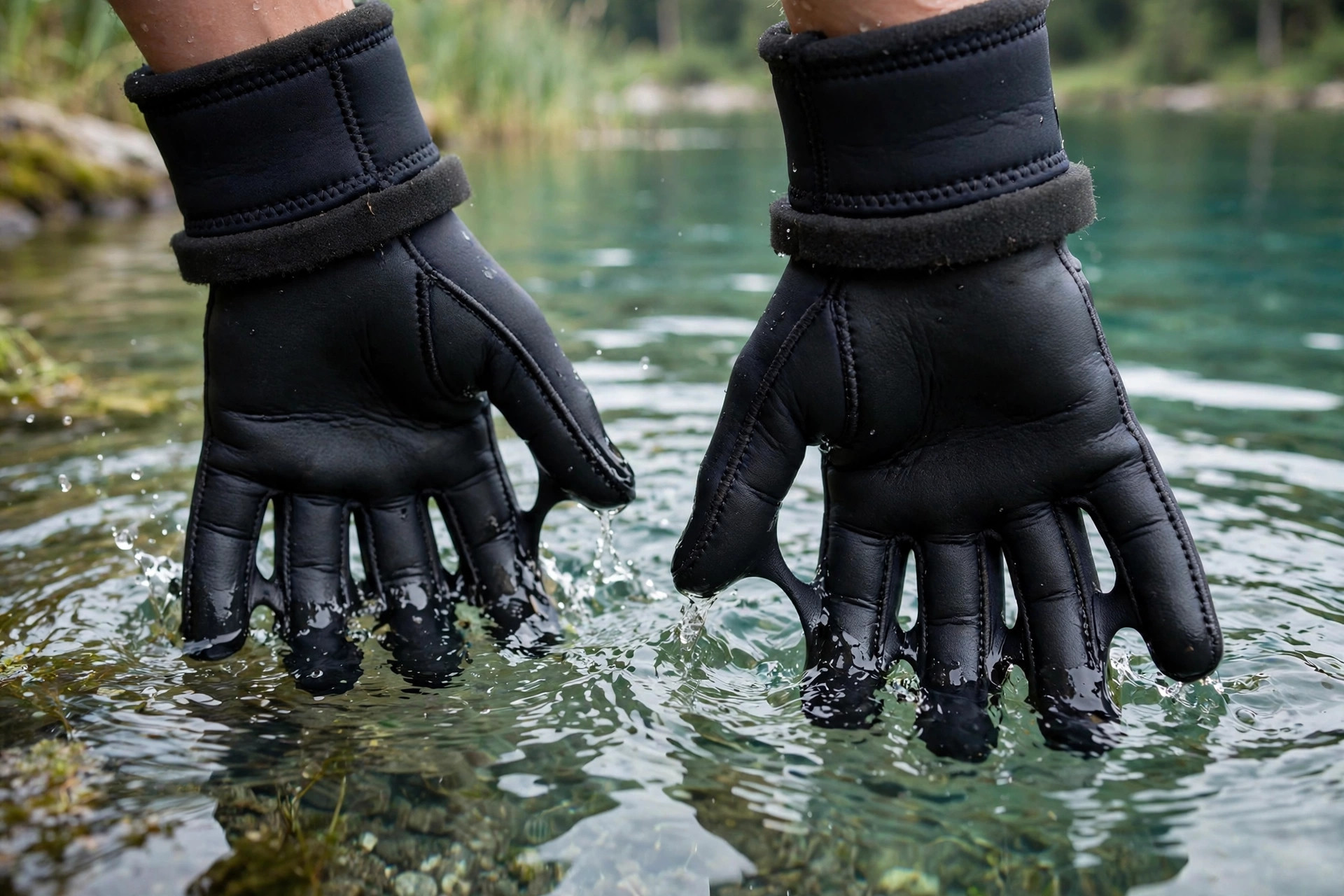
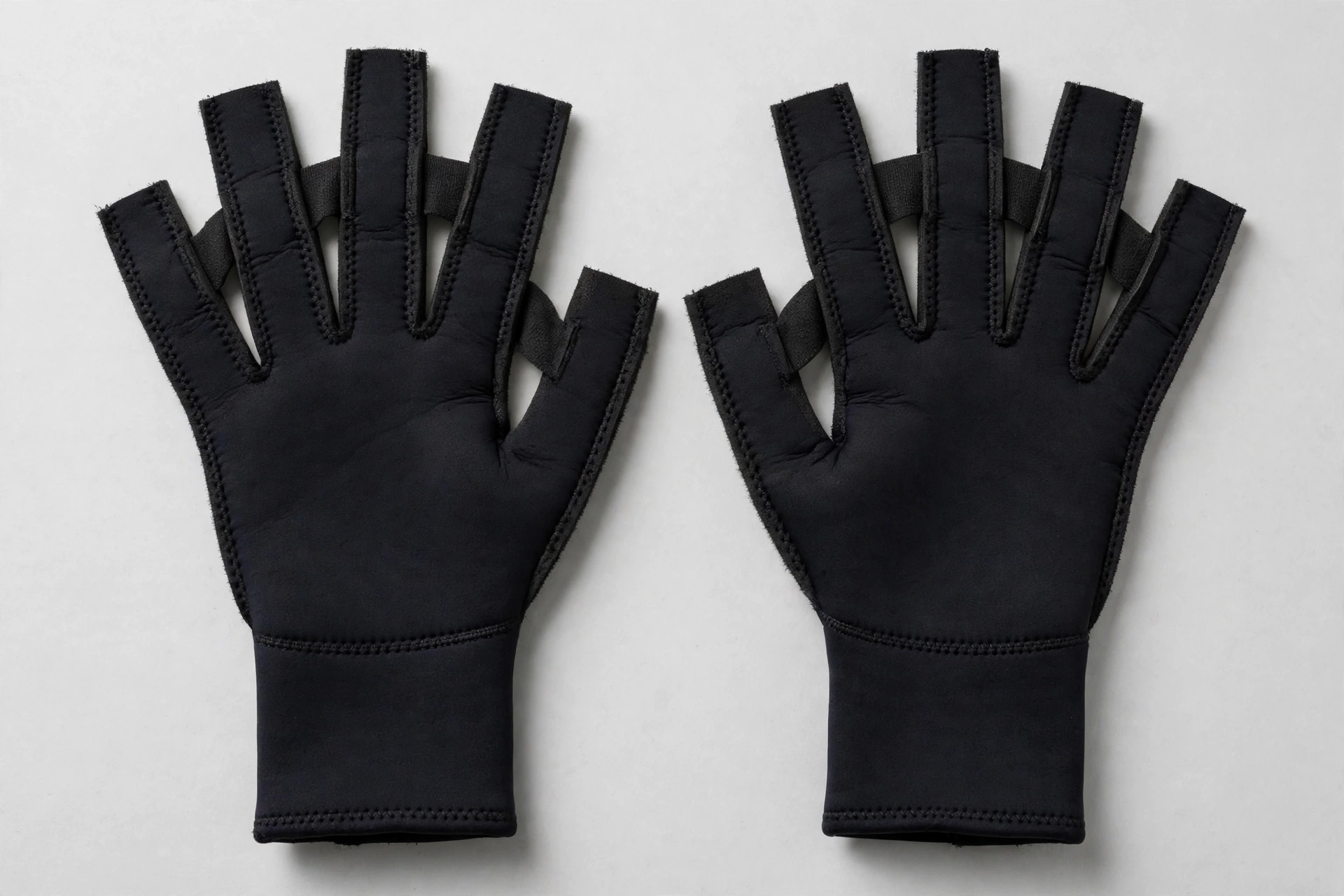
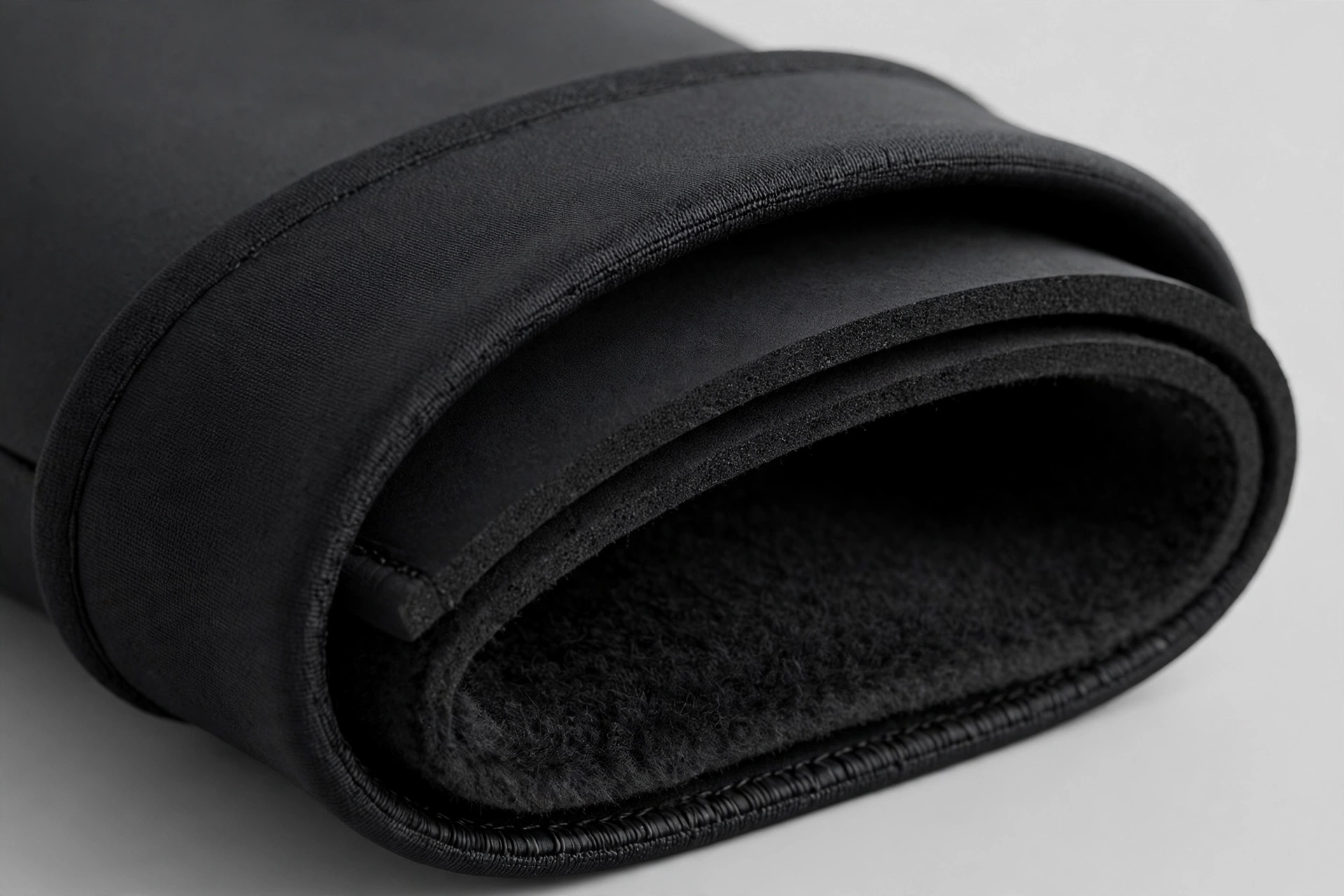
A neoprene swim glove is a thin glove cut and stitched from laminated neoprene (SBR, SCR or CR foam + fabric), worn for open-water and triathlon swimming. The foam layer holds a film of water against the hand and slows heat loss in cold water, and the panel between the fingers gives the hand a broader surface to pull with. It is a warmth and comfort accessory for swimmers — not a safety device. Send us your design drawing and hand sizes, and we will confirm the best material and thickness.
We manufacture custom neoprene swim gloves in our own factory in China, where we have made neoprene products for 15 years. We laminate the foam, cut the panels and stitch the finished gloves under one roof, so a change to the finger webbing, the cuff length or the print can be checked on a sample before bulk production starts.
Cold hands end open-water swims early. Fingers are thin, they sit at the end of the arm, and in cold water they lose feeling first — a swimmer who cannot feel their hands cannot sight, feed or undo a wetsuit zip at the exit. A neoprene glove answers with insulation shaped exactly to the hand: the foam slows the chill, the close fit keeps flushing to a minimum, and the long cuff overlaps the wetsuit sleeve so there is no bare gap at the wrist.
The webbed panel between the fingers is the second job. It holds the fingers in a relaxed paddle shape and adds surface to each pull, which many open-water swimmers prefer for steady distance swimming. The panel is cut as part of the glove, not added on, so it flexes with the hand instead of fighting it, and the glove still closes into a fist for sighting or holding a tow float line.
For swim and triathlon ranges, the glove is a small, light, easy add-on beside the wetsuit: flat-packing, simple to size, and printable with a team or brand design across the back of the hand — the part of the kit that is visible in every start-line photograph.
2 mm is the most popular thickness for neoprene swim gloves. A swim glove has to flex with every stroke, so the range runs thinner than most neoprene products — 1.5 mm to 3 mm — and 2 mm is where warmth and hand feel balance for most open-water swimmers. For the full range, see our neoprene sheet thickness guide.
| Thickness | Best for | Trade-off |
|---|---|---|
| 1.5 mm | Cool-water racing and triathlon, where hand feel and a fast transition matter most | The least warmth of the three; a short-swim glove in genuinely cold water |
| 2 mm | The standard open-water glove — training and racing through most of the season | The balanced choice; neither the thinnest nor the warmest |
| 3 mm | Cold-water and winter swimming, long swims where warmth decides whether the swim finishes | The stiffest feel; fingers work a little harder to close |
Size the glove by hand measurement, not by wetsuit size. Measure around the palm at its widest point and the length from wrist to middle fingertip, and match both to the size range. A swim glove should sit snug without squeezing — loose fingers fill with water and flush at every stroke, and tight fingers tire the hand. Send the size range your customers need, and we will grade the pattern across it.
CR is the popular choice for swim gloves, because the softer, more elastic foam follows the hand's movement stroke after stroke, and a glove is worn flexing constantly. SBR is the firmer, lower-cost option and suits entry-level and high-volume ranges where the glove is a simple warmth layer. SCR, a blend of the two, sits between them on both feel and cost.
The figures behind the two foams show why they feel different: our CR foam measures 3–5° Shore C hardness, 276.32 kg/m³ density, 860 kPa tensile strength and 550% elongation, while our SBR foam measures 10–15° Shore C, 158.34 kg/m³, 256 kPa and 185%. On a glove, CR's elongation is the number the swimmer feels — the panel stretches as the hand opens and closes instead of resisting it.
| SBR | CR | |
|---|---|---|
| Cost | Lower cost; the standard for entry-level gloves | Costs more than SBR |
| Flex on the hand | Firmer feel; holds its shape well at a working price | Softer and more elastic; follows the stroke and the fist |
| Best for | Volume ranges and swim-school kit | Open-water and triathlon ranges where feel sells the glove |
For webbing options, cuff lengths and printing, see our neoprene swim gloves product page. The head that goes with the hands is covered by our neoprene swim caps, and the feet by our neoprene fin socks.
Open-water swim brands — gloves in your sizes and print, sold beside the wetsuit as part of a cold-water kit.
Triathlon retailers — race-legal warmth for the swim leg, in the sizes your athletes ask for at the counter.
Swim schools and event organisers — numbered or team-printed gloves for training groups and event kit bags.
E-commerce sellers — light, flat-packing gloves in a full size range, ready for the shelf with a barcode label.
When neoprene is NOT the right choice
Tell us which of these your swim gloves need, and we will build the sample to your drawing.
Do swim gloves keep hands warm in cold water?
Yes — the foam layer slows heat loss and the close fit limits cold water flushing over the hand, which is why open-water swimmers wear them. They are insulation, sized 1.5–3 mm; the colder and longer the swim, the thicker the glove within that range.
What does the webbing between the fingers do?
The webbed panel holds the fingers in a relaxed paddle shape and gives the hand more surface on each pull. It is cut as part of the glove and flexes with the hand. Note that some races allow plain gloves but ban webbing — check your event rules before choosing.
How do I size neoprene swim gloves?
Measure around the palm at its widest point and from the wrist to the middle fingertip, and match both numbers to the size range. The fit should be snug without squeezing; loose gloves flush with water at every stroke.
What is the minimum order?
200 pieces per design as a general minimum, adjustable to your actual order.
Can I get a sample first?
Yes — we support sampling, usually in 5–7 days. Send us your design drawing and the hand sizes and size range you need.
How long does bulk production take?
Usually 15–18 days after sample approval, depending on the quantity and customisation.
We make custom neoprene swim gloves to your hand sizes, webbing pattern, colours and print, and we check the fit on a real hand before bulk production. The general minimum order is 200 pieces per design, adjustable to your actual order; sampling is supported, usually in 5–7 days, and bulk production usually takes 15–18 days after sample approval.
Request a Quotation
To help us review your inquiry, please send:
Website: https://www.neoprenecustom.com/ Email: kevin@neoprenecustom.com
A swim glove is judged at the far buoy, with cold hands and a long swim back. Send us your sizes and we will make a sample pair to be judged there. For the rest of the cold-water kit, see our neoprene triathlon wetsuits.
Contact: Kevin
Phone: 13417385320
Tel: 0734-87965514
Email: kevin@neoprenecustom.com
Add: Intersection of Zhangjialing Road and Science and Technology Road, Guiyang Industrial Park, Guiyang Town, Qidong County, Hengyang City, Hunan Province./Dongguan Factory(GUANXIN): Shixin Street, Fushan Village, Liaobu Town, Dongguan, Guangdong Province.