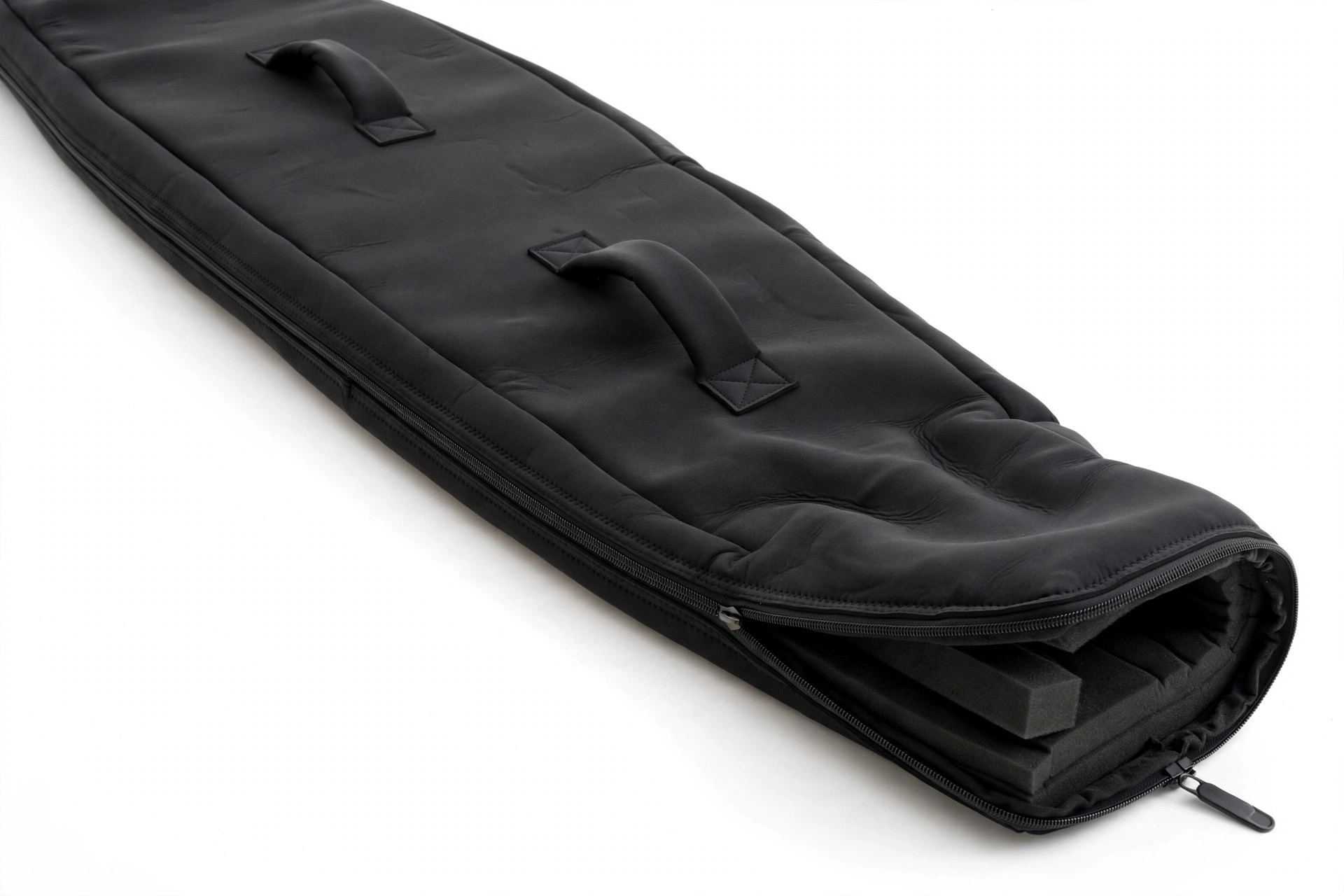
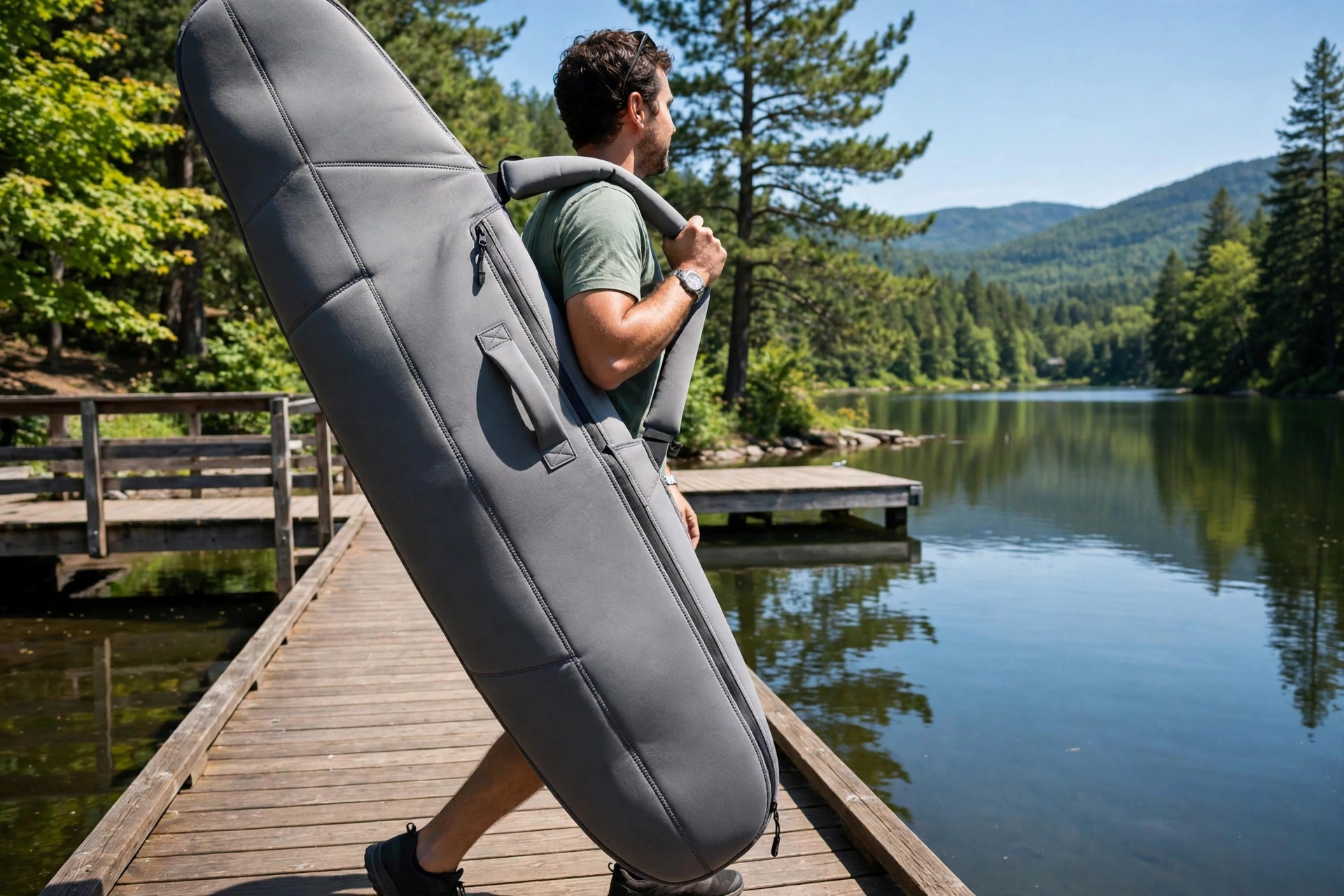
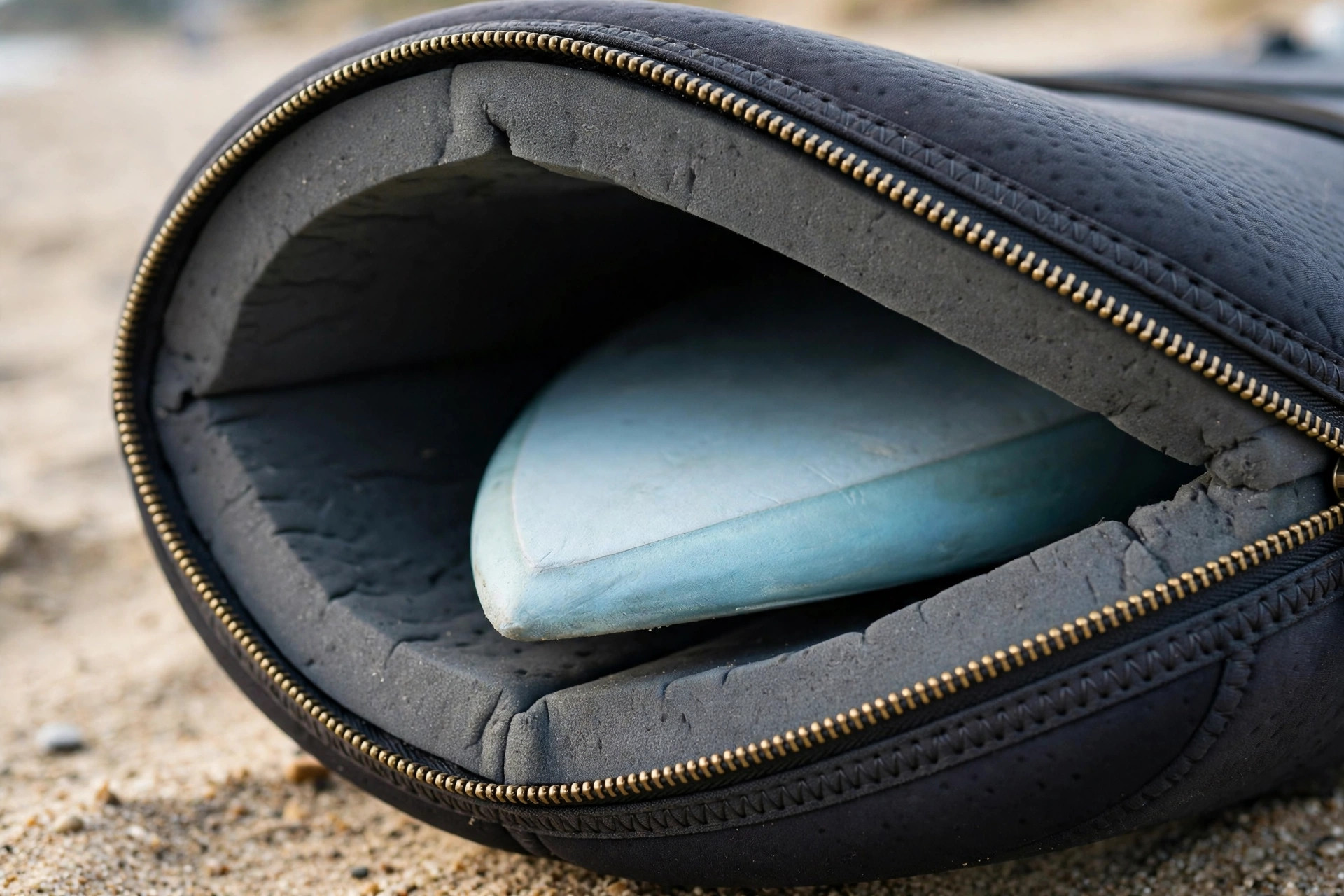
A neoprene SUP board bag is a full-length zippered bag cut and stitched from laminated neoprene (SBR, SCR or CR foam + fabric), shaped to enclose a stand-up paddle board completely — deck, rails and tail inside one padded foam wall. The foam cushions the board against roof-rack bars, garage walls and the knocks of loading and unloading, and the full-length zip makes the bag quick to load at the car and quick to open at the water. Send us your design drawing and the board sizes the bag must fit, and we will confirm the best material and thickness.
We manufacture custom neoprene SUP board bags in our own factory in China, where we have made neoprene products for 15 years. We laminate the foam, cut the panels and stitch the finished bags under one roof, so a change to the length, the fin slot or the print can be checked on a sample before bulk production starts.
A paddle board is at its most vulnerable out of the water. The rails take the hit when the board swings against a roof rack, the deck dents when something is stacked on it in the garage, and the tail chips when it is set down on concrete. A padded bag puts foam between the board and all of that. Because the bag encloses the whole board rather than covering one face, it also keeps the deck pad clean and stops loose straps, leashes and fins from tangling with everything else in the car.
Neoprene suits the job in a way thin nylon day covers do not. The foam itself is the padding — there is no separate lining to bunch or tear — and it stretches slightly over wide boards and thick rails, so one bag size covers the small differences between board models. Wet boards can be loaded straight after a session for the drive home, and the bag rinses clean and dries fast afterwards. For boards that travel on the roof regularly, the bag also spreads the pressure of the rack straps over a padded wall instead of two hard lines across the deck.
For SUP brands and rental fleets, the bag is also the visible surface: a printed panel carries the brand down the full length of the board, and colour-coded sizes make a rental fleet's 10'6" and 11' bags easy to tell apart on the rack. The same construction runs through our neoprene dive bags — big zippered foam bags built to be loaded, carried and rinsed daily.
5 mm is the most popular thickness for neoprene SUP board bags. It gives the rails and deck real padding against racks and garage knocks while the bag still folds down small enough to store in the car, which is why most of the board bags we make are cut in 5 mm. For the full range, see our neoprene sheet thickness guide.
| Thickness | Best for | Trade-off |
|---|---|---|
| 3 mm | Light day bags for short car trips and indoor storage | Least padding on the rails; a cover-weight bag rather than a travel bag |
| 5 mm | The standard travel bag — roof racks, garages and regular road trips | The balanced choice; neither the lightest nor the most padded |
| 7 mm | Long-distance travel and double-board bags where padding matters most | Bulkiest to fold and store, and the highest cost of the three |
Size the bag to the board's full dimensions: overall length, widest width and rail thickness, with the fin fitted if the bag has no fin slot. Bags are made for the standard board lengths from 9 ft to 14 ft, in all-round, touring and race shapes, and inflatable boards take a wider, softer pattern than hard boards of the same length. Send the board models in your range and we will pattern the clearance the foam needs to zip without forcing.
SBR is the standard choice for most SUP board bags, because the firmer foam holds the bag's long shape, keeps the price where an accessory range needs it and stands up to being dragged across roof racks and gravel. CR (chloroprene rubber) earns its higher price on premium travel lines — it is softer and more elastic, so it slips over wide boards and thick rails more easily and feels richer in the shop. SCR, a blend of the two, sits between them on both feel and cost.
The figures behind the two foams show why they behave differently: our CR foam measures 3–5° Shore C hardness, 276.32 kg/m³ density, 860 kPa tensile strength and 550% elongation, while our SBR foam measures 10–15° Shore C, 158.34 kg/m³, 256 kPa and 185%. CR is the softer, stretchier foam — useful on a bag that must ease over a wide touring board — while SBR is the firmer one that holds a long printed panel flat and shrugs off abrasion.
| SBR | CR | |
|---|---|---|
| Cost | Lower cost; the standard for most board bags | Costs more than SBR |
| Fit over the board | Firm walls that hold the bag's shape on and off the board | Softer and more elastic; eases over wide boards and thick rails |
| Best for | Brand and fleet ranges at a working price | Premium travel lines where fit and feel come first |
For sizes, fin slots and printing, see our neoprene SUP board bags product page. For a lighter cover that protects one face of the board rather than enclosing it, see our neoprene paddle board covers; the same foam thinking runs through our neoprene surfboard covers.
SUP and surf brands — a bag patterned to your own board range, sold with the board or as the branded travel accessory in the line.
Rental and tour fleets — colour-coded sizes that protect boards in daily loading, stacking and roof-rack work.
Paddle shops and watersports retailers — standard board lengths in your colours and print, ready for the shop floor.
E-commerce sellers — bags by board length and shape in your own label, packed flat for shipping.
When neoprene is NOT the right choice
Tell us which of these your SUP board bags need, and we will build the sample to your drawing.
Will the bag fit an inflatable SUP?
Yes. Inflatable boards take a wider, softer pattern than hard boards of the same length, and the bag can be made for the board inflated or sized to carry it rolled with its pump — tell us which way your customers travel and we will pattern to it.
Does the board's fin need to come off?
Not with a fin slot. Most bags are cut with a slot or a deeper tail section so a fixed centre fin stays on; slide-in fins can travel either way. Tell us the fin setup on your boards and the sample will be cut to match.
Can one bag carry two boards?
Yes. The double version is cut wider with a padded divider between the boards, and 7 mm foam is the usual choice for it because the load and the knocks are both bigger.
What is the minimum order?
200 pieces per design as a general minimum, adjustable to your actual order.
Can I get a sample first?
Yes — we support sampling, usually in 5–7 days. Send us your design drawing and the board sizes the bag must fit.
How long does bulk production take?
Usually 15–18 days after sample approval, depending on the quantity and customisation.
We make custom neoprene SUP board bags to your board sizes, your colours and your print, and we check the fit on the real board dimensions before bulk production. The general minimum order is 200 pieces per design, adjustable to your actual order; sampling is supported, usually in 5–7 days, and bulk production usually takes 15–18 days after sample approval.
Request a Quotation
To help us review your inquiry, please send:
Website: https://www.neoprenecustom.com/ Email: kevin@neoprenecustom.com
A board bag is judged at the roof rack, in the wind, with a wet board. Send us your board range and we will make a sample to be judged exactly there. For the paddle that travels with the board, ask us about paddle covers in the same foam.
Contact: Kevin
Phone: 13417385320
Tel: 0734-87965514
Email: kevin@neoprenecustom.com
Add: Intersection of Zhangjialing Road and Science and Technology Road, Guiyang Industrial Park, Guiyang Town, Qidong County, Hengyang City, Hunan Province./Dongguan Factory(GUANXIN): Shixin Street, Fushan Village, Liaobu Town, Dongguan, Guangdong Province.