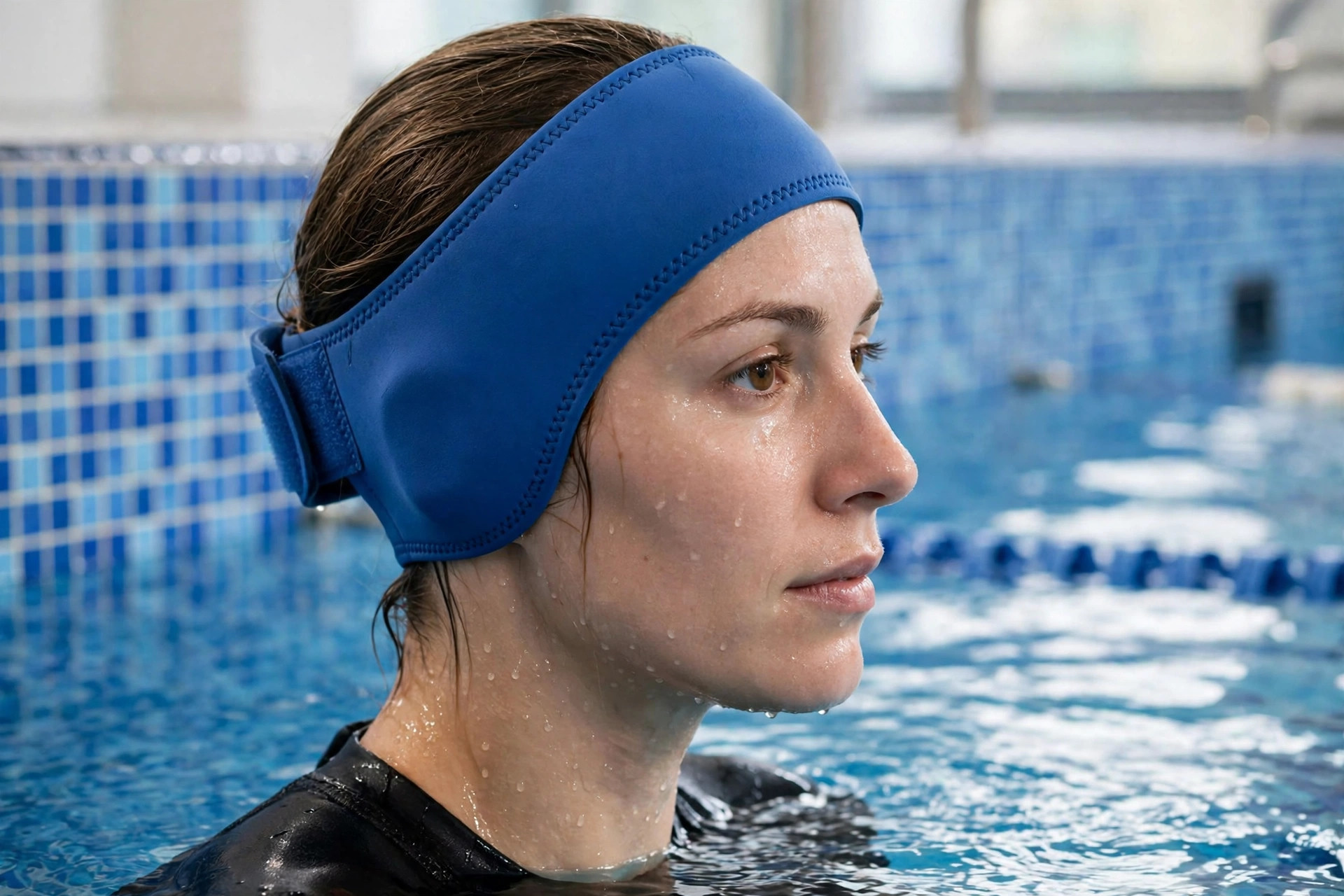
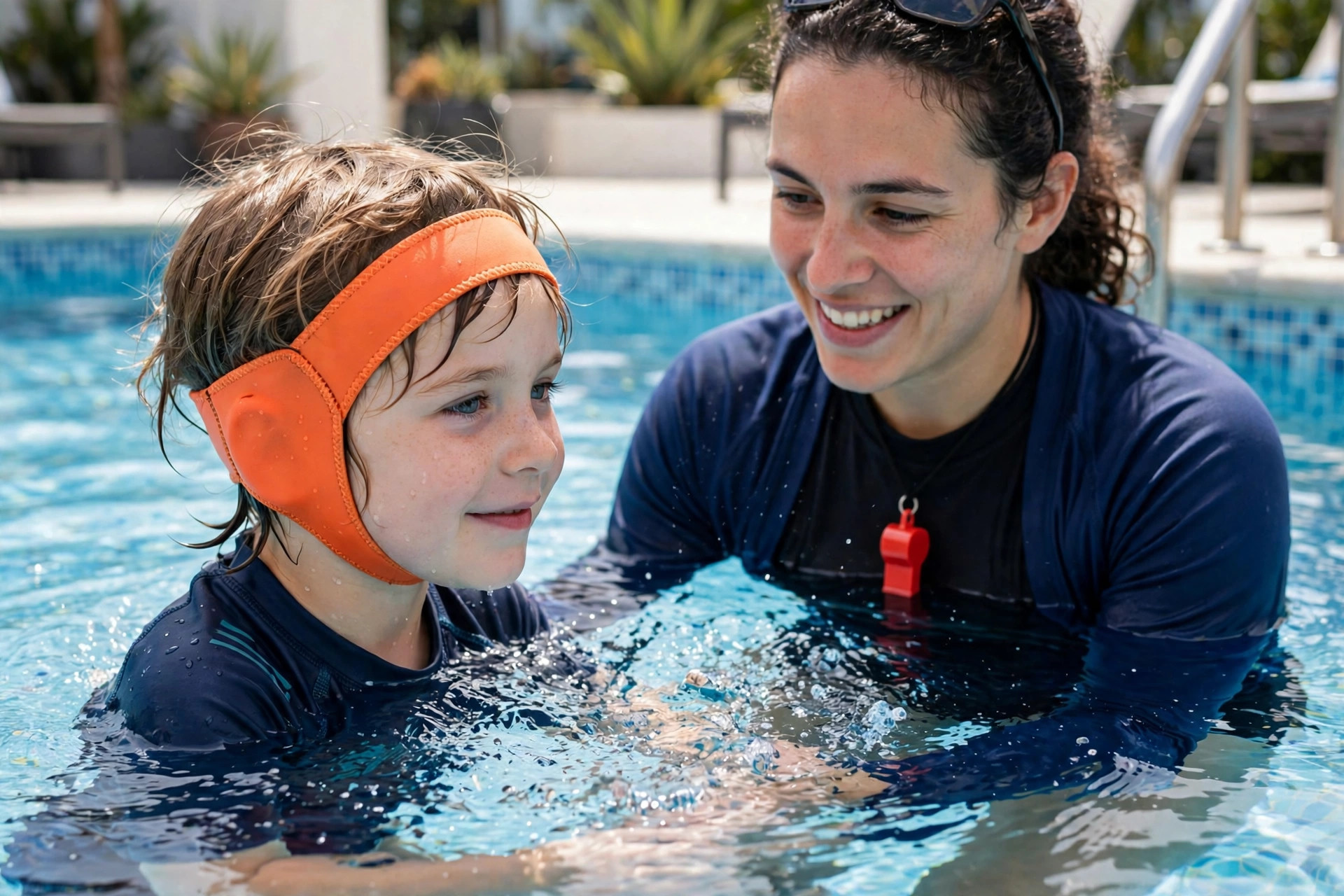
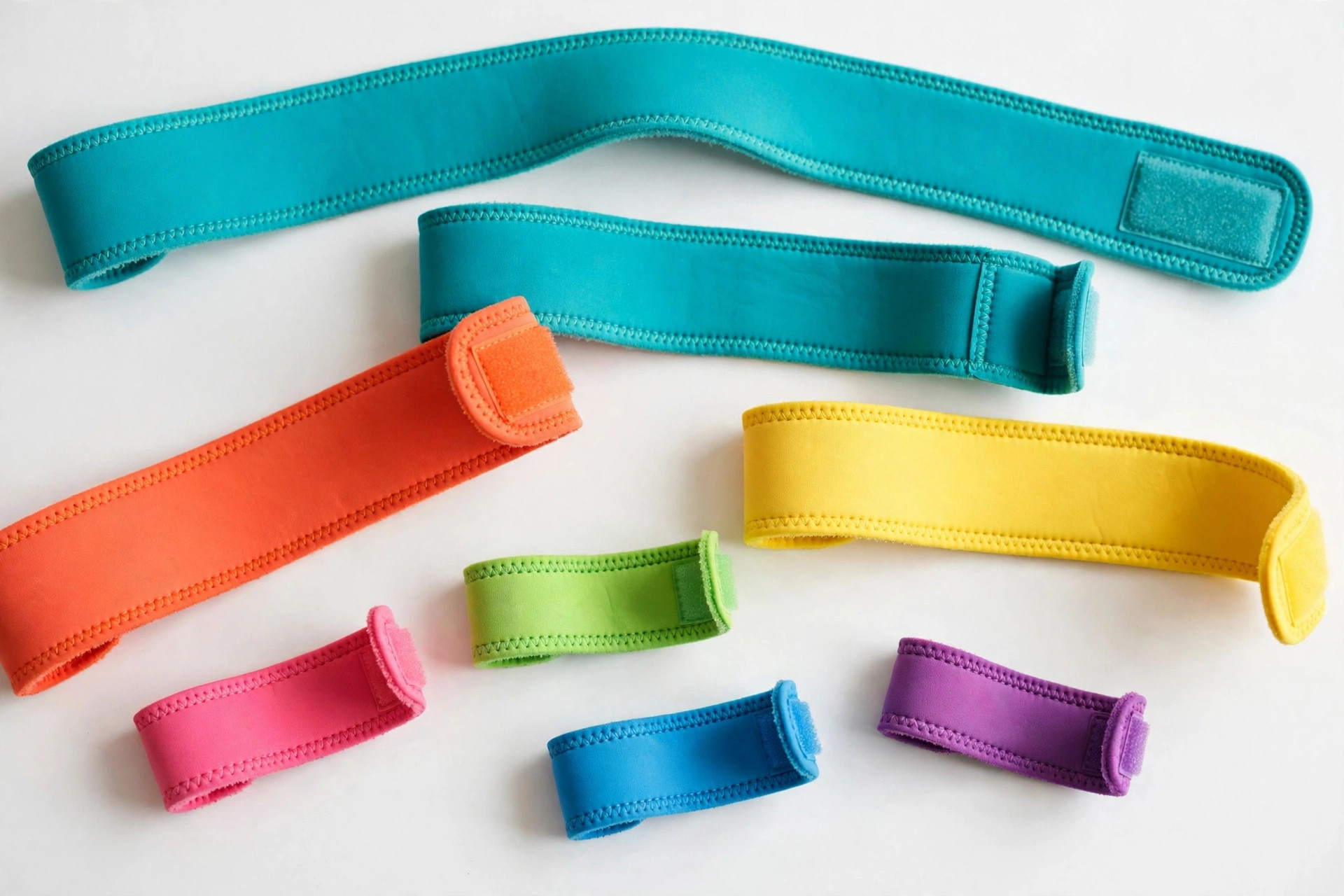
A neoprene swimming ear band is a wide, thin band of laminated neoprene (SBR, SCR or CR foam + fabric) that wraps around the head and covers the ears, fastening at the back with hook-and-loop. Swimmers wear it for comfort: it holds earplugs in place so they are not lost mid-set, keeps long hair back off the face, and puts a soft, warm layer over the ears in cold water. It is a swim comfort accessory — a band, not a seal and not a medical product. Send us your design drawing and head sizes, and we will confirm the best material and thickness.
We manufacture custom neoprene swimming ear bands in our own factory in China, where we have made neoprene products for 15 years. We laminate the foam, cut the bands and stitch the finished pieces under one roof, so a change to the width, the closure or the print can be checked on a sample before bulk production starts.
Earplugs are easy to lose. They work loose as the head turns, they come out in a tumble turn, and a dropped plug in a public pool is gone. A band over the ears simply keeps them where they were put, from the first length to the last — which is why swim teachers hand them out at lessons and open-water swimmers wear them under a cap. The same band solves the hair problem for long-haired swimmers: everything is held back in one motion, with no clips and no re-tying between sets.
Cold water is the other half of the story. Ears are thin, exposed and full of nerve endings, and they are the first thing that aches in a cold lake or a winter sea. A foam band does not seal water out — no band can — but it takes the direct flush of cold water off the ears and makes a long swim more comfortable, the same way our neoprene swim caps cover the head above it. Worn together, band and cap are the standard cold-water comfort pairing.
For swim brands and schools, the band is a small, bright, highly visible product: it carries a print around the whole head, it is the thing parents photograph at a child's first lesson, and it sizes simply — an adult size and a kids' size cover most of a range. It packs flat, costs little to ship and sells beside the goggles and caps it is worn with.
Swimming ear bands are a thin product, made in 2–3 mm foam: the band has to sit flat and comfortable around the head for a whole session, and anything thicker would feel bulky and lift at the edges. 3 mm is the most popular choice for adult bands; 2 mm is used where the lightest, closest fit is wanted. For how foam thickness behaves in general, see our neoprene sheet thickness guide.
| Thickness | Best for | Trade-off |
|---|---|---|
| 2 mm | The lightest, closest fit — pool swimmers who want the band forgotten once it is on | The least warmth over the ears in cold water |
| 3 mm | The standard adult band — open water and cold pools, where the ears feel the cold | Slightly more present on the head than the 2 mm band |
| 3 mm, kids' size | Children's lessons — the same foam cut shorter and narrower, holding plugs in through a class | Sized for children only; it will not fit an adult head |
Size the band by head circumference, measured around the forehead and over the ears where the band will sit. The hook-and-loop closure gives a range of adjustment on each size, so an adult size and a kids' size cover most ranges; send the head sizes of your swimmers and we will set the two lengths so the closure lands at the back, not the side.
SBR is the standard choice for most swimming ear bands, because at 2–3 mm the firmer foam holds the band's shape and print well and keeps the price where a small accessory needs it. CR (chloroprene rubber) earns its higher price on premium and open-water ranges — it is softer and more elastic, so the band sits more gently around the head and follows it without pressure points over a long swim. SCR, a blend of the two, sits between them on both feel and cost.
The figures behind the two foams show why they feel different: our CR foam measures 3–5° Shore C hardness, 276.32 kg/m³ density, 860 kPa tensile strength and 550% elongation, while our SBR foam measures 10–15° Shore C, 158.34 kg/m³, 256 kPa and 185%. On a band worn against the skin for an hour, CR's softness and stretch are what the swimmer notices; SBR's firmness is what keeps a bright printed design sitting flat and crisp.
| SBR | CR | |
|---|---|---|
| Cost | Lower cost; the standard for most ear bands | Costs more than SBR |
| Feel on the head | Firm and light; holds its shape and print | Softer and more elastic; gentler over a long swim |
| Best for | Swim schools and pool ranges at a working price | Open-water and premium ranges where comfort sells the band |
For sizes, colours and prints, see our neoprene swimming ear bands product page. The plugs the band holds travel in our neoprene swim goggle cases alongside the goggles.
Swim brands — your own bands in adult and kids' sizes, in your colours and print, sold with your caps and goggles.
Swim schools and lesson providers — class sets that keep children's earplugs in from the first length to the last.
Open-water and triathlon retailers — the cold-water comfort accessory your swimmers add to a cap purchase.
E-commerce sellers — small, flat, light bands in mixed colours and two sizes, packed ready for the shelf.
When neoprene is NOT the right choice
Tell us which of these your swimming ear bands need, and we will build the sample to your drawing.
Does an ear band keep the ears dry?
No — and it is not sold as doing so. The band covers the ears, holds earplugs in place and takes the direct flush of cold water off them. Water still reaches the ears; the plugs do the plugging, the band keeps them in.
Can children wear swimming ear bands?
Yes. The kids' size is the same 3 mm foam cut shorter and narrower for a child's head, and it is the standard lesson accessory for keeping earplugs in through a class. Size it by head circumference, as with the adult band.
Can the band be worn under a swim cap?
Yes — that is the usual cold-water arrangement. The band goes on first, over the ears and the plugs, and the cap goes over the top of it.
What is the minimum order?
200 pieces per design as a general minimum, adjustable to your actual order.
Can I get a sample first?
Yes — we support sampling, usually in 5–7 days. Send us your design drawing and the head sizes the band must fit.
How long does bulk production take?
Usually 15–18 days after sample approval, depending on the quantity and customisation.
We make custom neoprene swimming ear bands to your head sizes, colours and print, and we check the fit and closure on a sample before bulk production. The general minimum order is 200 pieces per design, adjustable to your actual order; sampling is supported, usually in 5–7 days, and bulk production usually takes 15–18 days after sample approval.
Request a Quotation
To help us review your inquiry, please send:
Website: https://www.neoprenecustom.com/ Email: kevin@neoprenecustom.com
An ear band is judged in the first cold length of a morning swim. Send us your head sizes and colours and we will make a sample to be judged there.
Contact: Kevin
Phone: 13417385320
Tel: 0734-87965514
Email: kevin@neoprenecustom.com
Add: Intersection of Zhangjialing Road and Science and Technology Road, Guiyang Industrial Park, Guiyang Town, Qidong County, Hengyang City, Hunan Province./Dongguan Factory(GUANXIN): Shixin Street, Fushan Village, Liaobu Town, Dongguan, Guangdong Province.