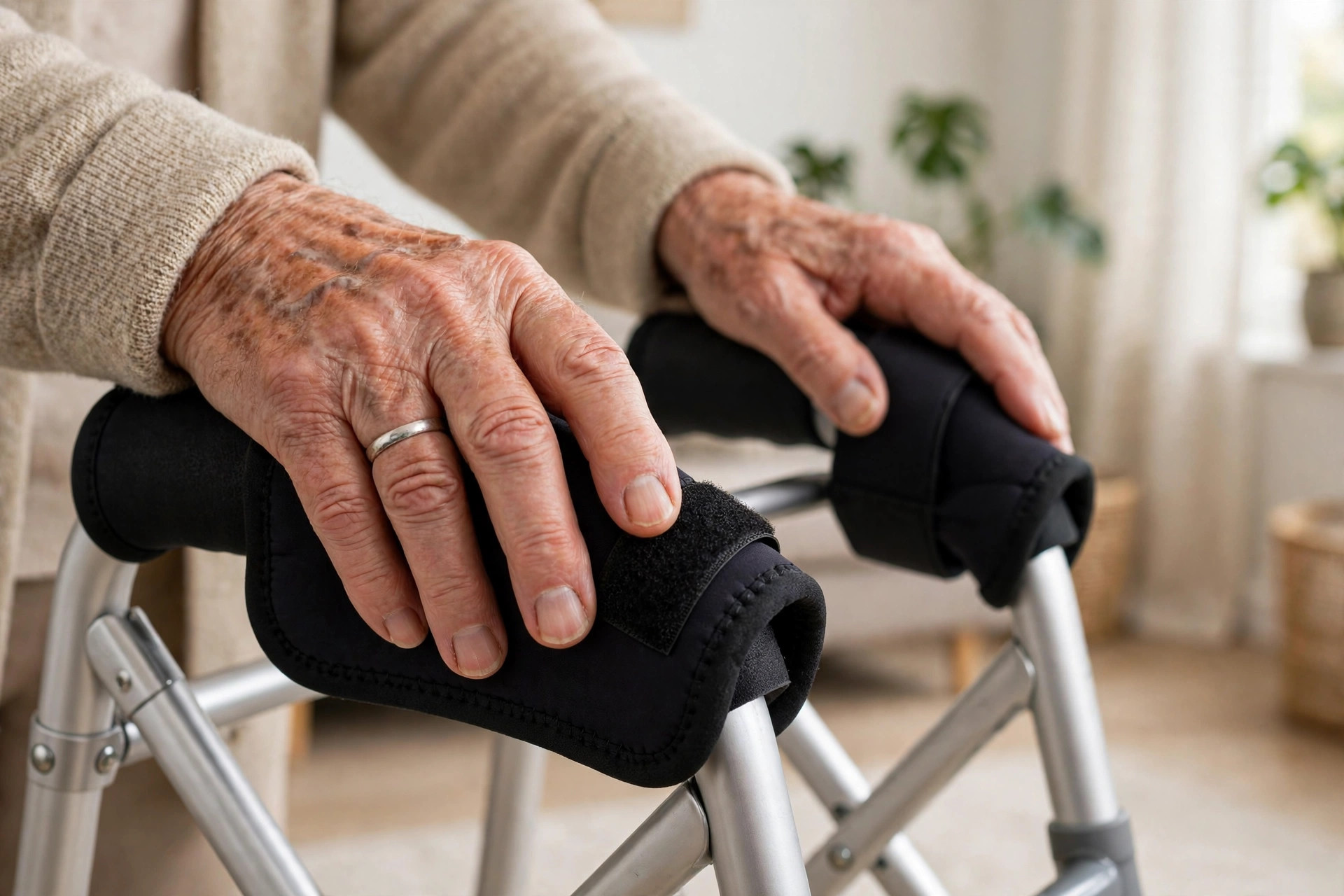
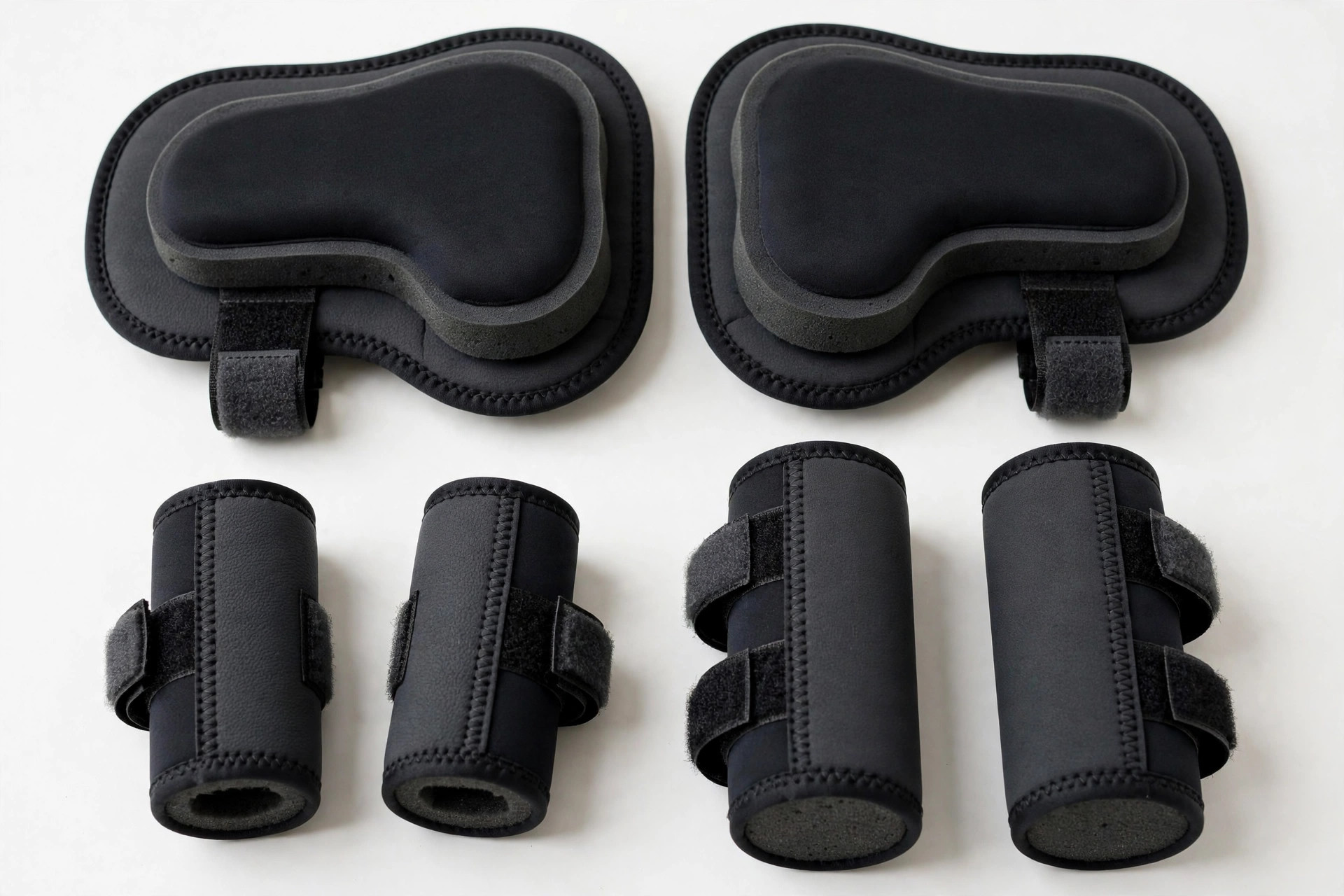
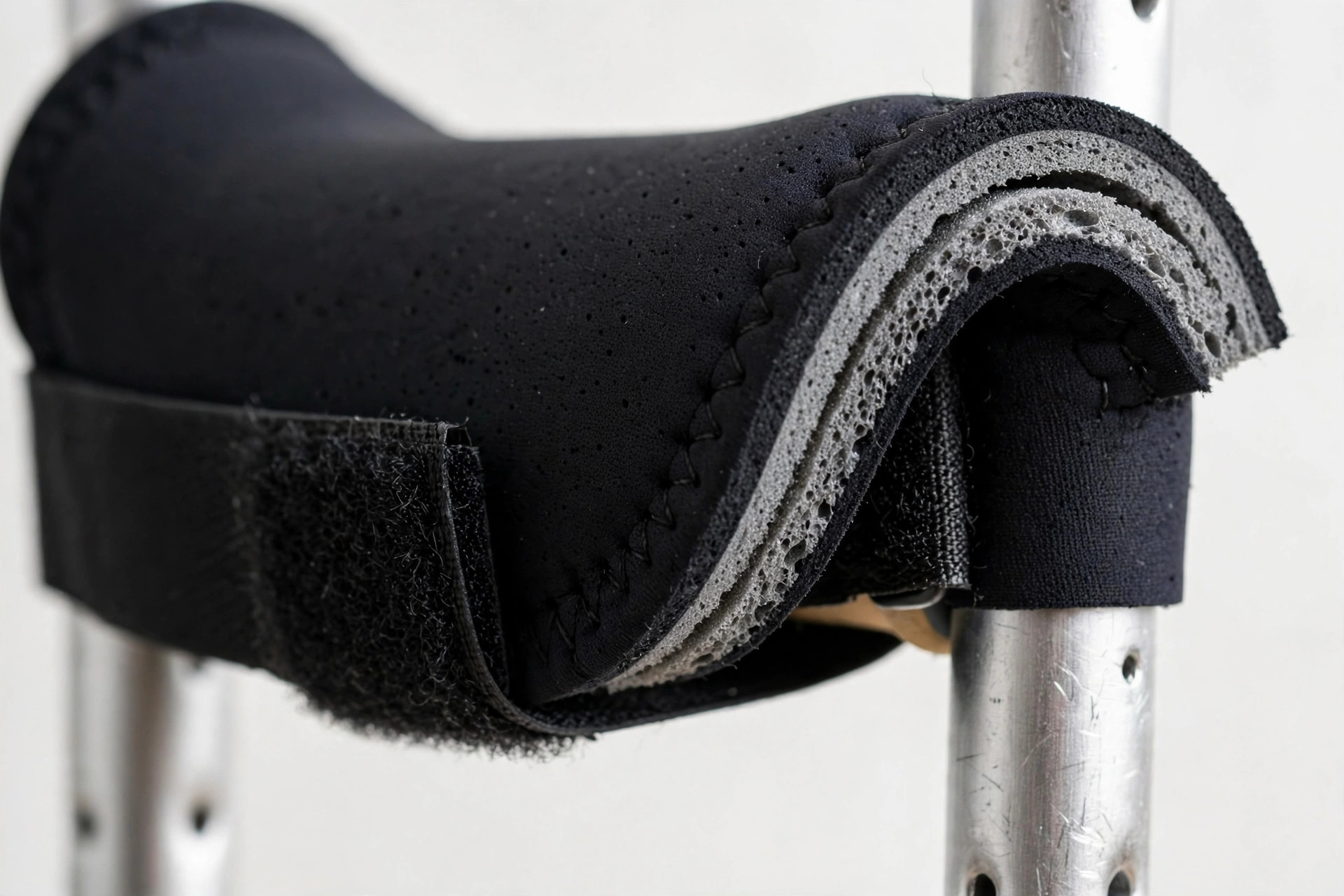
Neoprene for mobility aids and daily living is a family of padded grip and contact-point accessories — crutch underarm pads and hand grips, walker and rollator grip covers, and wheelchair push-rim and armrest padding — cut from laminated neoprene (SBR, SCR or CR foam + fabric), usually 3 to 5 mm thick, that wrap the hard tubes and handles a person leans on every day. The foam spreads the load over a wider, softer area than bare metal or hard rubber, and the cover unstraps for washing, so a worn pad is replaced on its own instead of the whole aid going out of service. Send us your design drawing and the grip or pad dimensions, and we will confirm the best material and thickness.
For the walker end of the range, see our neoprene walker hand grip covers product page.We manufacture custom neoprene mobility accessories in our own factory in China, where we have made neoprene products for 15 years. We cut the foam, laminate the fabric face and stitch the finished pads and covers under one roof, so a change to the size, the closure or the print can be checked on a sample before bulk production starts.
A mobility aid is only as comfortable as the few square centimetres where the body meets the frame. A crutch user puts weight through the underarm pad and the hand grip with every step; a walker user leans on two grips from the bedroom to the kitchen and back, all day, every day. The pads and grips fitted at the factory are usually thin, hard and shaped for nobody in particular, and they are the first parts to split, flatten or start rubbing. A thicker neoprene pad or cover is the simplest upgrade in the whole product: it wraps the contact point the user actually feels, and it can be sold, stocked and replaced separately from the aid itself.
That replaceability is why the channel buys these as accessories, not as parts. Pads and grips are wear items — they take sweat, hand cream, cleaning spray and daily compression — so a cover that unstraps, washes and goes back on keeps the aid in service and gives the retailer a repeat-purchase line that fits in a polybag on a shelf hook. Care homes and loan services run the same logic at fleet scale, holding a rotation stock of washable pads so one set is in the wash while another is on the frames. Our neoprene crutch pads application page covers the biggest-selling item in this family in detail.
For brands, the pad is also the part the customer touches first and remembers. The frame is aluminium tube — much the same from one maker to the next — but the grip is where a brand's colour, logo and hand-feel live, and a shaped underarm pad with a woven label reads as a designed product rather than a spare part. Colour-coding by model or size helps warehouses, loan stores and care staff sort pairs at a glance, and a printed size mark on the cover saves fitting time at the counter.
5 mm is the standard for most crutch underarm pads and grip covers. It gives a real cushion over the tube and softens the edge of the grip in the palm, in a cover that still wraps a standard tube without a fight and lets the hand close around the grip. For the full range, see our neoprene sheet thickness guide.
| Thickness | Best for | Trade-off |
|---|---|---|
| 3 mm | Wheelchair push-rim covers and armrest pads, where extra bulk would catch on doorways and clothing | Least padding; surface comfort and grip matter more than cushioning depth |
| 5 mm | Crutch underarm pads, crutch hand grips and walker grip covers — the standard working thickness | Best balance of cushioning, wrap and grip size for most users |
| 7 mm | Forearm crutch pads and grip covers for full-time users who put their weight through their hands all day | Adds the most diameter to the grip; check the finished grip size against the user's hand |
Measure the aid, not the catalogue. Take the tube diameter and the grip length, and tell us the aid type, because contact points differ between models — a standard underarm crutch, a forearm crutch and a rollator handle are all different patterns, and two walkers of the same class can carry different grip diameters between makers. The pad or cover is cut to your dimensions, with the closure placed so the seam sits away from the palm or the underarm.
SBR is the standard choice for most grip covers and pads, because a mobility accessory's working life is indoors, where the firmer, lighter, lower-cost foam does everything the job asks. CR (chloroprene rubber) earns its higher price on shaped underarm pads and premium grips, where its softer, springier feel and extra stretch let the cover hug a contoured pad without wrinkles. SCR, a blend of the two, sits between them where a range wants a softer hand-feel than SBR at a lower cost than CR.
The figures behind the two foams show why they feel different: our CR foam measures 3–5° Shore C hardness, 276.32 kg/m³ density, 860 kPa tensile strength and 550% elongation, while our SBR foam measures 10–15° Shore C, 158.34 kg/m³, 256 kPa and 185%. CR is the softer, springier foam; SBR is the firmer, lighter one. On a grip, that means a CR cover stretches over the tube and grips it, while an SBR cover is cut closer and feels stiffer and more supportive in the hand.
| SBR | CR | |
|---|---|---|
| Cost | Lower cost; the standard for most pads and grip covers | Costs more than SBR |
| Feel | Firm and light, with a supportive hold on the grip | Soft and elastic, with the softest contact feel of the three foams |
| Fit on shaped pads | Best on straight grips and flat pads, cut close to size | Stretches over contoured underarm pads and curved armrests without creasing |
For sizes, closures and printing on the core item in this family, see our custom neoprene crutch pads product page. The same daily-living channel buys body-worn supports alongside grip accessories — our neoprene hernia belts application page covers that side of the range.
Mobility aid brands — pads and grip covers supplied in your colours and branding, fitted to your frames at the factory or sold as your own accessory line.
Medical supply retailers — washable replacement pads and grip covers on the shelf next to the crutches and walkers, in the sizes your customers ask for by model.
Care homes and elderly care providers — rotation stock of washable pads and covers across a fleet of walkers, crutches and wheelchairs, replaced piece by piece as they wear.
Distributors and e-commerce sellers — paired sets and pad-and-grip kits for the best-selling crutch and walker models, packed for online sale.
When neoprene is NOT the right choice
Tell us which of these your pads and covers need, and we will build the sample to your drawing.
Will the pads and covers fit standard crutches and walkers?
Yes — every pad and cover is made to your dimensions. Send the aid type (underarm crutch, forearm crutch, walker or rollator), the tube diameter and the grip length, or send a sample pad, and mixed models can share one order.
Can the covers be washed?
Yes. The covers unstrap or slide off for washing and go back on the same way, which is why care providers and loan services keep a rotation set — one set in use, one in the wash.
Can you print our logo on the covers?
Yes. Screen print carries a brand name, logo or size mark on the fabric face, and a woven label gives a premium finish on retail sets.
What is the minimum order?
200 pieces per design as a general minimum, adjustable to your actual order.
Can I get a sample first?
Yes — we support sampling, usually in 5–7 days. Send us your design drawing and the grip or pad dimensions you need.
How long does bulk production take?
Usually 15–18 days after sample approval, depending on the quantity and customisation.
We make custom neoprene pads and grip covers to your aid model, your colours and your print, and we check the fit on a real frame sample before bulk production. The general minimum order is 200 pieces per design, adjustable to your actual order; sampling is supported, usually in 5–7 days, and bulk production usually takes 15–18 days after sample approval.
Request a Quotation
To help us review your inquiry, please send:
Website: https://www.neoprenecustom.com/ Email: kevin@neoprenecustom.com
A grip cover is judged in the hand, not on the shelf. Send us your tube size and we will make you a sample to wrap onto a real frame. For the body-worn supports that share the same foam and fit logic, see our custom neoprene knee braces product page.
Contact: Kevin
Phone: 13417385320
Tel: 0734-87965514
Email: kevin@neoprenecustom.com
Add: Intersection of Zhangjialing Road and Science and Technology Road, Guiyang Industrial Park, Guiyang Town, Qidong County, Hengyang City, Hunan Province./Dongguan Factory(GUANXIN): Shixin Street, Fushan Village, Liaobu Town, Dongguan, Guangdong Province.