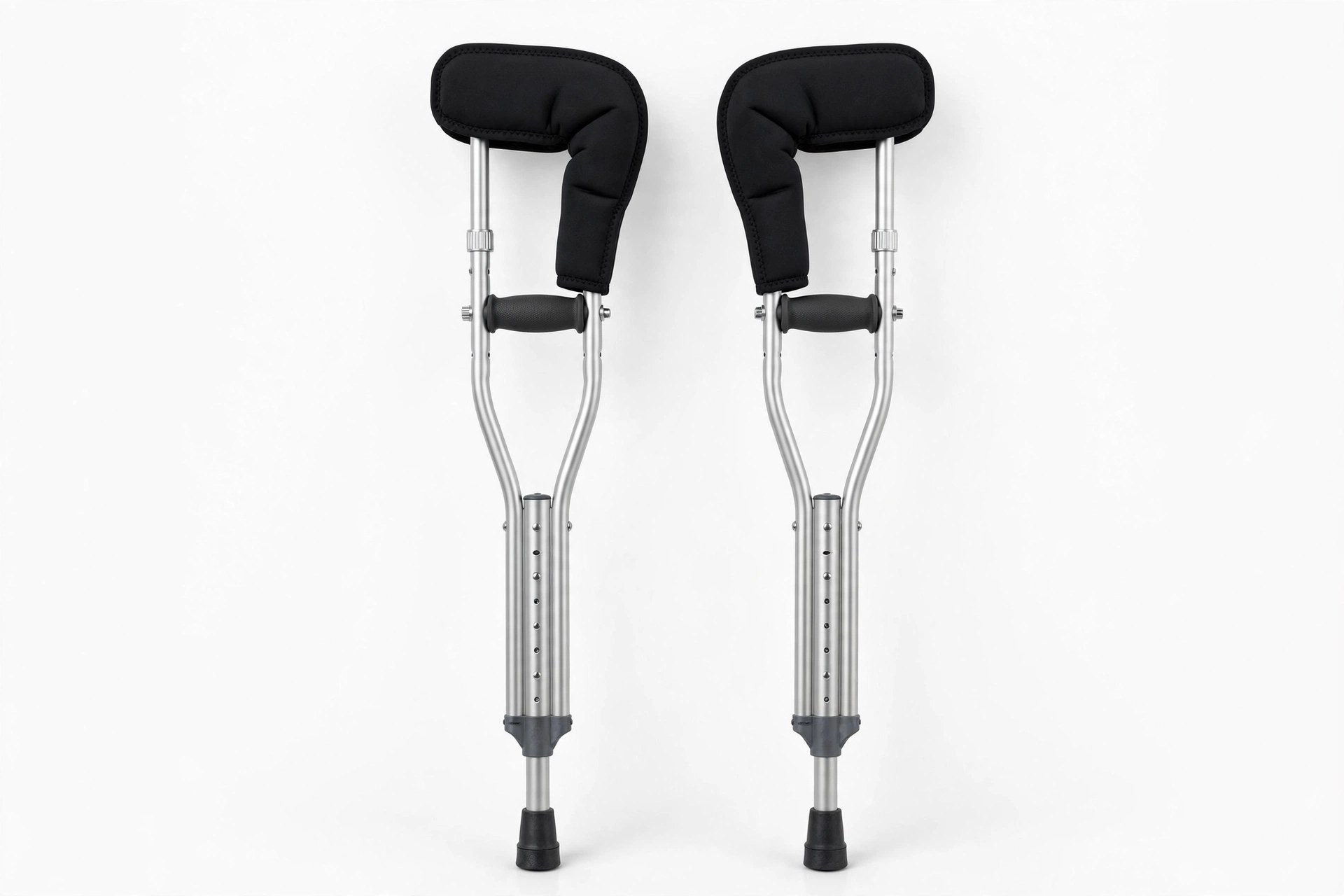
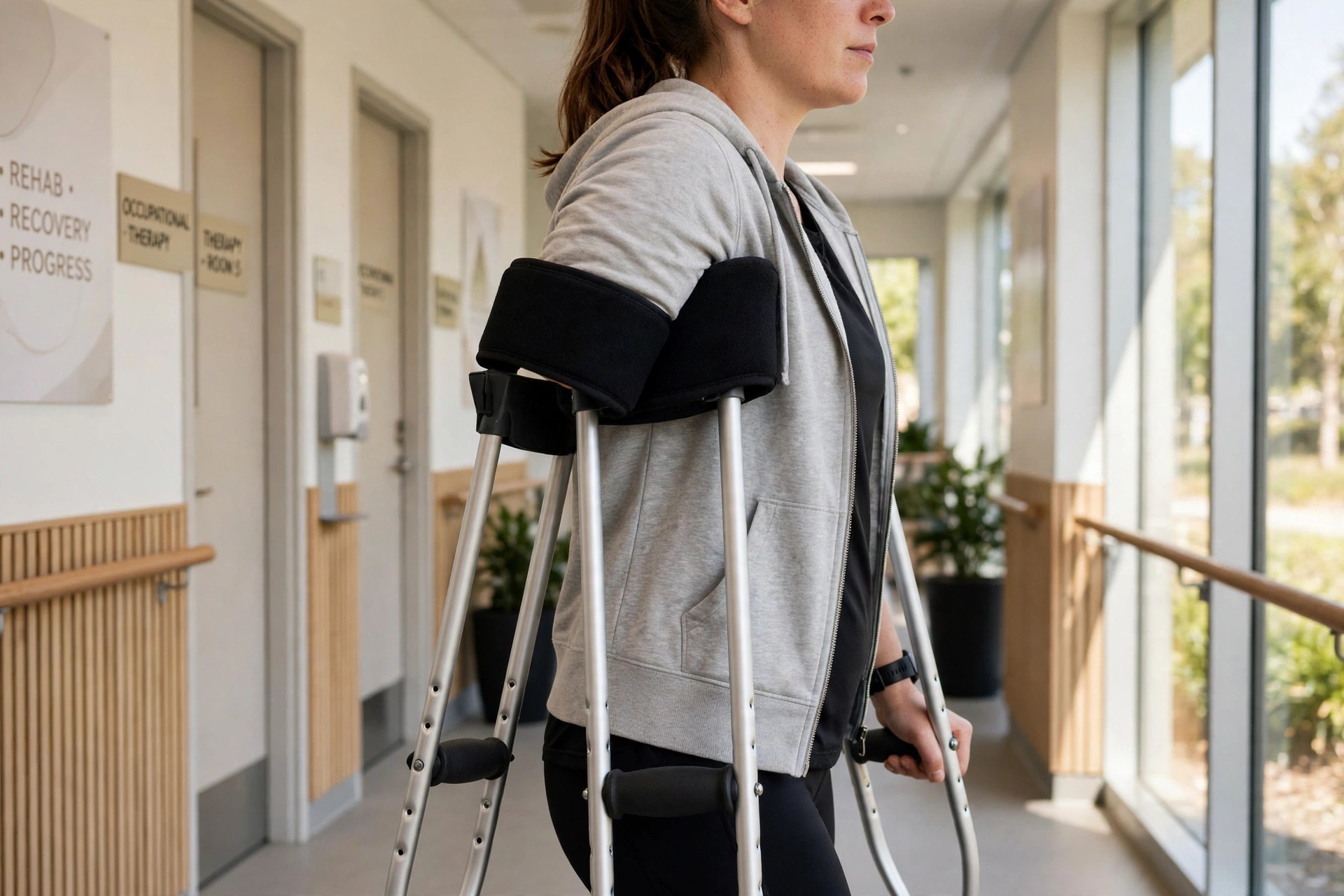
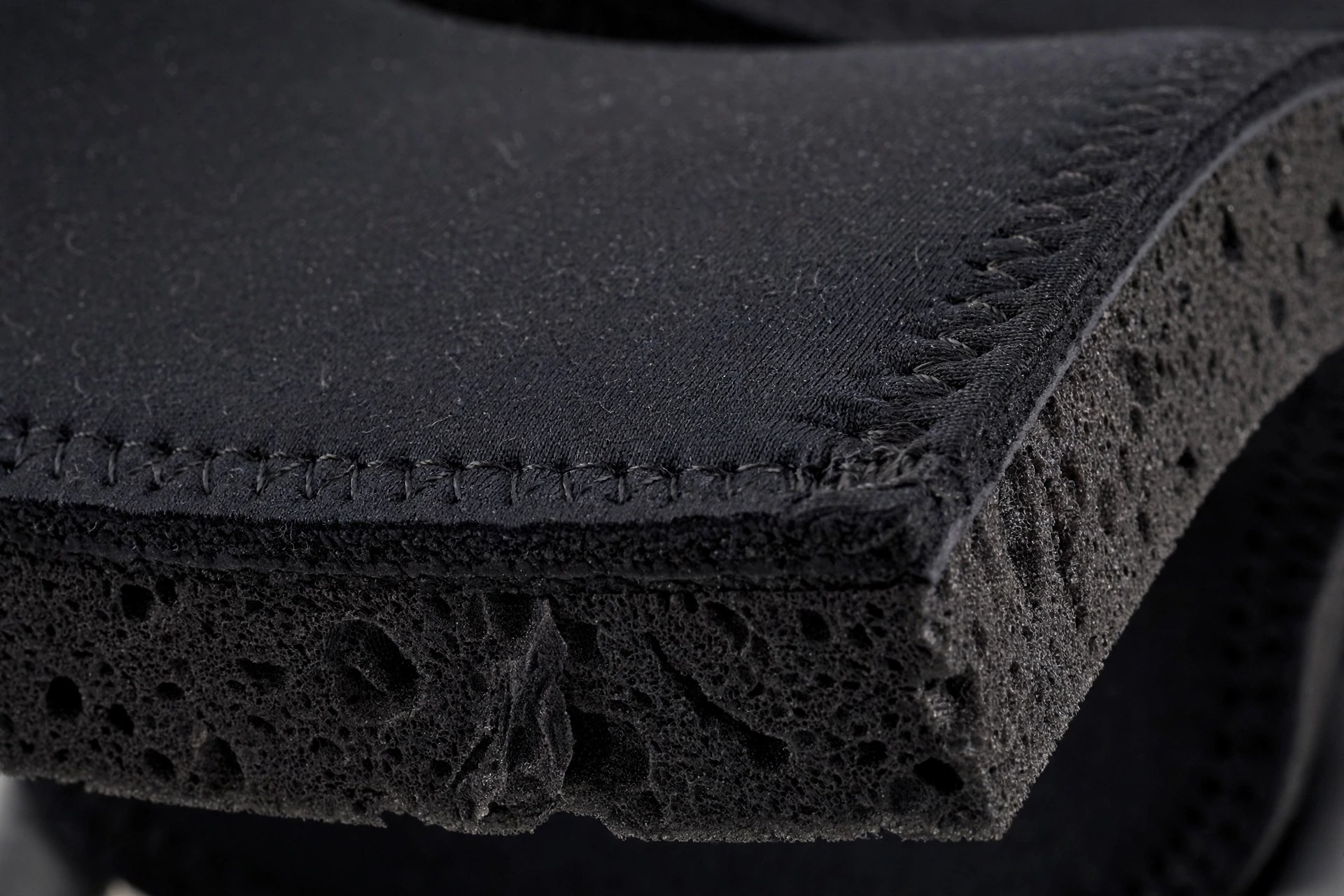
A neoprene crutch pad is a shaped cushion of laminated neoprene (SBR, SCR or CR foam + fabric), usually 5 mm thick, that wraps the top bar of an underarm crutch, with a matching cover for the hand grip. The foam puts a soft, grippy layer between the hard crutch and the user's side and palm, spreads the load over a wider area than the stock rubber cap, and fastens with hook-and-loop so it can be removed and washed. Pads are normally sold as a set of four pieces — two underarm pads and two grip covers — for one pair of crutches. Send us your design drawing and crutch model, and we will confirm the best material and thickness.
We manufacture custom neoprene crutch pads in our own factory in China, where we have made neoprene products for 15 years. We cut the foam, laminate the fabric face and stitch the finished pads under one roof, so a change to the pad shape, the fastening or the print can be checked on a sample before bulk production starts.
A crutch touches the body in exactly two places, and both are unforgiving. The top bar presses into the side under the arm with every step, and the handle takes the user's weight through the palm for hours a day. The caps a crutch ships with are thin, hard rubber shaped for the factory, not for the person — they concentrate the load on a narrow ridge and wear smooth and slippery. A foam pad widens the contact area, adds grip, and turns a hard edge into a cushioned one. It is a comfort accessory, not a medical device: it changes how a crutch feels, not what a crutch does.
Crutch pads are also a hygiene and replacement story, which is why dealers like them. The pads are the part of the crutch that is handled constantly and soaks up sweat; they wear out and get grubby long before the aluminium frame does. Because neoprene pads unfasten in seconds and wash clean, users buy spare and replacement sets — a repeat purchase that the plain rubber cap never generates. The same logic runs across our healthcare range, from braces to our neoprene cold therapy wraps: the neoprene part is the wearable, washable, replaceable part.
Fit is the detail that decides whether a pad set sells twice. Crutch tops and handles differ between models and markets, so a pad cut to a generic shape gaps on one crutch and bunches on another. We cut to the pattern of the crutches your customers actually sell — send the model name, measurements or a photo of the top bar and handle — and we check the wrap and fastening on a sample before bulk production.
5 mm is the standard for most neoprene crutch pad sets. It gives real cushioning under the arm while the wrap still fastens neatly around a standard crutch top, which is why most of the pad sets we make are cut in 5 mm. For the full range, see our neoprene sheet thickness guide.
| Thickness | Best for | Trade-off |
|---|---|---|
| 3 mm | Hand grip covers, and light pads for short-term crutch use after an injury | Least cushioning under the arm on long days |
| 5 mm | Most pad sets — everyday rehabilitation and mobility use | Best balance of cushioning, fit and fastening |
| 7 mm | Underarm pads for long-term users who are on crutches all day | Thickest wrap; needs a generous fastening length to close neatly |
Measure the crutch, not the catalogue. Take the length and width of the top bar where the pad wraps, and the circumference of the handle, and tell us the crutch model if you know it. Two crutches of the same type can differ in bar shape between makers, and the pad is cut to your dimensions, with the hook-and-loop placed to close on that bar.
SCR and SBR are the standard choices for most crutch pad ranges, and CR is the choice for premium lines. SBR (styrene-butadiene rubber) is the firm, light foam that holds the pad's shape at the lowest cost. CR (chloroprene rubber) is softer and more elastic, and gives the most cushioning feel under the arm. SCR sits between the two on cost and softness, and it is what most of our healthcare customers choose for pads and supports that are worn or handled all day.
The numbers show why the foams feel different: our CR foam measures 3–5° Shore C hardness, 276.32 kg/m³ density, 860 kPa tensile strength and 550% elongation, while our SBR foam measures 10–15° Shore C, 158.34 kg/m³, 256 kPa and 185%. CR is the softer, springier foam; SBR is the firmer, lighter one. On a crutch, that means a CR or SCR pad feels plush against the side, while an SBR pad feels firmer and keeps a crisper shape.
| SBR | CR | |
|---|---|---|
| Cost | Lower cost; the usual choice for value pad sets | Costs more than SBR |
| Cushioning feel | Firm support that holds its shape | Softest and most elastic; the plushest feel under the arm |
| Washing and daily wear | Good; rinses clean and dries fast | Good; stays flexible through repeated washing |
For set contents, fits and printing, see our custom neoprene crutch pads product page.
Medical supply brands — pad sets in your colours and packaging, cut to the crutch models in your catalogue.
Rehabilitation equipment dealers — bulk sets for fitting at handover, and the replacement sets that bring customers back.
Pharmacy and daily-living channels — retail-packed sets with hangtag and barcode for the mobility shelf.
Online mobility stores — a light, flat, easy-to-photograph accessory that ships in a polybag and pairs with crutch sales.
When neoprene is NOT the right choice
Tell us which of these your crutch pads need, and we will build the sample to your drawing.
How do the pads attach to the crutch?
Each pad wraps the crutch top or handle and closes with hook-and-loop — no tools, no glue, and it comes off the same way for washing or replacement.
Will the pads fit our crutch models?
Yes — send the crutch model, or measurements or a photo of the top bar and handle, and we cut the pattern to that bar. Mixed models can share one order.
Can the pads be washed?
Yes. Unfasten them, rinse or hand-wash, and dry flat. The foam does not soak up water, so a washed set is ready again the next day.
What is the minimum order?
200 pieces per design as a general minimum, adjustable to your actual order.
Can I get a sample first?
Yes — we support sampling, usually in 5–7 days. Send us your design drawing and the crutch models you need.
How long does bulk production take?
Usually 15–18 days after sample approval, depending on the quantity and customisation.
We make custom neoprene crutch pads to your crutch models, your colours and your print, and we check the fit and fastening on a sample before bulk production. The general minimum order is 200 pieces per design, adjustable to your actual order; sampling is supported, usually in 5–7 days, and bulk production usually takes 15–18 days after sample approval.
Request a Quotation
To help us review your inquiry, please send:
Website: https://www.neoprenecustom.com/ Email: kevin@neoprenecustom.com
A crutch pad is judged on the hundredth step of the day, not the first. Send us your crutch model and we will make you a sample set to fit and try. For the rest of the healthcare range it sits alongside, see our custom knee sleeves.
Contact: Kevin
Phone: 13417385320
Tel: 0734-87965514
Email: kevin@neoprenecustom.com
Add: Intersection of Zhangjialing Road and Science and Technology Road, Guiyang Industrial Park, Guiyang Town, Qidong County, Hengyang City, Hunan Province./Dongguan Factory(GUANXIN): Shixin Street, Fushan Village, Liaobu Town, Dongguan, Guangdong Province.