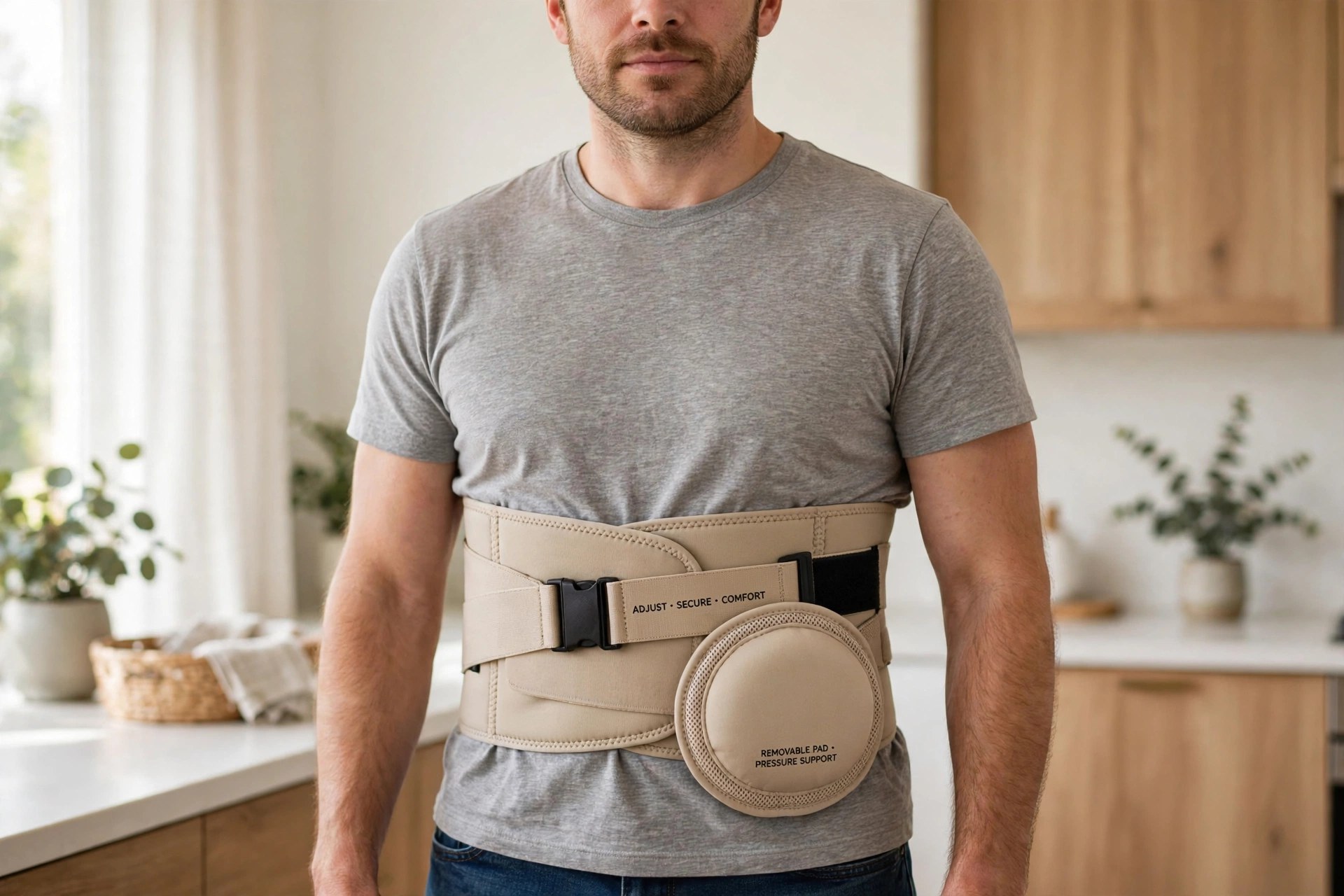
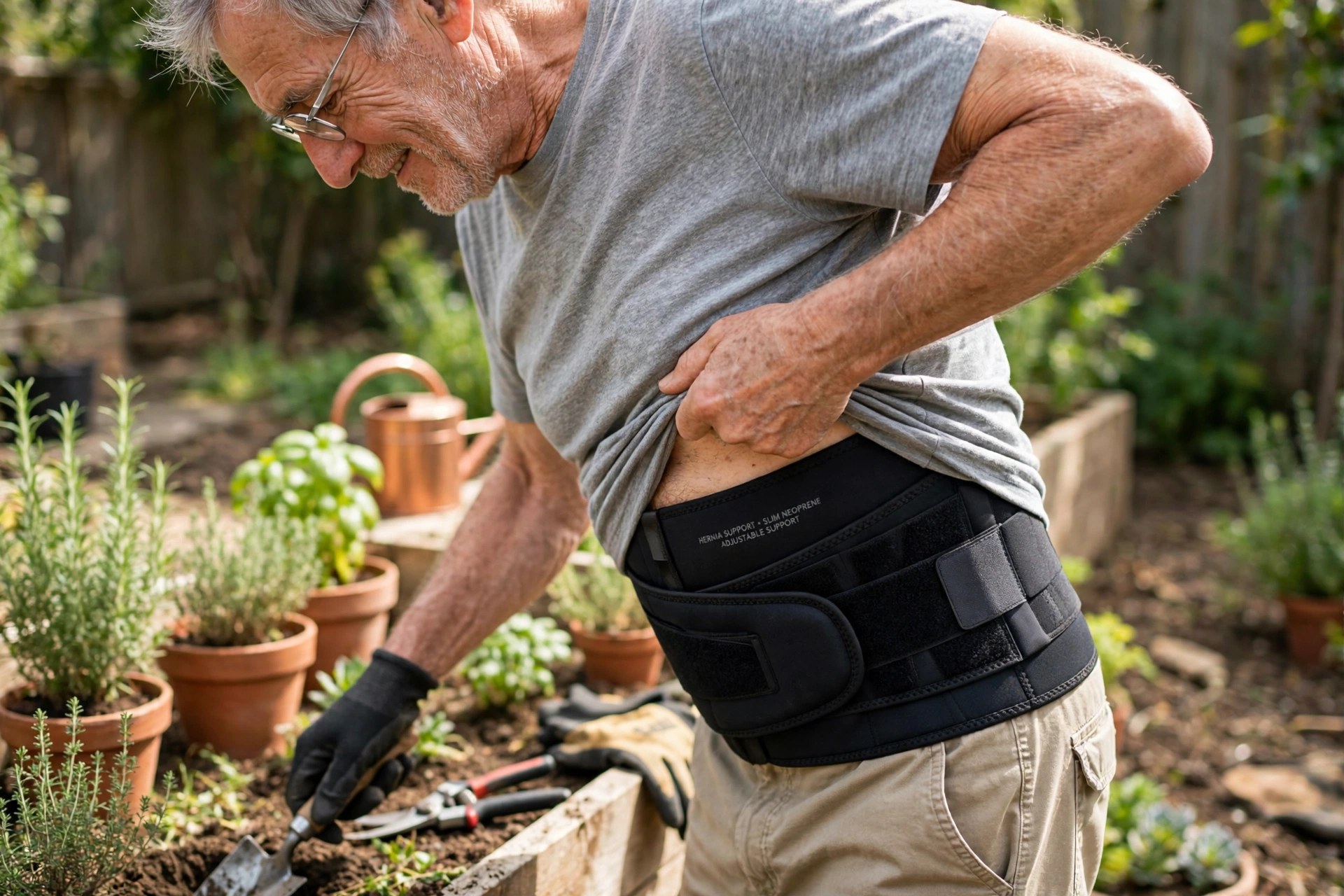
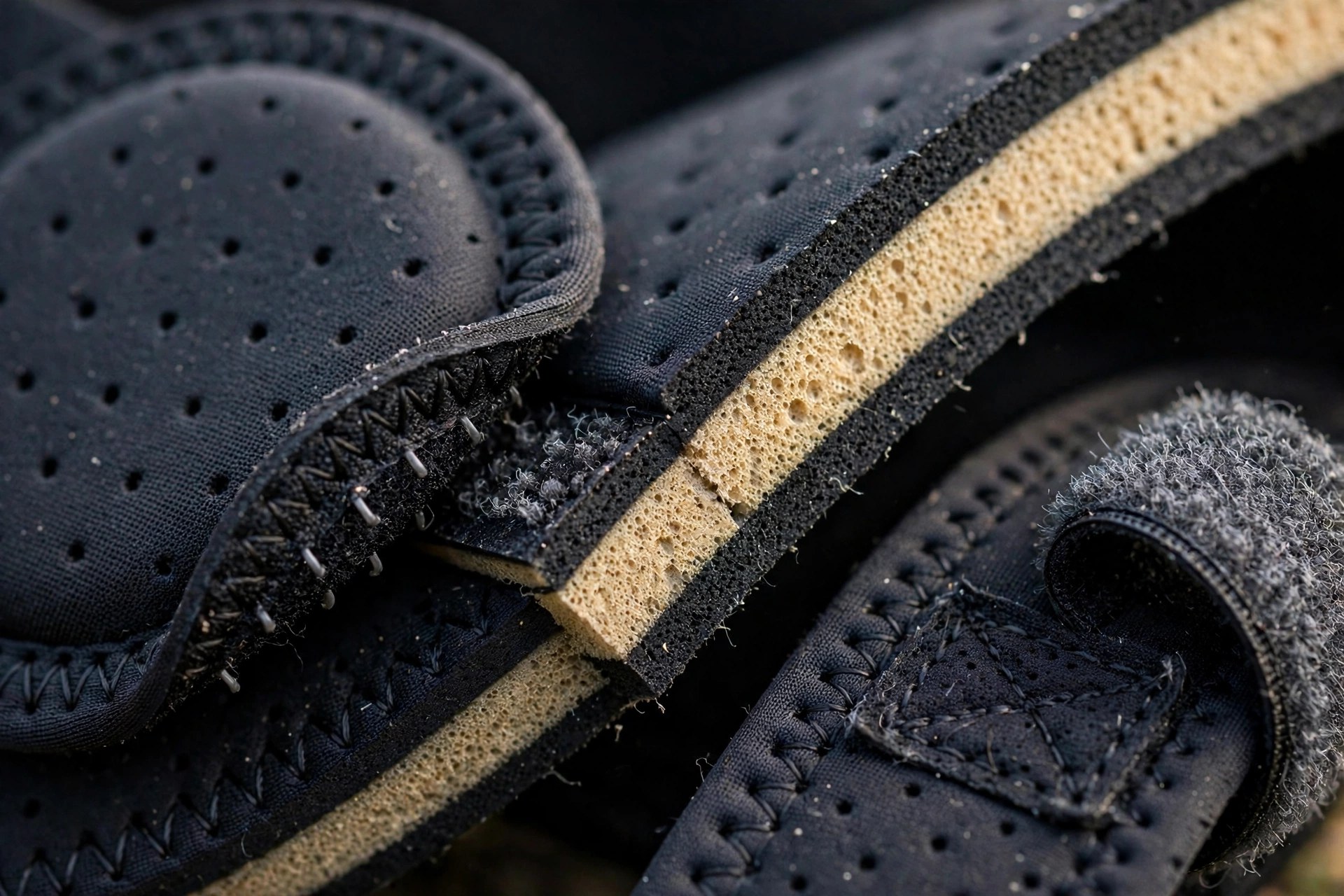
A neoprene hernia belt is a soft support belt of laminated neoprene (SBR, SCR or CR foam + fabric), usually 5 mm thick, worn around the hips during daily activity. An adjustable strap sets the fit, and a removable foam pressure pad sits inside the belt at the front, positioned by the wearer and held gently in place by the belt's tension. Single versions carry one pad; double versions carry two. It is a comfort product — a support wearable, not a medical treatment — sold through medical-supply and pharmacy channels. Send us your design drawing and size range, and we will confirm the best material and thickness.
We manufacture custom neoprene hernia belts in our own factory in China, where we have made neoprene products for 15 years. We cut the foam, laminate the fabric face and stitch the finished belts under one roof, so a change to the size grading, the strap or the pad can be checked on a sample before bulk production starts.
What a wearer asks of a hernia belt is simple: it should feel comfortable from morning to evening, stay where it is put, and disappear under clothing. The construction answers those three asks directly. The neoprene body is soft and warm against the skin and flexes as the wearer sits, stands and walks. The strap adjusts in seconds, so the fit can be eased or firmed through the day. And the pressure pad — the part that defines the product — is a shaped foam pad that the wearer positions at the front of the belt; it is removable, so the belt can be washed and the pad replaced or supplied as a spare. Nothing about the belt is complicated, and that is the point: it is an everyday wearable, worn for comfort while life goes on around it, in the same support-wear family as our neoprene crutch pads for mobility ranges.
Neoprene earns its place here over a plain elastic belt for three reasons. The foam body holds its shape and its gentle tension through daily wear instead of stretching out; the material is warm and soft against the body, which matters in a product worn all day; and the belt cuts into a slim, smooth profile that sits flat under a shirt. The same foam logic runs through the rest of the support range, from hernia belts to our neoprene back braces for the waist.
Sizing is graded by hip measurement, from small to extra-large, and the grading matters more than the material choice: a belt that is a size out will be adjusted all day and then left in a drawer. We grade to standard hip measurements or to your own size chart, and we check the fit across the size run on samples before bulk production. Single and double versions share the same grading, so a brand can run both from one size chart.
5 mm is the standard for most neoprene hernia belts. It gives a firm, substantial feel and a well-padded pressure pad while the belt still sits comfortably under clothing, which is why most of the belts we make are cut in 5 mm. For the full range, see our neoprene sheet thickness guide.
| Thickness | Best for | Trade-off |
|---|---|---|
| 3 mm | Slim belts for discreet wear under fitted clothing | Least padding in the pressure pad |
| 5 mm | Most belts — all-day wear at work, at home and travelling | Best balance of firmness, pad padding and discretion |
| 7 mm | Ranges that want the firmest feel and the thickest pad | Thickest and most noticeable under clothing; costs more than 5 mm |
Measure the hips, not the waist. The belt sits low, around the hip line, so the size chart should be built on hip measurements. Our standard grading runs from small to extra-large, and we cut to a brand's own size chart on request.
SBR and SCR are the standard choices for most hernia belt ranges, and CR is the choice for premium lines. SBR (styrene-butadiene rubber) is the firm, light foam that holds the belt's shape at the lowest cost. CR (chloroprene rubber) is softer and more elastic, so the belt feels gentler against the body and springs back after a full day of wear. SCR sits between the two on cost and stretch, and it is what most support-wear ranges choose.
The numbers show why the two foams feel different: our CR foam measures 3–5° Shore C hardness, 276.32 kg/m³ density, 860 kPa tensile strength and 550% elongation, while our SBR foam measures 10–15° Shore C, 158.34 kg/m³, 256 kPa and 185%. CR is the softer, springier foam; SBR is the firmer, lighter one. On the body, that means a CR belt feels softer through a long day, while an SBR belt keeps a crisper shape and a firmer fit.
| SBR | CR | |
|---|---|---|
| Cost | Lower cost; the usual choice for everyday lines | Costs more than SBR |
| Feel on the body | Firm fit that keeps its shape | Soft and elastic; gentler through a full day of wear |
| Repeated daily use | Good; holds up through daily wear and washing | Better; springs back after repeated stretching and washing |
For sizes, versions and ordering, see our custom neoprene hernia belts product page.
Medical supply brands — single and double belts in your size run, with your label and retail box.
Pharmacy chains and drugstore suppliers — beige and black belts in the standard hip sizes the pharmacy shelf turns over.
Support-wear and orthopaedic distributors — hernia belts as one line in a wider supports catalogue, next to products like our neoprene abdominal binders.
Online medical-supply stores — a light, flat product that ships in a polybag or retail box and sizes clearly by hip measurement.
When neoprene is NOT the right choice
Tell us which of these your hernia belts need, and we will build the sample to your drawing.
Is a hernia belt a medical treatment?
No. A hernia belt is a support wearable worn for comfort during daily activity. It does not treat, cure or replace medical care, and anyone with a hernia should follow their doctor's advice on whether and how to wear one.
What is the difference between single and double versions?
A single belt carries one removable pressure pad, positioned on the left or the right. A double belt carries two pads, one on each side. The strap, sizing and materials are the same.
How are the belts sized?
Belts are sized by hip measurement, in graded sizes from small to extra-large, because the belt sits around the hips. Send your size chart or use our standard grading.
What is the minimum order?
200 pieces per design as a general minimum, adjustable to your actual order.
Can I get a sample first?
Yes — we support sampling, usually in 5–7 days. Send us your design drawing and the hip size range you need.
How long does bulk production take?
Usually 15–18 days after sample approval, depending on the quantity and customisation.
We make custom neoprene hernia belts to your size run, your colours and your label, in single and double versions, and we check the fit across the size run on samples before bulk production. The general minimum order is 200 pieces per design, adjustable to your actual order; sampling is supported, usually in 5–7 days, and bulk production usually takes 15–18 days after sample approval.
Request a Quotation
To help us review your inquiry, please send:
Website: https://www.neoprenecustom.com/ Email: kevin@neoprenecustom.com
A hernia belt is judged at the end of a long day, by whether the wearer forgot it was on. Send us your size run and we will make you samples to check the fit.
Contact: Kevin
Phone: 13417385320
Tel: 0734-87965514
Email: kevin@neoprenecustom.com
Add: Intersection of Zhangjialing Road and Science and Technology Road, Guiyang Industrial Park, Guiyang Town, Qidong County, Hengyang City, Hunan Province./Dongguan Factory(GUANXIN): Shixin Street, Fushan Village, Liaobu Town, Dongguan, Guangdong Province.