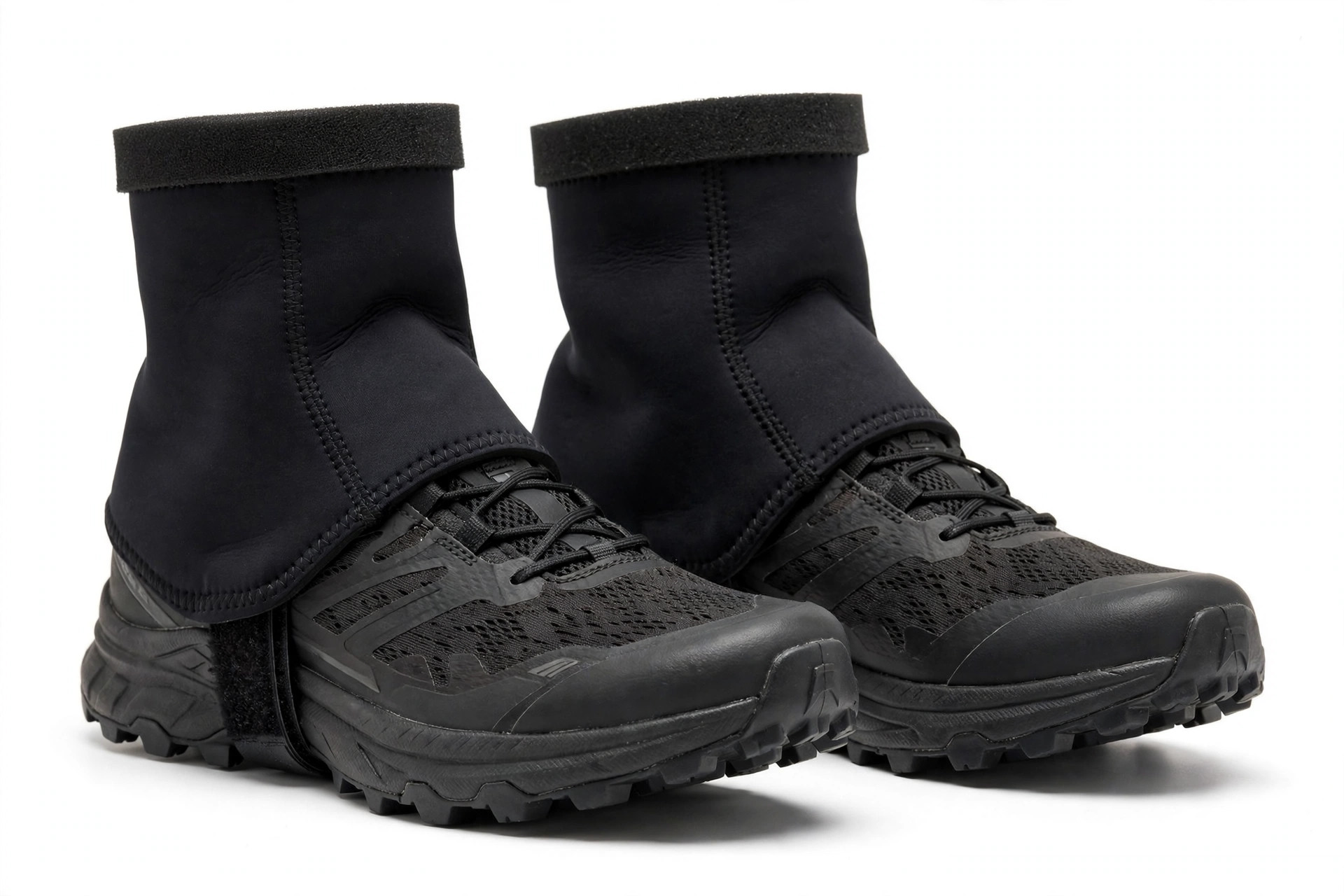
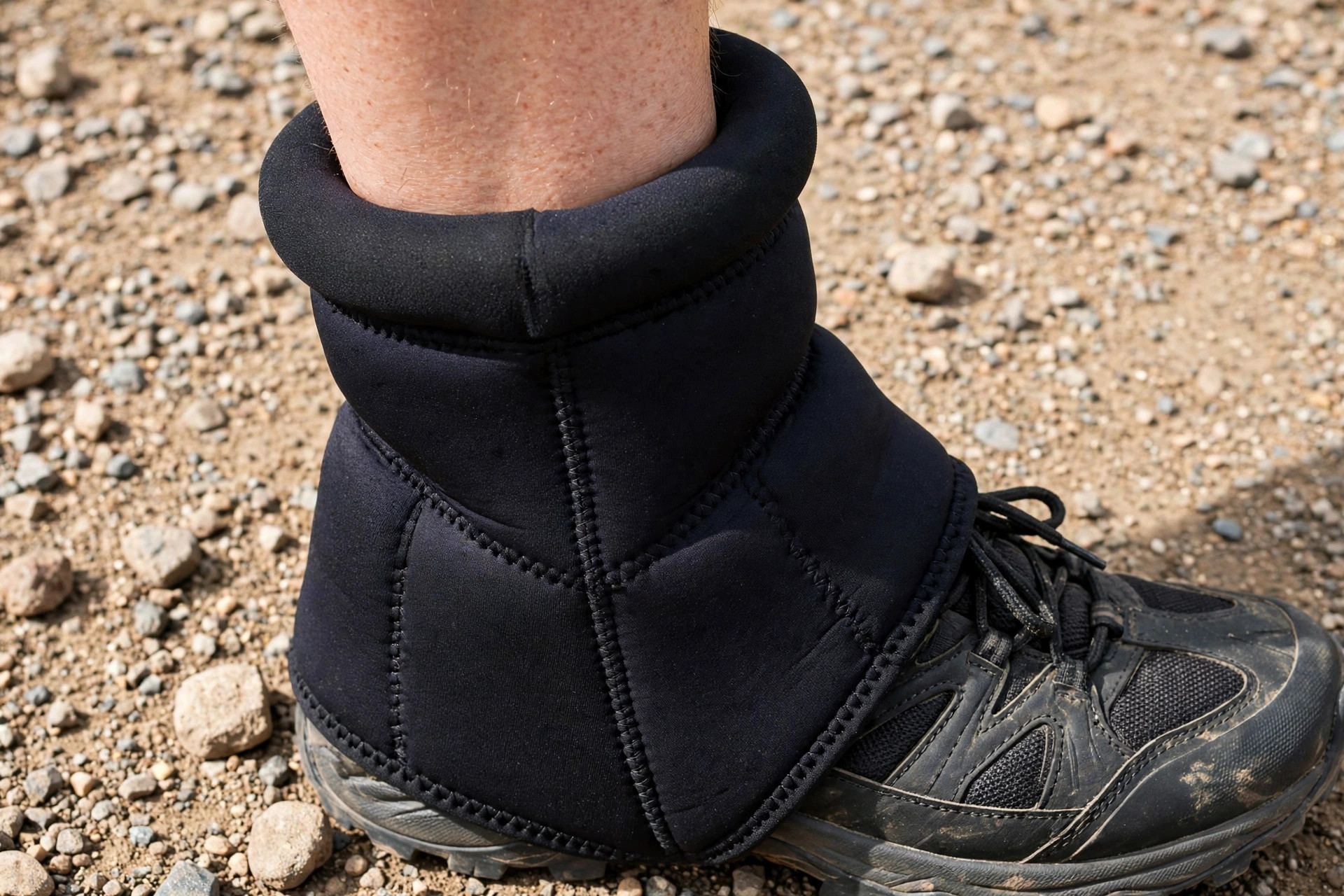
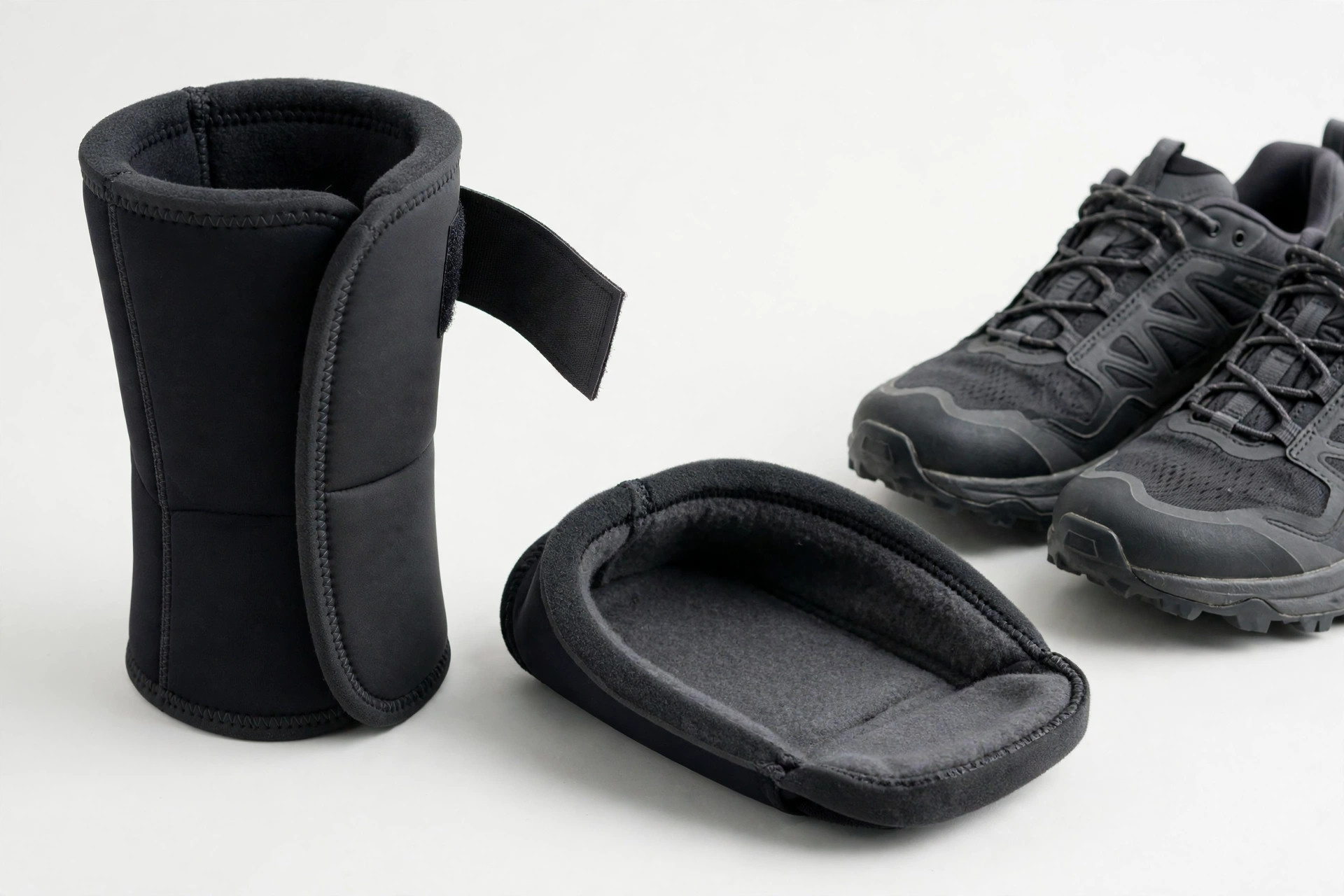
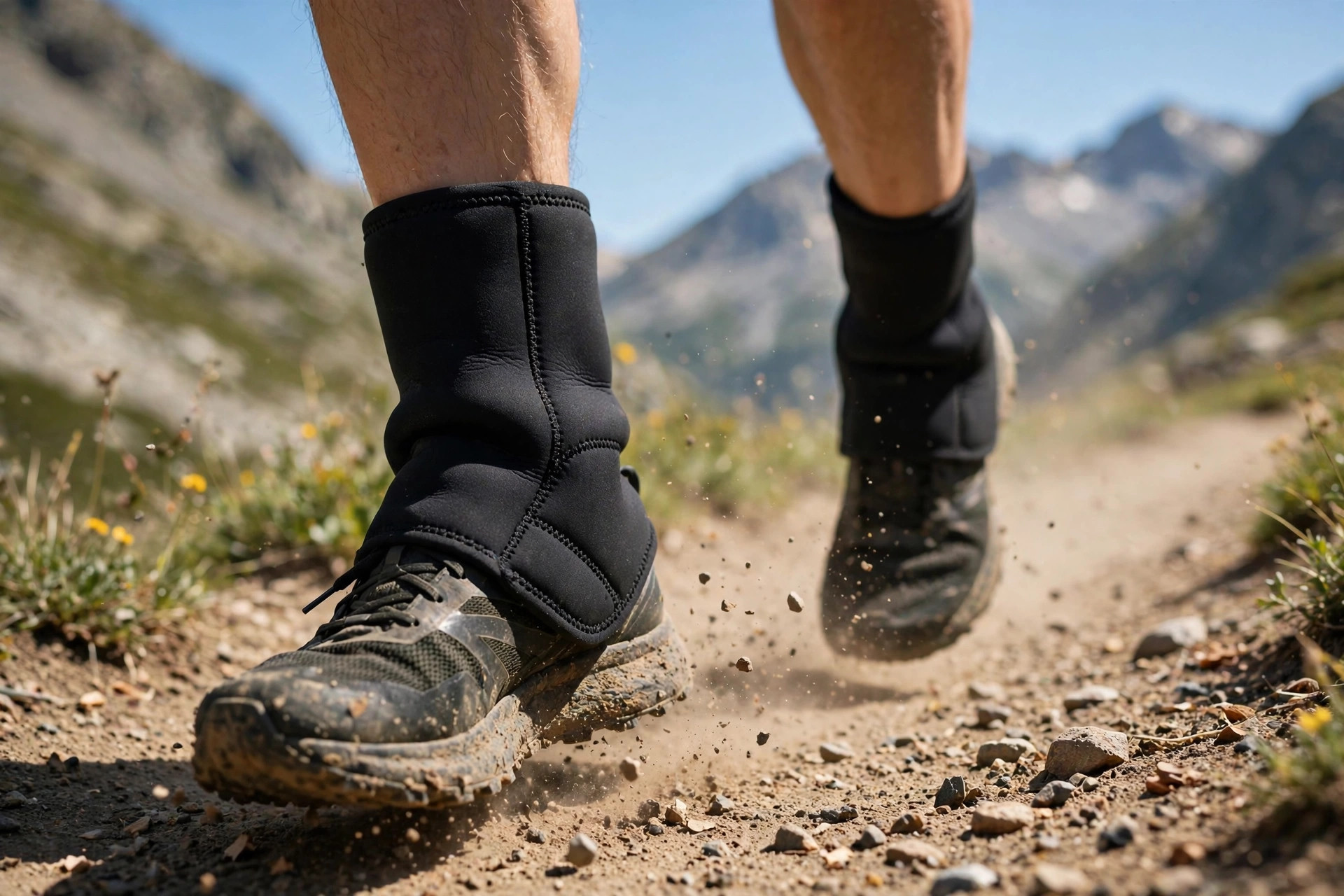
A neoprene ankle gaiter is a low cuff of laminated neoprene (SBR, SCR or CR foam + fabric) that wraps the ankle and seals the opening at the top of a trail shoe, so the grit, sand, seeds and small stones the trail throws up stay outside the shoe instead of working their way in. The foam cuff sits close around the ankle, the lower edge overlaps the shoe’s collar and tongue, and a strap under the shoe holds the whole seal in place while you run. One stone in a shoe can cost a runner a race; the gaiter is the small piece of kit that stops it getting in. Send us your shoe type and size range, and we will confirm the best material and thickness for the gaiter.
| Material | Laminated neoprene (SBR / SCR / CR foam + fabric) |
| Thickness | 3-8mm |
| Sizes | S / M / L by shoe size and ankle circumference; sold in pairs |
| Closure | Hook-and-loop wrap with replaceable under-shoe strap |
The seal is the whole design. Trail debris gets into a shoe at one place only — the gap between the ankle and the shoe’s collar — so the gaiter closes exactly that gap: the neoprene cuff stretches over the ankle, the skirt of the gaiter lies over the collar and the laces, and the under-shoe strap keeps the skirt from riding up as the foot flexes. Because the foam itself is padded, the cuff also puts a layer of cushioning around the ankle bones, which softens the knock of brush, scree and the other shoe on rough descents. It is the same job our neoprene gravel guards do for wading boots, adapted to the lighter, faster trail shoe.
It is worth stating plainly what a gaiter is not. It is not one of our neoprene ankle braces: a brace is a support product, shaped and strapped to hold the ankle joint. A gaiter holds nothing — it is a debris guard that covers the shoe opening and the ankle area, and it makes no support or injury claims. Brands sell the two side by side without confusion, because runners buy them for different problems: the brace for the joint, the gaiter for the grit.
We laminate the foam, cut the panels and stitch the finished gaiters in our own factory in China, where we have made neoprene products for 15 years. The foam is laminated with a smooth jersey on the inside face before cutting, so the cuff slides over a sock without dragging, while the outside face can be a tougher abrasion-resistant fabric for rocky trails or a printable surface for a brand’s colours. The figures behind the foams: our CR foam measures 3–5° Shore C hardness, 276.32 kg/m³ density, 860 kPa tensile strength and 550% elongation, while our SBR foam measures 10–15° Shore C, 158.34 kg/m³, 256 kPa and 185%. CR is the softest and most elastic of the three, so a CR cuff seals closest around the ankle and flexes without folding; SBR is firmer and lighter, which suits high-volume retail ranges. SCR, a blend of the two, sits between them. The under-shoe strap is stitched and replaceable, the closure is hook-and-loop so the fit adjusts over thick or thin socks, and the seams are stitched flat so nothing raised rubs the ankle bone.
For a gaiter, thickness is a balance between seal and bulk. A 3 mm cuff is the lightest: it seals well, flexes with the ankle and disappears on the foot, which is why most trail and ultra runners choose it. A 5 mm cuff adds padding around the ankle bones and stands up better to brush and scree, the usual choice for hiking and rough mountain trails. A 7–8 mm cuff is the heavy end, ordered for work and hunting use in cold, rough country, where the foam’s warmth and cushioning matter as much as the seal. Whichever thickness is chosen, the fit matters more than the foam: a gaiter that gaps at the collar lets grit in at any thickness.
Tell us the shoe type, the sock thickness your customers run in and the terrain, and we will recommend the thickness and the cuff height — and cut the sample to your shoe. For the full range, see our neoprene sheet thickness guide, and our neoprene wading socks application page for the other end of the trail-and-water range.
| Item | Standard |
|---|---|
| Material | Laminated neoprene (SBR / SCR / CR foam + fabric) |
| Thickness | 3–8 mm (3 mm is the most common for trail running) |
| Sizes | S / M / L by shoe size and ankle circumference, or cut to your size list; sold in pairs |
| Closure and strap | Hook-and-loop wrap closure; pull-on elastic cuff on request. Stitched under-shoe strap, replaceable; lace hook at the front on request |
| Cuff height | Low ankle height as standard; higher cuff for hiking and work versions on request |
| Logo and colours | Screen print, heat transfer, rubber patch or woven label. Black as standard; custom colours and full-surface sublimation print on request |
| Packaging | Polybag + carton as standard; header card for retail peg display on request |
The foam figures explain the seal: CR at 3–5° Shore C and 550% elongation is the softest and most elastic of the three foams, so a CR cuff seals closest around the ankle and flexes without folding, while SBR at 10–15° Shore C is firmer and lighter, which suits high-volume retail ranges. SCR, a blend of the two, sits between them. For a gaiter the foam’s stretch is what makes the seal, so the pattern is cut slightly under the ankle’s circumference and the foam does the rest.
| Trail running brands — gaiters cut to your own shoe range and printed with your brand, supplied as the matched accessory for a shoe launch or as a retail line. | Outdoor retailers — the standard sizes on header cards for the peg, beside the shoes they are bought to go with. |
| Race organisers and running clubs — event-colour gaiters with the race print, sized across the field, with repeat orders cut to the same template. | Distributors and e-commerce sellers — mixed sizes and colours in one order, with a barcode label and retail-ready packaging options. |
Request a Quotation
Send us your design drawing, the shoe type and the size range the gaiters must fit, the quantity you need, your thickness or material preference (SBR, SCR or CR), logo and colours, and packaging requirements — we will reply with a quotation and a sampling plan.
Website: https://www.neoprenecustom.com/ Email: kevin@neoprenecustom.com
Is a gaiter the same as an ankle brace?
No. An ankle brace is a support product shaped and strapped to hold the ankle joint. A gaiter is a debris guard: it seals the opening at the top of the shoe so grit and stones stay out, and its foam covers the ankle area with padding. It offers no joint support, and the two products are bought for different problems.
How does the gaiter stay in place?
By three things working together: the stretch cuff grips the ankle, the skirt overlaps the shoe’s collar and laces, and a strap under the shoe holds the skirt down as the foot flexes. Fitted to the right size, it does not ride up on the run.
Will it fit over hiking boots as well as trail shoes?
Yes, with the right size. The hiking version uses a higher cuff and a larger skirt to cover a boot’s collar; send us the boot type and ankle circumference and the sample is cut to it.
What is the minimum order?
200 pieces per design as a general minimum, adjustable to your actual order. Gaiters are supplied in pairs, and mixed sizes and colours can be combined in one order.
Can I get a sample first?
Yes — we support sampling, usually in 5–7 days. Send us your design drawing and the shoe the gaiter must fit, and we will make the sample to that shoe.
How long does bulk production take?
Usually 15–18 days after sample approval, depending on the quantity and customisation.
联系人:蒋生
手机:13417385320
电话:0734-87965514
邮箱:kevin@neoprenecustom.com
地址: 湖南省衡阳市祁东县归阳镇归阳工业园工业聚集区张家岭路与科技路交汇处