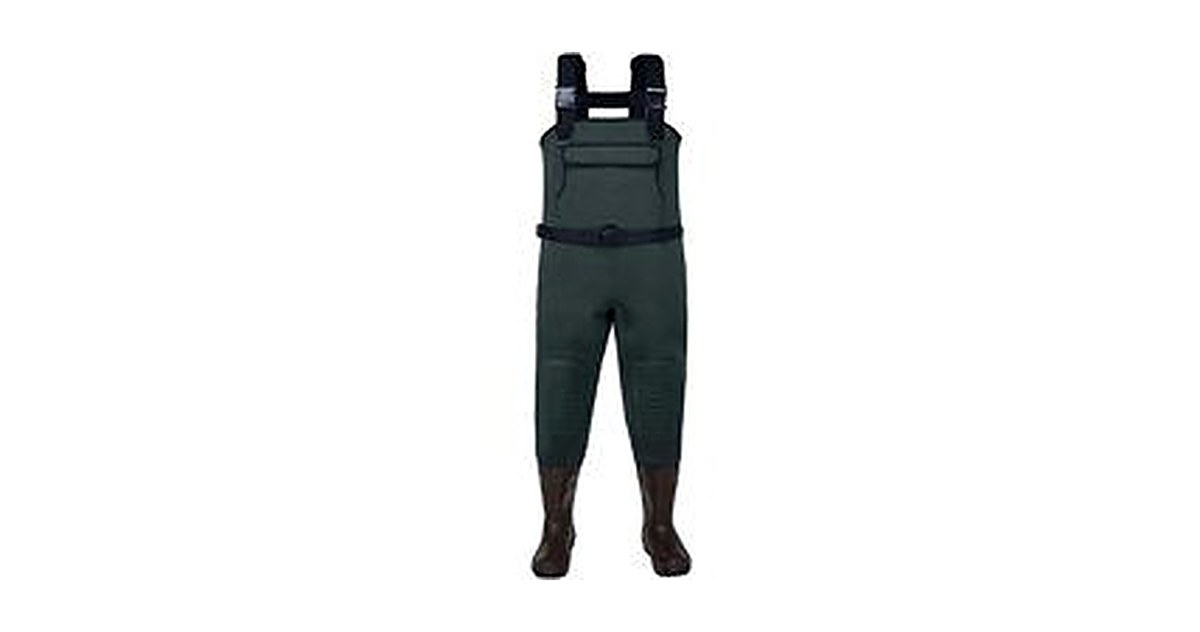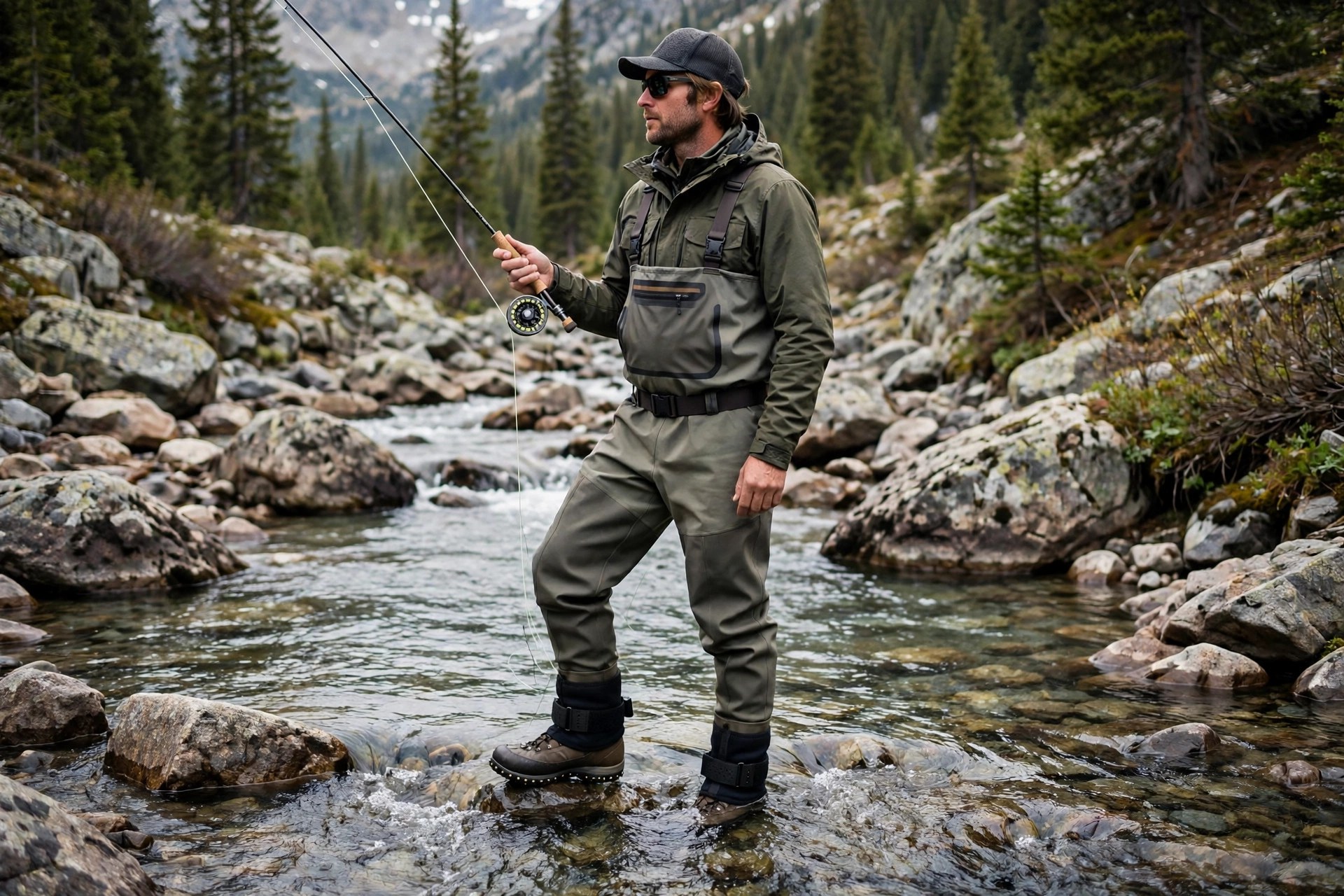
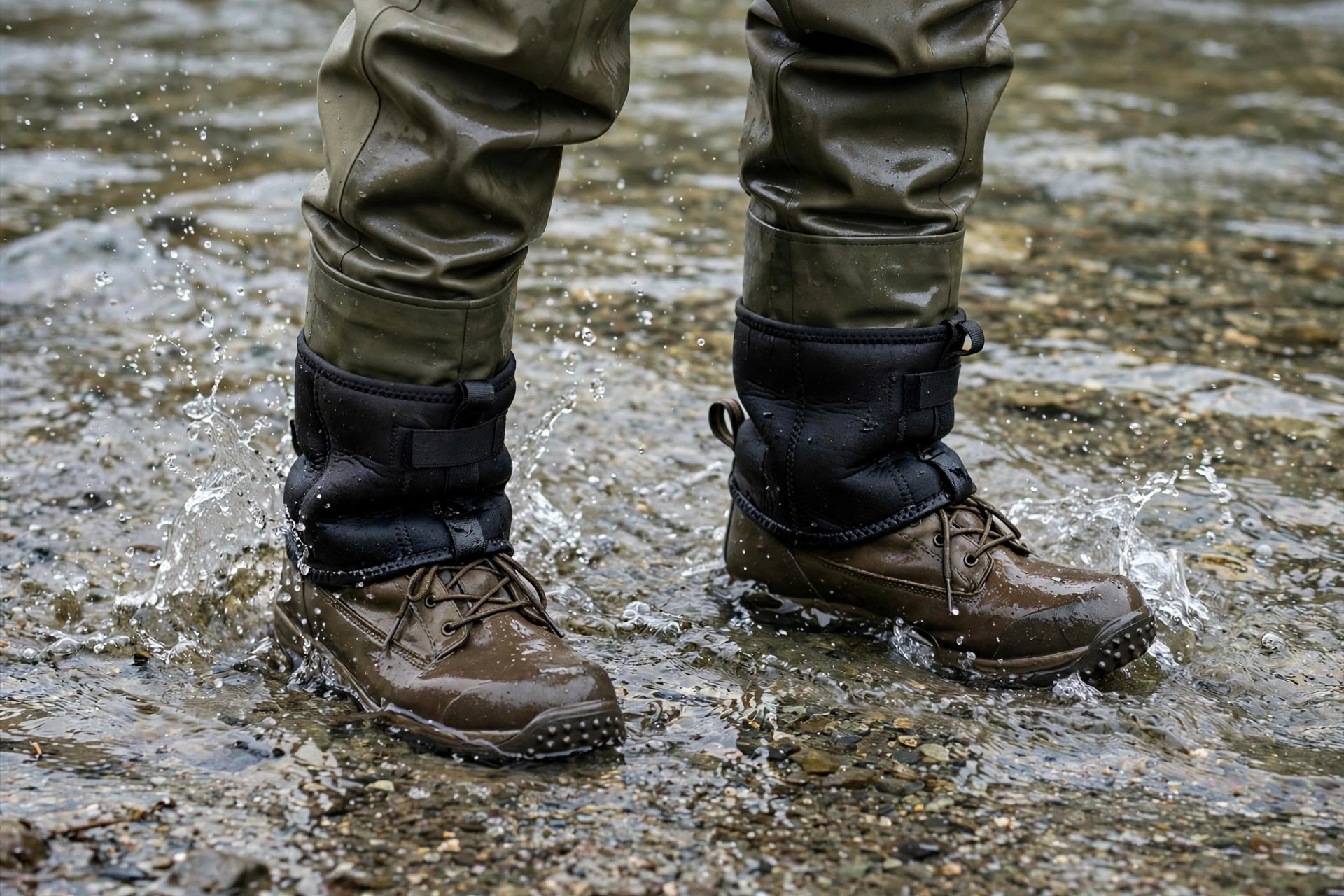
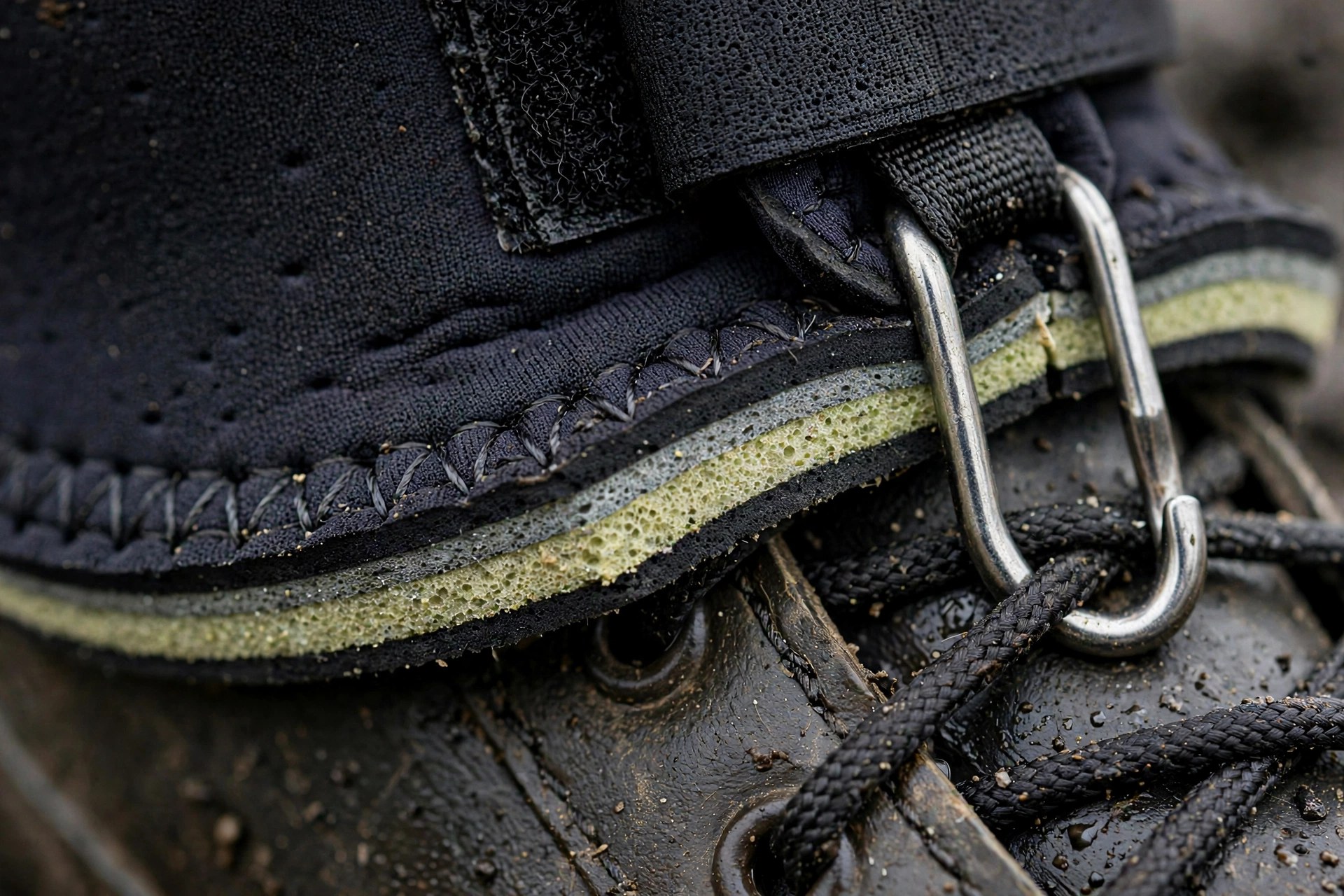
A neoprene gravel guard is a wrap-around sleeve of laminated neoprene (SBR, SCR or CR foam + fabric), usually 5 mm thick, that seals the top of a wading boot. It wraps over the join between the wader bootie and the boot, a hook-and-loop strap pulls the seal tight, and a lace hook clips to the boot laces to hold it down. Sand and gravel stay out of the boot, and the neoprene bootie of a stockingfoot wader is protected from the grit that grinds through it. Guards are a standard part of a fly fishing wading range, sold in pairs and sized to the boot. Send us your design drawing and boot sizes, and we will confirm the best material and thickness.
We manufacture custom neoprene gravel guards in our own factory in China, where we have made neoprene products for 15 years. We cut the foam, laminate the fabric face and stitch the finished guards under one roof, so a change to the size run, the strap or the print can be checked on a sample before bulk production starts.
The damage a gravel guard prevents is slow and mostly invisible. Every step in a river pushes water — and whatever the water carries — at the top of the boot. Sand and fine gravel work down past the boot collar, settle around the ankle and then grind, step after step, against the neoprene bootie of a stockingfoot wader. A season of that grinding thins the bootie until it leaks, and the angler blames the waders. The guard closes the gap the grit comes through: it is the small, cheap part of the system that decides how long the most expensive part lasts. That is why it belongs in the same range conversation as the neoprene fishing waders it is worn with.
Neoprene earns its place here over a plain fabric gaiter for three reasons. The foam stretches, so the guard seals against the boot instead of hanging over it; the seal holds under water pressure while the angler kneels and climbs, where loose cloth gaps open; and the guard keeps its shape and grip size after size and season after season. The strap side is also a print and patch surface, so the guard carries the brand at the one point of the outfit that sits above the boot in every photograph.
Sizing is the detail that decides whether a guard seals. A guard is cut to the boot: too small and it will not close over a thick bootie and boot collar; too large and the seal wrinkles, and a wrinkled seal is a channel for grit. We cut to the size run you sell — send the boot sizes or your size chart — and check the fit over a real boot and bootie before bulk production.
5 mm is the standard for most neoprene gravel guards. It gives a firm seal at the boot top and stands up to a season of grit while the guard still stretches on and off easily, which is why most of the guards we make are cut in 5 mm. For the full range, see our neoprene sheet thickness guide.
| Thickness | Best for | Trade-off |
|---|---|---|
| 3 mm | Warm-water and summer wading, wet-wading boots | Least resistance to heavy grit over a long season |
| 5 mm | Most guards — stockingfoot waders and everyday river use | Best balance of seal, durability and easy fitting |
| 7 mm | Cold rivers, rocky beds and professional guides | Thickest and stiffest over the boot; costs more than 5 mm |
Measure the boot dressed, not bare. Take the circumference over the wader bootie and the boot collar together, at the height where the guard will sit, and tell us the boot sizes the run must cover. Our standard runs follow common wading boot sizes, and we cut to a brand's own size chart on request.
CR and SCR are the standard choices for most gravel guard ranges, and SBR is the choice for value lines. CR (chloroprene rubber) is softer and more elastic, so the guard stretches over the boot, seals closely and springs back after being pulled on and off every day of a season. SBR (styrene-butadiene rubber) is firmer and lighter and holds the guard's shape at the lowest cost. SCR sits between the two on cost and stretch, and it is what most wading ranges choose.
The numbers show why the two foams feel different: our CR foam measures 3–5° Shore C hardness, 276.32 kg/m³ density, 860 kPa tensile strength and 550% elongation, while our SBR foam measures 10–15° Shore C, 158.34 kg/m³, 256 kPa and 185%. CR is the softer, springier foam; SBR is the firmer, lighter one. On a boot, that means a CR guard hugs the collar and seals, while an SBR guard keeps a crisper shape at a lower price.
| SBR | CR | |
|---|---|---|
| Cost | Lower cost; the usual choice for value lines | Costs more than SBR |
| Seal on the boot | Firm sleeve that keeps its shape | Soft and elastic; stretches over the collar and seals closely |
| Repeated on-off use | Good; holds up through a season of daily use | Better; springs back after repeated stretching over the boot |
For sizes, colours and ordering, see our custom neoprene gravel guards product page.
Fly fishing brands — guards in your colours across your boot size run, sold with the wading range or bundled with waders.
Wader and boot brands — guards cut to your boot profiles, carrying your logo at the top of your own boots.
Tackle shops and fishing distributors — plain and printed pairs for the counter, in junior to senior boot sizes.
Fishing lodges and guide services — durable guards for client wading kits, replaced as a consumable, not a repair.
When neoprene is NOT the right choice
Tell us which of these your gravel guards need, and we will build the sample to your drawing.
How does a gravel guard fit?
The guard wraps over the wader bootie and the top of the wading boot, the hook-and-loop strap pulls the seal tight, and a lace hook clips to the boot laces so it cannot ride up while wading.
Will the guards fit our boot sizes?
Yes — guards are cut in a size run that follows standard wading boot sizes, or made to your size chart. Send the boot sizes you sell and we match the run.
Do gravel guards make waders waterproof?
No. A guard keeps sand and gravel out of the boot and protects the bootie from grinding wear — the waders' own seams and material provide the waterproofing.
What is the minimum order?
200 pieces per design as a general minimum, adjustable to your actual order.
Can I get a sample first?
Yes — we support sampling, usually in 5–7 days. Send us your design drawing and the boot sizes you need.
How long does bulk production take?
Usually 15–18 days after sample approval, depending on the quantity and customisation.
We make custom neoprene gravel guards to your boot size run, your colours and your print, and we check the fit over a real boot and bootie before bulk production — the same factory that makes our custom waders, so a bundled wader-and-guard order is made under one roof. The general minimum order is 200 pieces per design, adjustable to your actual order; sampling is supported, usually in 5–7 days, and bulk production usually takes 15–18 days after sample approval.
Request a Quotation
To help us review your inquiry, please send:
Website: https://www.neoprenecustom.com/ Email: kevin@neoprenecustom.com
A gravel guard is judged at the end of the season, by the bootie it kept whole. Send us your boot sizes and we will make you a sample pair to try on real boots.
Contact: Kevin
Phone: 13417385320
Tel: 0734-87965514
Email: kevin@neoprenecustom.com
Add: Intersection of Zhangjialing Road and Science and Technology Road, Guiyang Industrial Park, Guiyang Town, Qidong County, Hengyang City, Hunan Province./Dongguan Factory(GUANXIN): Shixin Street, Fushan Village, Liaobu Town, Dongguan, Guangdong Province.