
Custom Neoprene Golf Headcovers: How to Choose Driver, Fairway and Putter Covers
A good neoprene golf headcover is a 3 mm neoprene cover that fits your club head snugly, covers the shaft, and stops clubs clanking. It protects a 460cc driver, a fairway wood, a hybrid or a putter from dings and rain, and costs a fraction of a leather cover. We make it to order in any size, colour and logo.
What Is a Neoprene Golf Headcover — and Why Golf Brands Choose It
A neoprene golf headcover is a soft sleeve made from closed-cell chloroprene rubber foam, laminated with fabric on one or both faces. It slides over the club head and part of the shaft. The foam is full of tiny sealed gas bubbles. When two clubs knock together in the bag, the bubbles compress and absorb the hit, so the club face does not get a dent or a scratch. A hard plastic cover protects too, but it is bulky and noisy. A leather cover looks good, but it costs several times more and soaks up rain. Neoprene is light, quiet, and cheap to make in any colour.
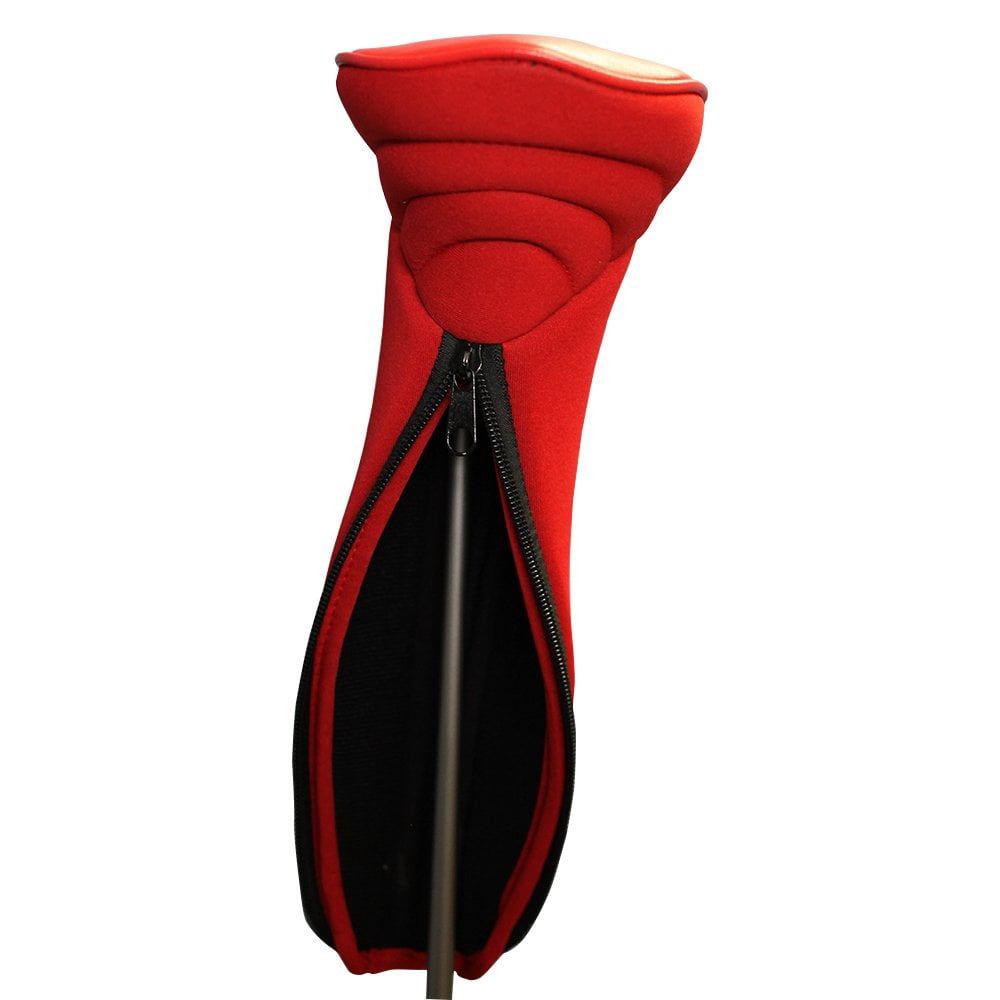
A red zippered neoprene cover on a wood — the smooth matte neoprene stretches over the head and the zip keeps it in place.
The material is the same CR neoprene foam sheet we use across our wetsuits and sports supports — see our ultimate guide to neoprene sheets for how the foam is made. Bulk buyers are golf brands, pro shops, resorts and corporate gift buyers. A printed cover turns a basic accessory into a branded product, and one set covers a whole bag.
Driver, Fairway, Hybrid, Putter: Size and Fit by Club
Order by club, not by "one size fits all." A driver head is the biggest club in the bag. The Rules of Golf cap driver head volume at 460 cm³ (Golf club, Wikipedia), so a driver cover must fit a full-size 460cc head with room to spare. A fairway wood head is smaller — a 3-wood is about 170–200cc. A hybrid is smaller still, close to an iron in size. A putter is a different shape altogether: a blade putter is flat and narrow, a mallet putter is wide and round. One cover cannot fit all four.
| Club | Head size | Cover to order | Check before ordering |
|---|---|---|---|
| Driver (1) | Up to 460cc | Driver cover, long neck | Fits 460cc heads, not just "oversized" |
| Fairway wood (3, 5, 7) | About 170–200cc | Fairway cover | Number tag 3 / 5 / 7 |
| Hybrid / rescue (3, 4, 5, X) | Smaller than fairway | Hybrid cover | Shorter neck than a fairway cover |
| Putter — blade | Flat, narrow | Blade putter cover | Slim profile, magnetic or velcro closure |
| Putter — mallet | Wide, round | Mallet putter cover | Wide pocket — check the shape first |
Number tags are 1 for the driver, 3 / 5 / 7 for fairway woods, and 3 / 4 / 5 or X for hybrids. Interchangeable tags let one cover serve different clubs. Measure the head before you order: length, width and height in mm. A cover that is 10 mm too short will not close. A cover that is 20 mm too long slides off in the bag. Tell your supplier the club model, not just "driver" — a 460cc driver and a 400cc driver need different covers.
How Thick Should the Neoprene Be?
3 mm is the standard. Most factory listings for neoprene golf headcovers specify 3 mm. That thickness is a balance: thick enough to absorb a knock between clubs, thin enough to slide on and off with one hand. Below 2 mm, the cover is a dust sleeve — it stops scratches but does almost nothing for a drop or a hard knock. Above 5 mm, the cover gets bulky, hard to pull on, and takes up room in the bag.
Our factory splits foam from 1.5 mm to 45 mm, so any thickness is possible — but for headcovers we use a soft SBR grade. Our SBR 5–7° foam is our soft grade for sewn accessories: tensile strength 247 kPa and elongation 199% on its technical data sheet. That stretch is what lets the cover hug the head instead of gaping open. See our neoprene sheet thickness guide for how to pick the right mm for any product.
Thickness is only half the story. The foam must be closed-cell. Open-cell foam is softer and cheaper, but it absorbs water and stays damp, and it tears more easily. Ask your supplier which foam they use — and ask for the data sheet, not just a claim.
Lining, Closure and Number Tags
Check the inside before you check the outside. The lining touches the club face, so it must be soft — plush, fleece or smooth nylon. A rough lining scratches a painted club face or a graphite shaft over a season. A soft lining also stops the cover sliding off the head.
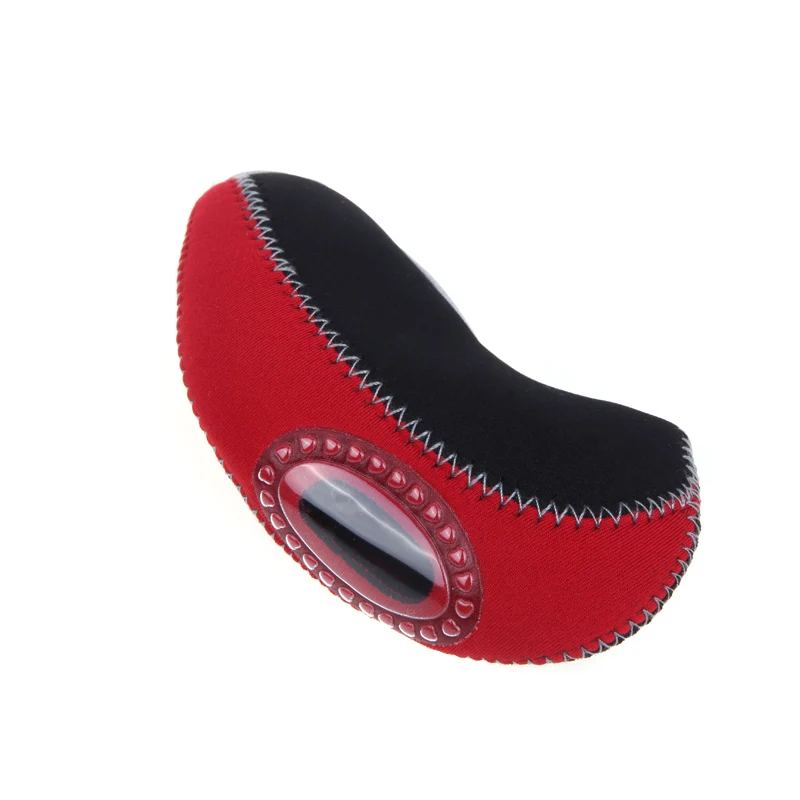
A red and black neoprene putter cover — the clear window shows the club number without taking the cover off.
Closure comes in two kinds. A zipper cover opens wide and fits any head shape, and it stays shut in transit. A slip-on cover is faster on the course, but it must fit snugly or it falls off in the bag. A long neck covers the shaft where it meets the bag divider — that is where most bag chatter happens, so the neck matters as much as the head pocket. Some covers add an embossed texture for grip — our embossed neoprene sheets use the same shark-skin texture.
Identification is the small detail that saves time on the course. Number tags (1, 3, 5, 7, X) or a clear window let you find the right club without pulling every cover off. Interchangeable tags are the flexible option: one cover, any club. A cover with no tag and no window looks clean, but you will pull the wrong club out of the bag at least once a round.
Printing and Custom Colours
Print on the fabric face, not on the foam. Neoprene headcovers take full-colour sublimation printing on the fabric face — logos, patterns, even photos. Embroidery works for a small logo or a number. If the cover must match a brand colour, ask for Pantone matching — our colour matching and printing guide explains how we match Pantone colours and print full-colour designs. A blank patch stitched near the top is the usual spot for a logo.
Keep the print away from the zipper and the seams, or it cracks when the cover stretches. And check the print after the first wash — a good sublimation print stays bright, a cheap print fades after one season. Ask your supplier for the minimum order per design and per colour before you commit, because a 3-colour set costs more to set up than a single-colour run.
Rain, Cleaning and Care
Water-resistant, not waterproof. Closed-cell neoprene sheds rain — our waterproof vs water-resistant guide explains the difference: the foam blocks water, but the zipper and the seams let water in. In light rain the club stays dry enough for the round. In heavy rain, take the covers off at the end of the round and let them dry — a cover left zipped shut on a wet club traps damp against the club face.
Cleaning is simple: rinse with clean water, a little mild soap, then air dry away from sun and heat. Never machine-dry a neoprene cover — heat warps the foam and shrinks the fabric face. A cover that smells after a wet season usually has a lining that never dried out. Store covers open, not zipped shut, and they last for years.
Learn more about our OEM production capabilities on our official website: https://source.neoprenecustom.com
Ready to design custom golf headcovers? Contact our team directly: kevin@neoprenecustom.com
Frequently Asked Questions (FAQ)
Q: What size headcover fits a 460cc driver?
A: A driver cover listed for 460cc heads. The Rules of Golf cap driver head volume at 460 cm³, so ask your supplier to confirm the cover fits a full-size 460cc driver, not a smaller fairway head.
Q: How thick should a golf headcover be?
A: 3 mm is the standard. Below 2 mm it stops scratches but not dings; above 5 mm it gets bulky and hard to pull on. Most factory listings specify 3 mm.
Q: Will a fairway cover fit a hybrid?
A: No. A hybrid head is smaller than a fairway wood, so a fairway cover is loose and slides off. Order a hybrid cover with the right number tag (3, 4, 5 or X).
Q: Is a neoprene headcover waterproof?
A: No — it is water-resistant. Closed-cell neoprene sheds rain, but the zipper and seams let water in. For a full day in heavy rain, the club stays dry enough to play, but dry the covers after the round.
Q: How do I order custom headcovers with my logo?
A: Send your club models, Pantone colours and logo file to kevin@neoprenecustom.com for a quotation. We print the full-colour design on the fabric face of the cover.