
Custom Neoprene Diving Boots: How to Choose Thickness, Sole and Fit
A neoprene diving boot is a 3–7 mm closed-cell neoprene boot with a vulcanised rubber sole, a fin-strap heel ridge and a fit that keeps water out. Choose 3 mm for water above 24 °C, 5 mm for 15–24 °C, and 7 mm for water below 15 °C. We make it to order in any size, thickness and colour.
What Is a Neoprene Diving Boot — and Why Divers Wear One
A neoprene diving boot is a soft boot made from closed-cell chloroprene rubber foam, laminated with fabric on one or both faces, with a rubber sole glued and stitched to the bottom. It does three jobs at once. It keeps the foot warm in cold water. It protects the sole of the foot on rocks, coral and hot boat decks. And it fills an open-heel fin, so the fin strap has something firm to hold.
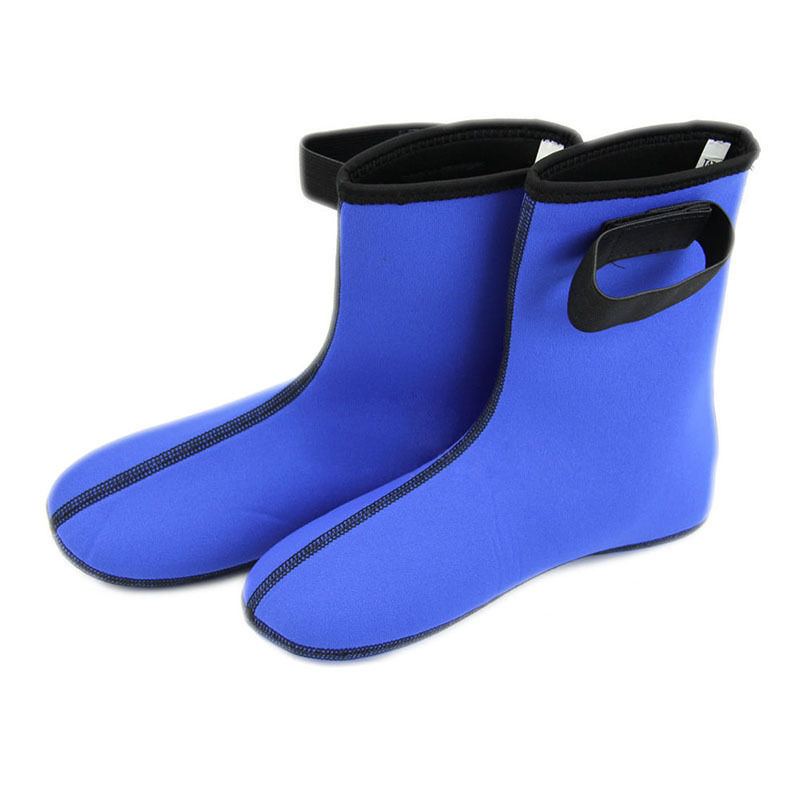
A pair of bright blue neoprene diving boots — smooth matte blue uppers with black trim and heel pull loops.
The foam is full of tiny sealed gas bubbles. Those bubbles trap a thin layer of water against the skin, and the body warms that layer — the same way a wetsuit works. The material is the same CR neoprene foam sheet we use across our wetsuits and sports supports — see our ultimate guide to neoprene sheets for how the foam is made, and our neoprene wetsuit range for the suit the boots are made to match.
Bulk buyers are dive brands, dive shops, resorts and dive schools. A printed boot turns a basic accessory into a branded product, and one size range covers a whole dive class.
How Thick Should the Boot Be? Match Thickness to Water Temperature
Pick the thickness by the water, not by the price. Dive brands list the same three thicknesses — 3 mm, 5 mm and 7 mm — and the choice is the water temperature where the boot will be used. Thicker foam holds more warm water against the foot, but it also makes the boot stiffer and harder to fit inside a fin:
| Water Temperature | Boot Thickness | Best For | Trade-off |
|---|---|---|---|
| Above 24 °C | 3 mm | Tropical diving, snorkelling | Lightest, most flexible |
| 15–24 °C | 5 mm | Temperate diving, most dive sites | Best all-round balance |
| Below 15 °C | 7 mm | Cold-water diving, long dives | Warmest, stiffest, bulkiest |
Our factory splits foam from 1.5 mm to 45 mm, so any thickness is possible — but for diving boots we use a soft SBR grade. Our SBR 5–7° foam is our soft grade for sewn accessories: tensile strength 247 kPa and elongation 199% on its technical data sheet. That stretch is what lets the boot hug the foot instead of gaping open at the ankle. See our neoprene sheet thickness guide for how to pick the right mm for any product.
One honest note on standards: there is no EN standard written for diving boots alone. EN 14225-1:2017 covers wet suits and their thermal requirements, but its scope states that separate accessories such as gloves, hoods and boots are not covered (BS EN 14225-1:2017, BSI). So a boot's warmth is judged by its foam thickness and the maker's data sheet, not by a boot standard. Ask your supplier for the data sheet, not just a claim.
The Sole: Vulcanised Rubber, Tread and the Fin-Strap Heel
Check the sole before you check the upper. The sole is what stands between the foot and the reef. A good diving boot has a vulcanised rubber sole — rubber cured onto the neoprene so it cannot peel off — with a deep tread pattern that grips wet boat decks and slippery rocks. A thin printed sole looks the same in a photo, but it wears through in one season. Press the sole with a thumb: a vulcanised sole feels firm and springs back; a cheap glued sole feels soft and bends away from the upper at the edge.
Two sole details matter for divers. First, the toe and heel caps: reinforced rubber over the toe and heel stops the boot tearing where the fin rubs and where the foot pushes off rocks. Second, the fin-strap ridge: a raised ridge across the back of the heel that stops the fin strap sliding down. Without that ridge, the fin works loose on every kick. Ask your supplier whether the sole is vulcanised or glued, and whether the heel has a fin-strap ridge — those two answers tell you more than the price does.
Zipper or Pull-On? How the Closure Changes the Fit
Zipper for easy on and off, pull-on for fewer leaks. A side zipper opens the boot wide, so a diver with a wide foot or a thick sock gets in fast — and gets out fast on a rocking boat. The trade-off is water: a zipper is a seam, and water seeps through it, so a zippered boot is a little colder than a pull-on boot of the same thickness. A pull-on boot has no zipper at all — the neoprene stretches over the foot and seals at the ankle. It is warmer and simpler, but it needs a strong pull loop at the heel and a foot that fits the opening.
Most dive shops stock the zipper version, because customers try boots on in the shop and a zipper makes that easy. Most dive schools order the pull-on version for rental fleets, because there is no zipper to break. A heavy-duty zipper with an inner gusset — a flap of neoprene behind the teeth — cuts the water entry right down. If you order zippers, ask for a #10 zipper with an inner gusset, and check the pull tab is big enough to grip with cold fingers.
How Should a Diving Boot Fit?
Snug, not tight — and try it with the fin on. A diving boot should fit like a sock, not like a shoe. The toes should reach the end without curling, the heel should sit in the heel cup without lifting, and the ankle should seal without a gap. A boot that is one size too big lets water slosh in and out, and the foot slides inside the fin. A boot that is one size too small cuts off circulation, and the foot goes numb in 20 minutes.
Three fit checks before you order. First, measure the foot in a neoprene sock if the diver wears one — a 3 mm sock adds a full size. Second, try the boot inside the fin it will be used with: a 7 mm boot needs a bigger fin pocket than a 3 mm boot, and a boot that fits the foot but not the fin is useless. Third, check the calf: a high boot with a narrow opening will not fit a wide calf, so order a wider cuff or a shorter boot. Tell your supplier the foot length in mm, the sock thickness, and the fin model — the boot is cut to fit all three.
How to Clean and Dry Neoprene Boots
Rinse, soap, air dry — no heat. Rinse the boots in fresh water after every dive to wash off salt, then hand wash in cool water with mild soap. Turn them inside out if the zipper allows it, to clean the lining. Rinse again and stand them up to air dry, toes down so water drains out. Do not machine wash and do not tumble dry: heat damages the foam and shrinks the fabric face. Do not leave them in direct sun for days — UV ages neoprene faster than anything else. Our waterproof vs water-resistant guide explains why closed-cell foam stays dry inside while the fabric face gets wet.
A neoprene boot dries faster than a leather boot because the foam holds no water — only the fabric face gets wet. In normal indoor air, a rinsed boot is dry enough to wear again in about 4 hours. Stuffing newspaper inside speeds it up, but never use a hair dryer or a radiator — the heat warps the sole and cracks the rubber.
Your Trusted Custom Neoprene Diving Boot Manufacturer
Stop buying plain boots that leak at the zipper, peel at the sole, or fall apart after one season. We are a specialized custom neoprene factory making diving boots, wetsuits, and dive accessories for brands worldwide.
When you partner with our factory for custom OEM boots, you get 3 mm, 5 mm or 7 mm closed-cell neoprene, vulcanised rubber soles with fin-strap heel ridges, zipper or pull-on closures, Pantone-matched colours, and full-colour print. See our colour matching and printing guide for how we hit Pantone colours on neoprene.
Do you want to launch a branded line of neoprene diving boots? We accept custom OEM orders with full branding options, tailored sizes, and low minimum order quantities.
- True 3–7 mm closed-cell neoprene, warm and flexible in cold water.
- Vulcanised rubber soles with deep tread and fin-strap heel ridges.
- Low Minimum Order Quantities (MOQ) for custom brand runs.
Learn more about our OEM production capabilities on our official website: https://source.neoprenecustom.com
Ready to design a custom diving boot? Contact our team directly: kevin@neoprenecustom.com
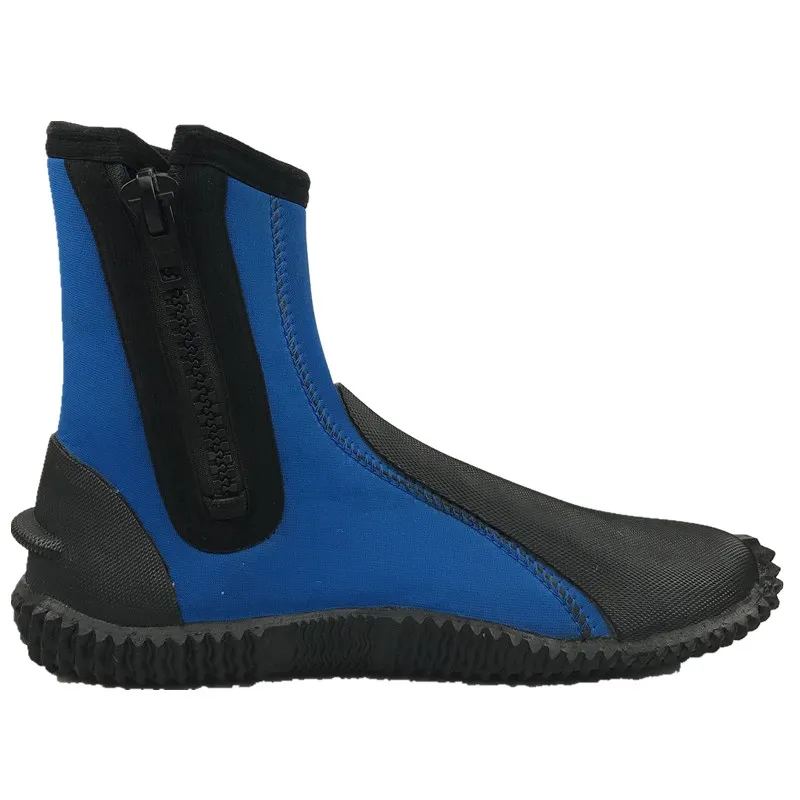
A blue neoprene diving boot with a side zipper — the black reinforced toe and rugged sole grip wet boat decks.
Frequently Asked Questions (FAQ)
Q: What thickness diving boot do I need?
A: 3 mm for water above 24 °C, 5 mm for 15–24 °C, and 7 mm for water below 15 °C. Most divers buy 5 mm — it covers the widest range of dive sites, from 15 °C to 24 °C.
Q: Do diving boots go inside fins?
A: Yes — open-heel fins are worn over diving boots. The boot fills the fin pocket and the fin strap sits on the heel ridge. A 7 mm boot needs a bigger fin pocket than a 3 mm boot, so try the boot and fin together before you order.
Q: Zipper or pull-on — which is warmer?
A: Pull-on is warmer, because a zipper is a seam and water seeps through it. A zippered boot with a #10 zipper and an inner gusset cuts the leak right down, and it is much easier to get on and off with cold hands.
Q: Are neoprene diving boots waterproof?
A: No — they are water-resistant. The closed-cell foam does not absorb water, but the zipper and seams let water in. A stitched boot cannot claim a waterproof rating; it keeps the foot warm by trapping a thin layer of water, not by staying dry.
Q: How do I order custom diving boots with my logo?
A: Send your sizes, thickness, Pantone colours, and logo file to kevin@neoprenecustom.com for a quotation. We print the full-colour design on the fabric face of the boot.