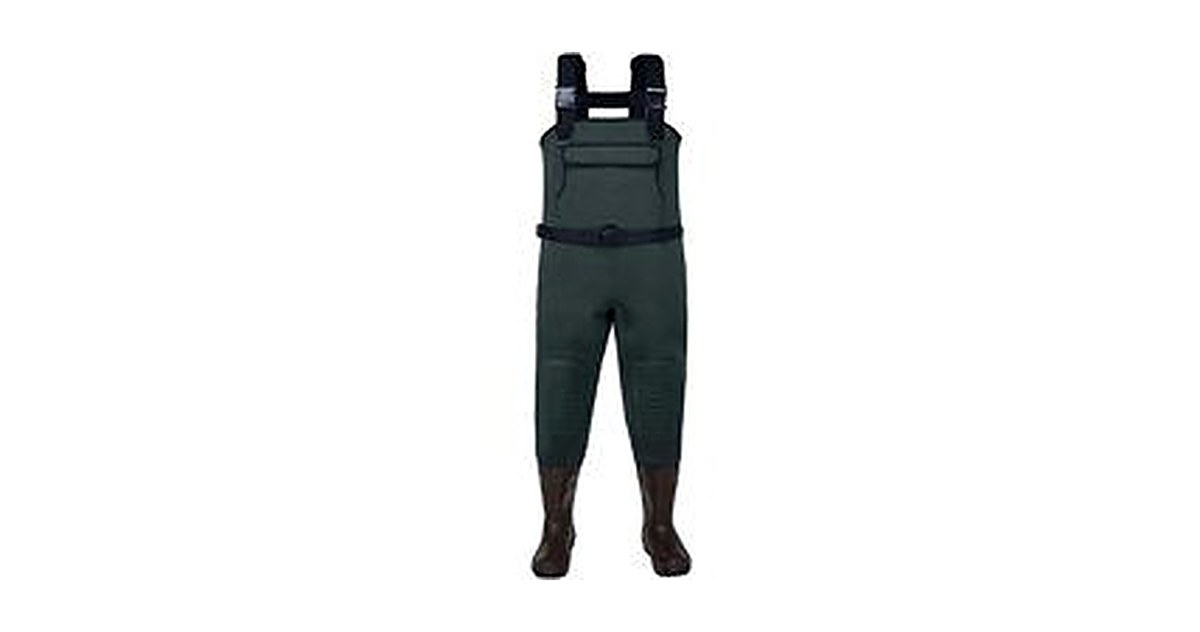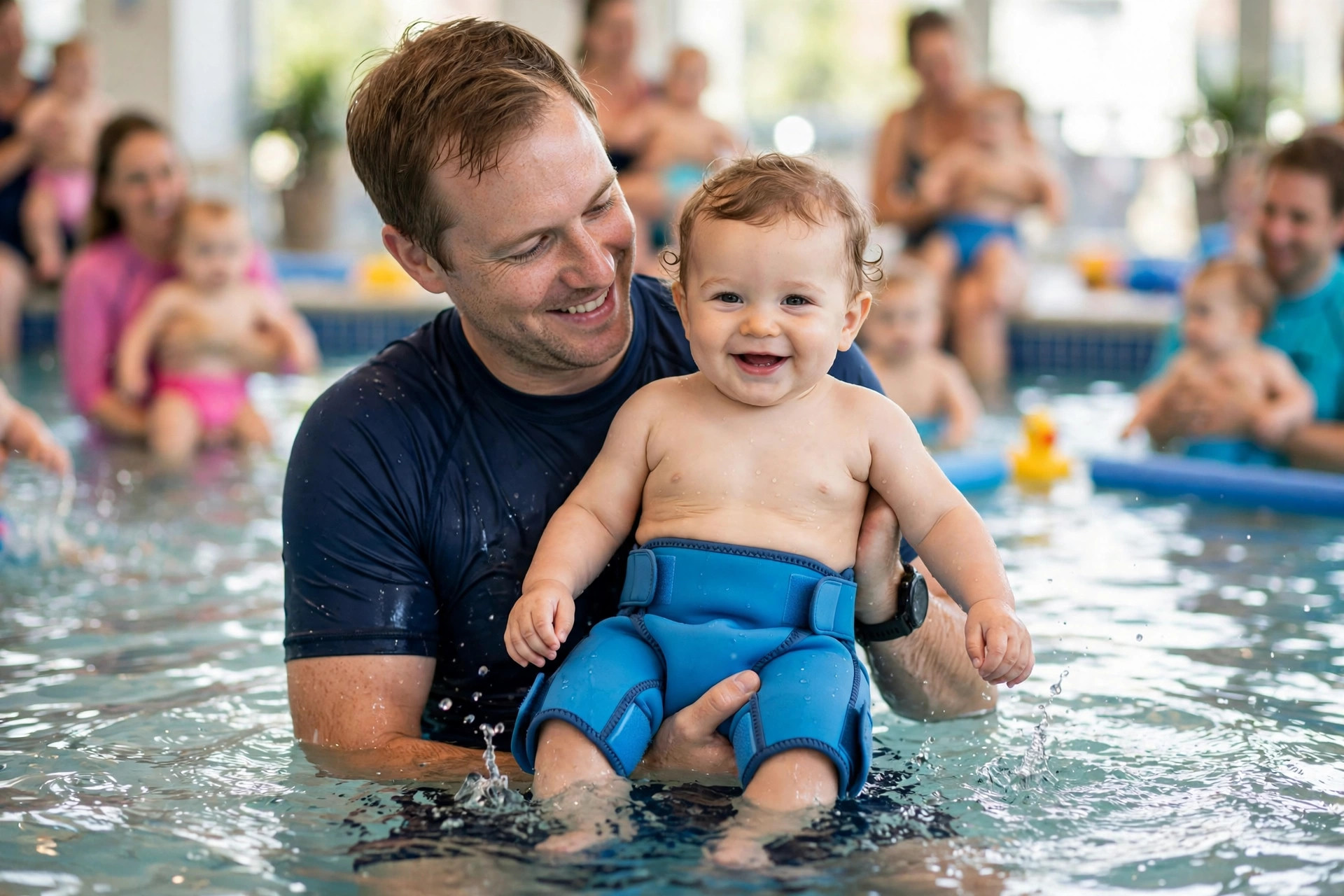
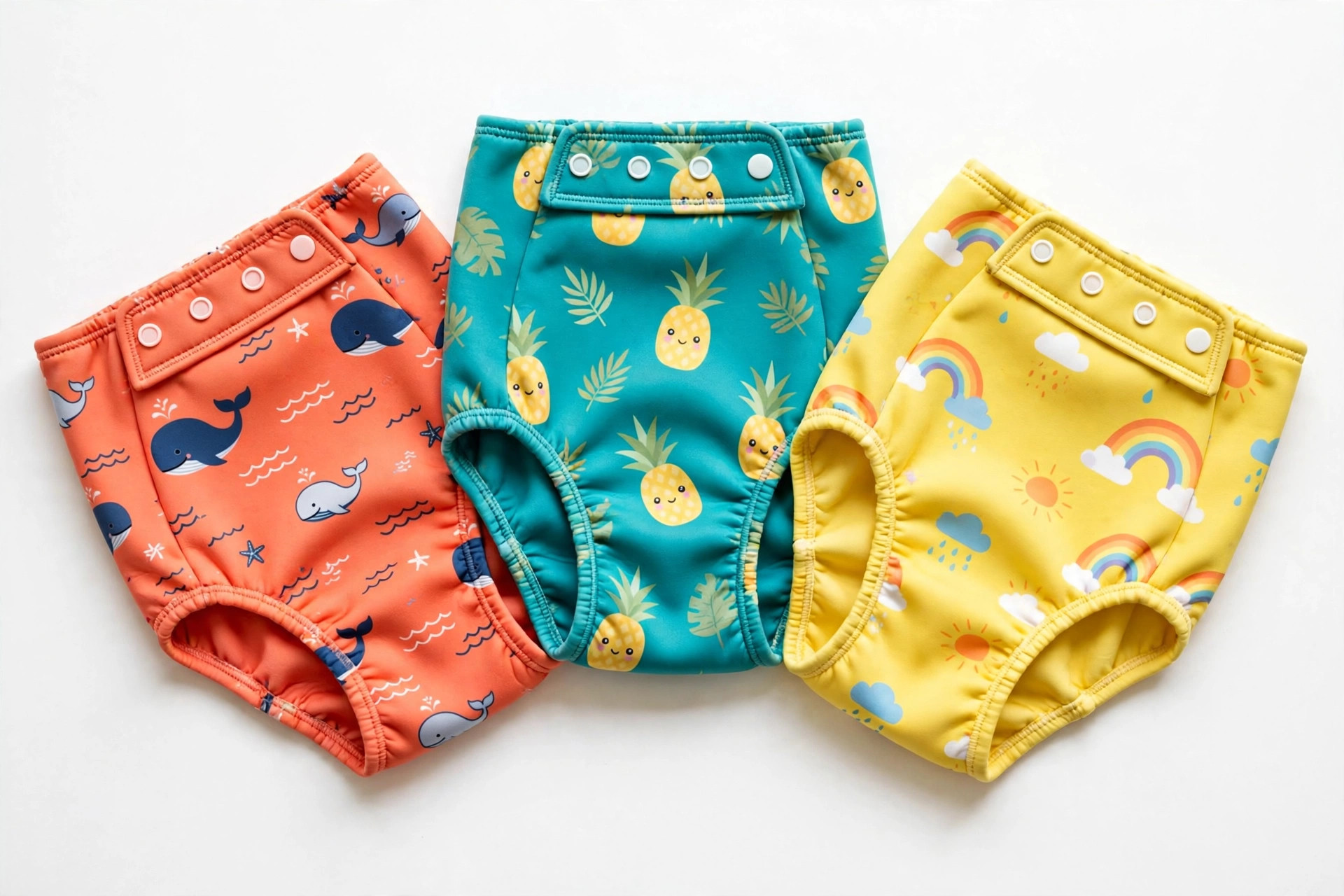
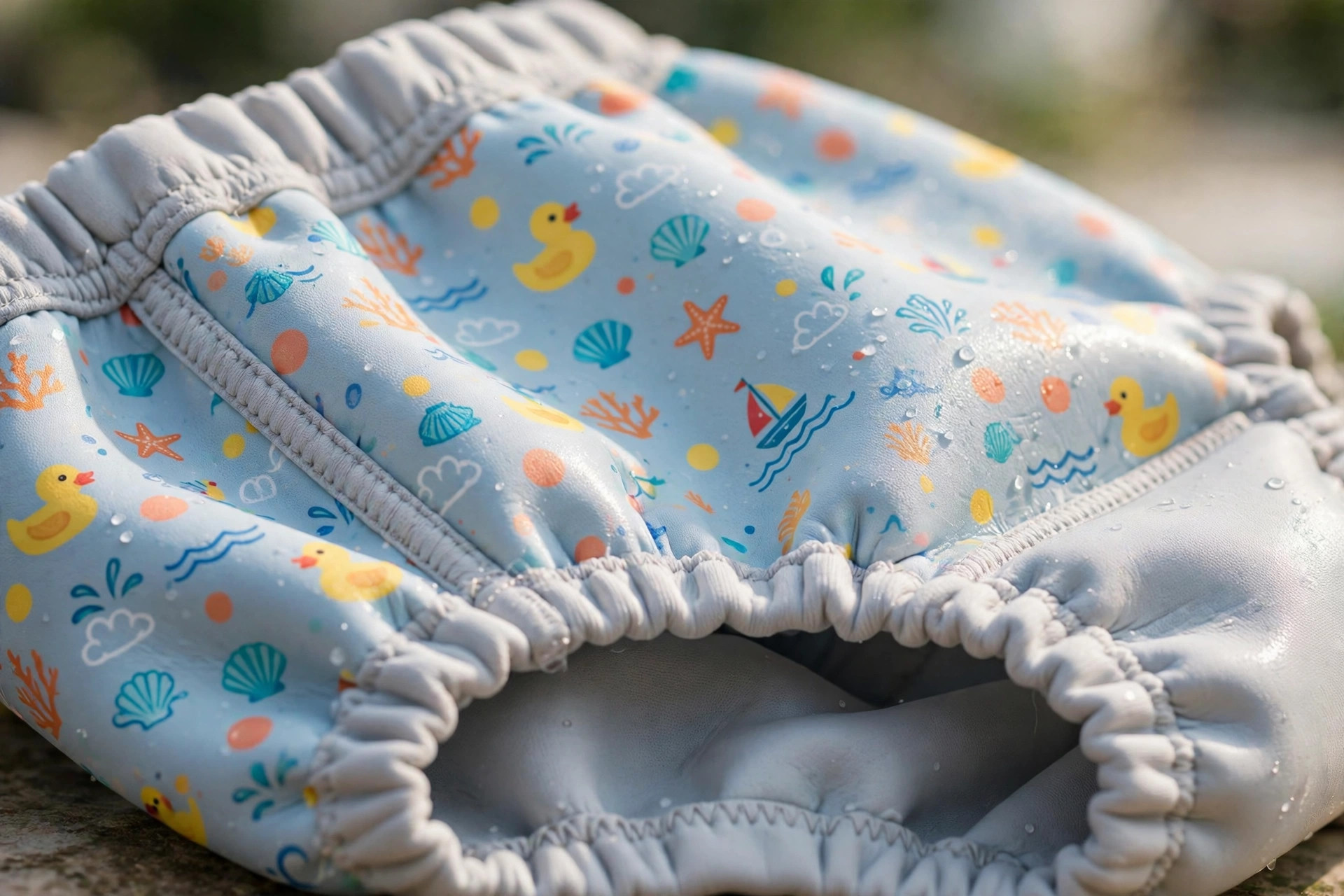
A neoprene swim nappy is a reusable baby swim brief made from laminated neoprene (SBR, SCR or CR foam + fabric), usually 3 mm thick, worn in the pool instead of — or over — a disposable swim diaper. It is cut snug at the waist and legs, so solid messes stay inside the nappy rather than leaking into the water, which is why so many pools and swim schools require babies to wear one. The foam layer also keeps the baby warmer than a thin swimsuit while it is in the water. Send us your design drawing and size chart, and we will confirm the best material and thickness.
We manufacture custom neoprene swim nappies in our own factory in China, where we have made neoprene products for 15 years. We foam, laminate, print, cut and stitch under one roof, so a change to the size grading, the elastic or the artwork can be checked on a sample before bulk production starts.
The containment job comes first. A normal nappy absorbs, a normal swimsuit is cut loose, and neither seals at a baby's waist and thighs — in a pool, that gap is exactly where a leak happens, and a leak closes the pool. A swim nappy is graded to close that gap: the waist and leg bands sit snug against the skin, so what the baby produces stays in the nappy until changing time. That is the whole reason pool rules name a swim nappy, rather than any swimwear, for babies who are not yet toilet-trained.
The second job is warmth. Babies lose heat in the water far faster than adults, and a baby swim lesson is short — twenty to thirty minutes is a full session. Neoprene is wetsuit material: the foam slows the loss of body heat, so the baby stays comfortable for the whole lesson instead of coming out cold and finished halfway through. It is the same reason older children wear neoprene wetsuits, applied to the smallest swimmers.
The third job is economic. A disposable swim diaper is bought, worn once and binned; a season of weekly lessons is a season of disposables. One neoprene nappy is rinsed after each session and used again, which is why swim schools retail them at the desk and why brands print them to match a swimwear line — the nappy becomes part of the range, not a consumable. The foam behind most of them is SBR, the same foam used across baby products; for more on why, see our notes on SBR neoprene for baby products.
3 mm is the standard for most neoprene swim nappies. It is warm enough for a heated indoor pool, flexible enough to pull on and off over a liner, and light enough that the nappy still seals at the legs on a small baby — which is why most of the swim nappies we make are cut in 3 mm. For the full range, see our neoprene sheet thickness guide.
| Thickness | Best for | Trade-off |
|---|---|---|
| 2 mm | Warm indoor pools and summer lessons — the lightest, most flexible fit | Least warmth; chosen where the water is warm and the session is short |
| 3 mm | Everyday lessons in heated pools, newborn to toddler — the standard cut | Best balance of warmth, flexibility and easy changing |
| 5 mm | Cooler water — unheated pools, outdoor lidos and the youngest babies | Warmest, but stiffer to pull on and off over a liner |
Size by weight, not by the age printed on the label. Swim nappies are graded by the baby's weight because the seal depends on the fit at the thigh: a nappy that gaps at the leg will leak whatever its thickness, and one that is too tight marks the skin and gets taken off early. Send us your size chart — or the age and weight range you sell to — and we grade the pattern to it, with the elastic set so the band seals without digging in.
SBR is the standard choice for swim nappies, because it holds a snug, printed fit at a cost that works for a garment a baby grows out of in months — it is the foam used across baby products such as bibs and changing mats. CR (chloroprene rubber) is the softer, more elastic foam, and it earns its higher cost on premium nappy lines and on ranges sold for cooler water, where its warmth and gentle stretch over a liner matter most. SCR, a blend of the two, sits between them where a brand wants more give than SBR at a lower cost than CR.
The figures behind the two foams show why they feel different: our SBR foam measures 10–15° Shore C hardness, 158.34 kg/m³ density, 256 kPa tensile strength and 185% elongation, while our CR foam measures 3–5° Shore C, 276.32 kg/m³, 860 kPa and 550%. SBR is the firmer, lighter foam; CR is the softer, springier one. On a baby, that means an SBR nappy keeps a crisp printed shape and a firm seal at the leg, while a CR nappy stretches on more easily and feels softer in the hand.
| SBR | CR | |
|---|---|---|
| Cost | Lower cost; the standard for baby swim ranges | Costs more than SBR |
| Warmth in the water | Good; suits heated indoor pools and short lessons | Better; the choice for cooler water and longer sessions |
| Feel | Firm and light, holds a snug printed fit | Soft and elastic, stretches on easily over a liner |
For sizes, prints and elastic options, see our custom neoprene swim nappies product page. For the children who have grown out of nappies, our neoprene kids wetsuits application page covers the same foams in full suits, 3–7 mm.
Baby swimwear brands — a nappy line printed to match your swimwear and graded from newborn to toddler, so parents come back for the next size up.
Swim schools — nappies in your school colours for the lesson desk; the pool rule that requires them means your customers have to buy one anyway.
Resorts and leisure centres — reusable nappies for baby swim sessions and hotel pools, sold at the pool shop with your branding on them.
Mother-and-baby retailers and importers — retail-packed nappies in mixed prints and sizes, ready for the shelf.
When neoprene is NOT the right choice
Tell us which of these your swim nappies need, and we will build the sample to your drawing.
Why do pools require babies to wear a swim nappy?
Because of the fit. A swim nappy seals snugly at the waist and legs, so solid messes stay inside it instead of leaking into the water; a normal nappy absorbs and sags, and a normal swimsuit is cut loose. Rules vary from pool to pool, but many require a swim nappy for any baby who is not yet toilet-trained.
Is a neoprene swim nappy worn on its own, or over a disposable?
Either. Many parents put a disposable liner underneath for an easier change, and some pools ask for both; the neoprene nappy is the reusable outer layer that provides the seal and the warmth, and it is the layer that stays in the swim bag from lesson to lesson.
Does a swim nappy absorb like a normal nappy?
No — deliberately not. A swim nappy's job in the water is to contain solids and keep the baby warmer, not to absorb; a nappy that soaked up pool water would go heavy, sag and lose its seal. Change the baby into a normal absorbent nappy after the session.
How do the sizes run?
By weight, from newborn to toddler. The fit has to be snug at the waist and thighs without marking the skin, because the seal — not the thickness — is what stops leaks. Send us your size chart and the sample is graded to it.
What is the minimum order?
200 pieces per design as a general minimum, adjustable to your actual order.
Can I get a sample first, and how long does production take?
Yes — we support sampling, usually in 5–7 days; send us your design drawing and size chart. Bulk production usually takes 15–18 days after sample approval, depending on the quantity and customisation.
We make custom neoprene swim nappies to your size chart, your prints and your colours, and we check the fit and the seal on a sample before bulk production. The general minimum order is 200 pieces per design, adjustable to your actual order; sampling is supported, usually in 5–7 days, and bulk production usually takes 15–18 days after sample approval.
Request a Quotation
To help us review your inquiry, please send:
Website: https://www.neoprenecustom.com/ Email: kevin@neoprenecustom.com
A swim nappy is judged in the water, not on the shelf. Send us your size chart and we will make you a sample to try at a real lesson. For the rest of the baby range in the same foams, see our neoprene baby bibs, and for toddlers who are swimming rather than being carried, our neoprene kids swim vests.
Contact: Kevin
Phone: 13417385320
Tel: 0734-87965514
Email: kevin@neoprenecustom.com
Add: Intersection of Zhangjialing Road and Science and Technology Road, Guiyang Industrial Park, Guiyang Town, Qidong County, Hengyang City, Hunan Province./Dongguan Factory(GUANXIN): Shixin Street, Fushan Village, Liaobu Town, Dongguan, Guangdong Province.