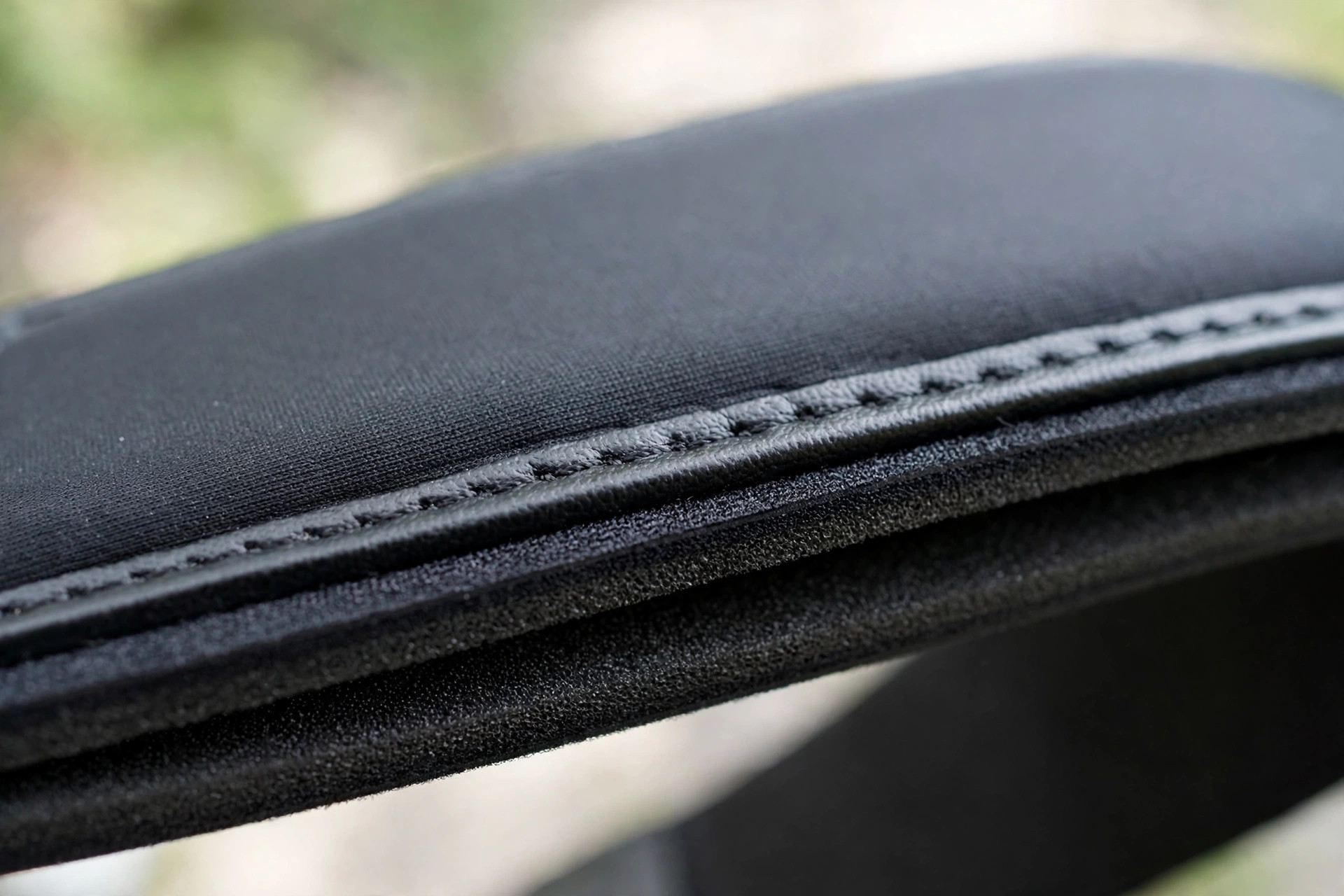
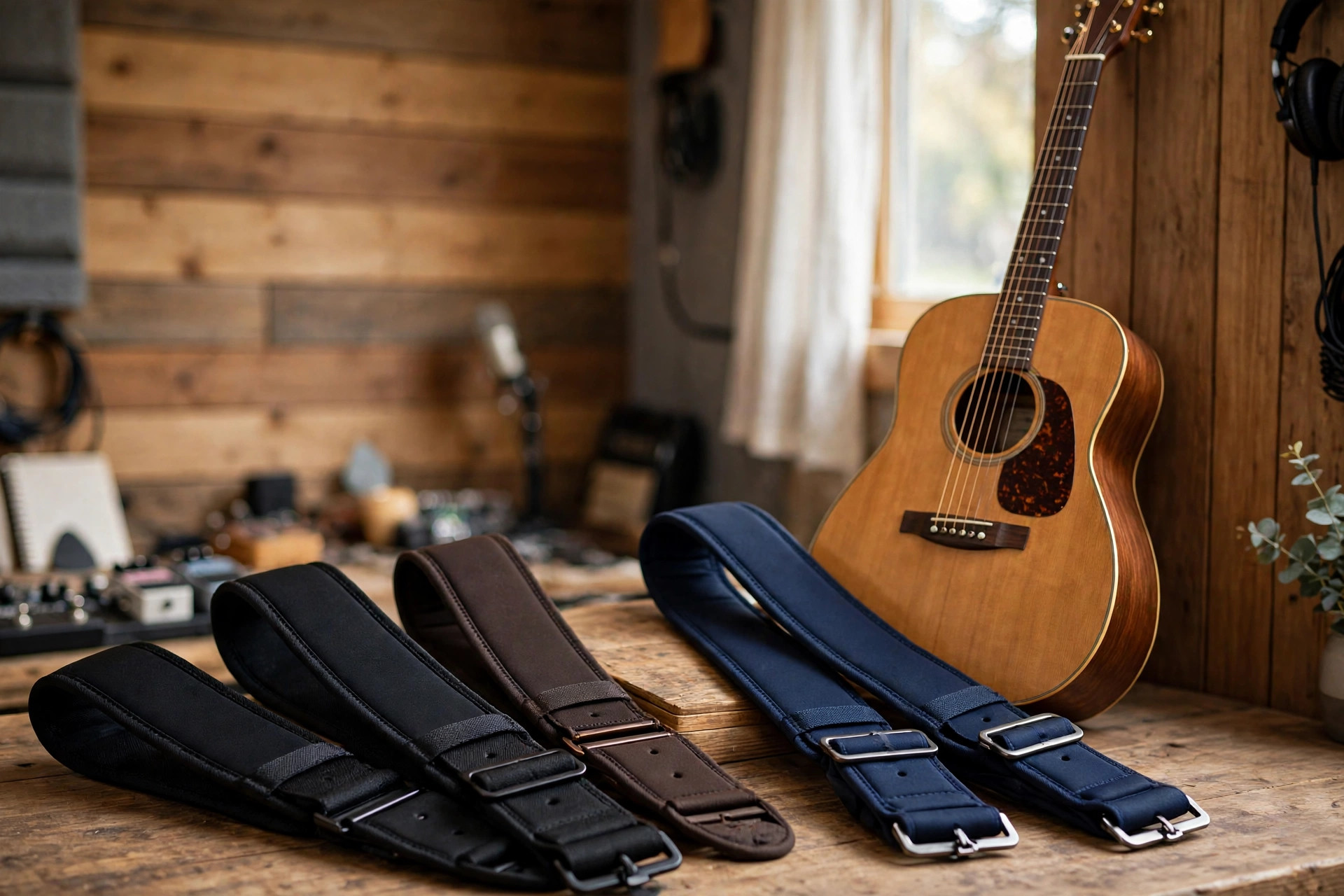
A neoprene guitar strap is a wide shoulder strap built around a core of laminated neoprene (SBR, SCR or CR foam + fabric), usually 5 mm thick, that carries an electric, acoustic or bass guitar on the player's shoulder. The foam spreads the weight of the instrument across a wide padded section instead of one narrow line, the fabric face carries a printed design, and the ends are reinforced where they meet the strap buttons. Send us your design drawing and strap dimensions, and we will confirm the best material and thickness.
We manufacture custom neoprene guitar straps in our own factory in China, where we have made neoprene products for 15 years. We cut the foam, laminate the fabric face and stitch the finished straps under one roof, so a change to the width, the ends or the print can be checked on a sample before bulk production starts.
A solid-body electric or a bass hangs on one shoulder for a rehearsal, a soundcheck and a two-hour set, and all of that weight arrives through the strap. A thin webbing strap puts it on a hard edge about as wide as a thumb, and by the third song the player's shoulder is doing the complaining. The foam pad spreads the same weight over a section 50 mm wide or more, and because the foam gives a little under load, there is no single pressure point digging in while the player is trying to concentrate on playing.
The underside of the strap works as well. It grips the player's clothing, so the guitar stays at the angle it was put at — which matters most on a headstock-heavy bass that wants to slide and dive every time a hand leaves the neck. And where a leather strap soaks up sweat, stiffens and eventually cracks, neoprene does not absorb it: the strap wipes clean after the gig and feels the same at the next one.
The strap is also the most visible accessory a musician wears, and the flat fabric face is a print surface. Sublimation puts artwork into the fabric itself, edge to edge and in full colour, so the same strap that carries the guitar can carry a band's artwork, an album design or a brand's pattern. That is why straps are sold as merch at the venue table as well as hung on the accessory wall of a music shop.
5 mm is the standard for most neoprene guitar straps. It puts real padding under a solid-body electric without making the strap bulky to roll into a gig bag, which is why most of the straps we make are cut in 5 mm. For the full range, see our neoprene sheet thickness guide.
| Thickness | Best for | Trade-off |
|---|---|---|
| 3 mm | Light straps for acoustic guitars, and printed fashion or merch straps where the artwork is the point | Least padding; a heavy electric still makes itself felt on a long set |
| 5 mm | Most electric guitars — the standard gigging strap | Best balance of padding, flexibility and price |
| 7 mm | Heavy basses and long sets, on the widest padded sections | Thickest and stiffest to roll up; costs more than 5 mm |
Measure the strap, not the catalogue. The two numbers that matter are the width of the padded section — 50 mm is the standard for guitar, 75–100 mm suits bass — and the adjustable length range, which should be set for the players the strap is sold to, because a strap played high on the chest and a strap played low at the hip are different lengths. The ends take standard strap-button holes unless your drawing asks for something else.
SBR is the standard choice for most guitar straps. A strap works indoors, on stage and in rehearsal rooms, and SBR (styrene-butadiene rubber) is the firmer, lighter, lower-cost foam that gives a flat, stable print base for sublimation artwork. CR (chloroprene rubber) is the softer, more elastic foam with the more premium hand feel, and it is the choice for a top-of-the-range strap or one sold for touring and outdoor stages, where sweat, sun and weather are part of the job — it is the same foam family trusted around string instruments themselves, as our article on CR foam for string instruments explains. SCR, a blend of the two, sits between them where a brand wants more give than SBR at a lower cost than CR.
The figures behind the two foams show why they feel different: our CR foam measures 3–5° Shore C hardness, 276.32 kg/m³ density, 860 kPa tensile strength and 550% elongation, while our SBR foam measures 10–15° Shore C, 158.34 kg/m³, 256 kPa and 185%. CR is the softer, springier foam; SBR is the firmer, lighter one. On a shoulder, that means a CR strap moulds a little more to the player, while an SBR strap holds its shape and its print registration exactly as it was cut.
| SBR | CR | |
|---|---|---|
| Cost | Lower cost; the standard for printed and merch straps | Costs more than SBR |
| Sweat, sun and stage use | Fine for indoor playing and rehearsal use | Better; the choice for touring and outdoor stages |
| Feel | Firm and light, holds its shape and print exactly | Soft and elastic, moulds more to the shoulder |
For widths, ends and printing in detail, see our custom neoprene guitar straps product page.
Guitar accessory brands — a padded strap line with your own widths, prints and packaging, sold beside your picks, capos and cases.
Instrument retailers and chains — a house-brand strap that is visibly more comfortable than the webbing strap in the starter pack, at a price that still works as an add-on sale.
Band merch and tour merch companies — full-colour straps printed with album or tour artwork, sold at the merch table alongside shirts and posters.
Music schools and rehearsal studios — house straps on loaner guitars, handled by students all day, that wipe clean between lessons and do not crack like leather.
When neoprene is NOT the right choice
Tell us which of these your straps need, and we will build the sample to your drawing. The ends and adjusters carry the whole load of the instrument, so they are worth specifying properly — our guide to tensile strength on neoprene straps covers how strap anchors and adjusters are tested.
How is a neoprene strap different from a webbing or leather strap?
The padding. A neoprene strap is built around a foam core, so the weight of the guitar is spread across a wide padded section of shoulder. Webbing concentrates the same weight on a narrow, hard edge, and leather is wide but stiff and does not cushion.
What sizes can you make?
We cut the strap to your pattern. The padded section is usually 50 mm wide for guitar and 75–100 mm for bass, the length is adjustable to your size range, and the ends take standard strap-button holes unless your drawing says otherwise.
What is the minimum order?
200 pieces per design as a general minimum, adjustable to your actual order.
Can I get a sample first?
Yes — we support sampling, usually in 5–7 days. Send us your artwork and the strap dimensions you need.
How long does bulk production take?
Usually 15–18 days after sample approval, depending on the quantity and customisation.
How do I order?
Send us your artwork or design drawing, the strap width and length, and the quantity. We confirm the material, thickness and price, then make a sample for your approval before bulk production.
We make custom neoprene guitar straps to your width, your length and your artwork, and we check the fit and the print on a real sample before bulk production. The general minimum order is 200 pieces per design, adjustable to your actual order; sampling is supported, usually in 5–7 days, and bulk production usually takes 15–18 days after sample approval.
Request a Quotation
To help us review your inquiry, please send:
Website: https://www.neoprenecustom.com/ Email: kevin@neoprenecustom.com
A strap is judged in the first song, not on the shelf. Send us your artwork and dimensions and we will make you a sample to hang on a real guitar. And for the case the guitar travels in, see our custom neoprene inserts for instrument cases.
Contact: Kevin
Phone: 13417385320
Tel: 0734-87965514
Email: kevin@neoprenecustom.com
Add: Intersection of Zhangjialing Road and Science and Technology Road, Guiyang Industrial Park, Guiyang Town, Qidong County, Hengyang City, Hunan Province./Dongguan Factory(GUANXIN): Shixin Street, Fushan Village, Liaobu Town, Dongguan, Guangdong Province.