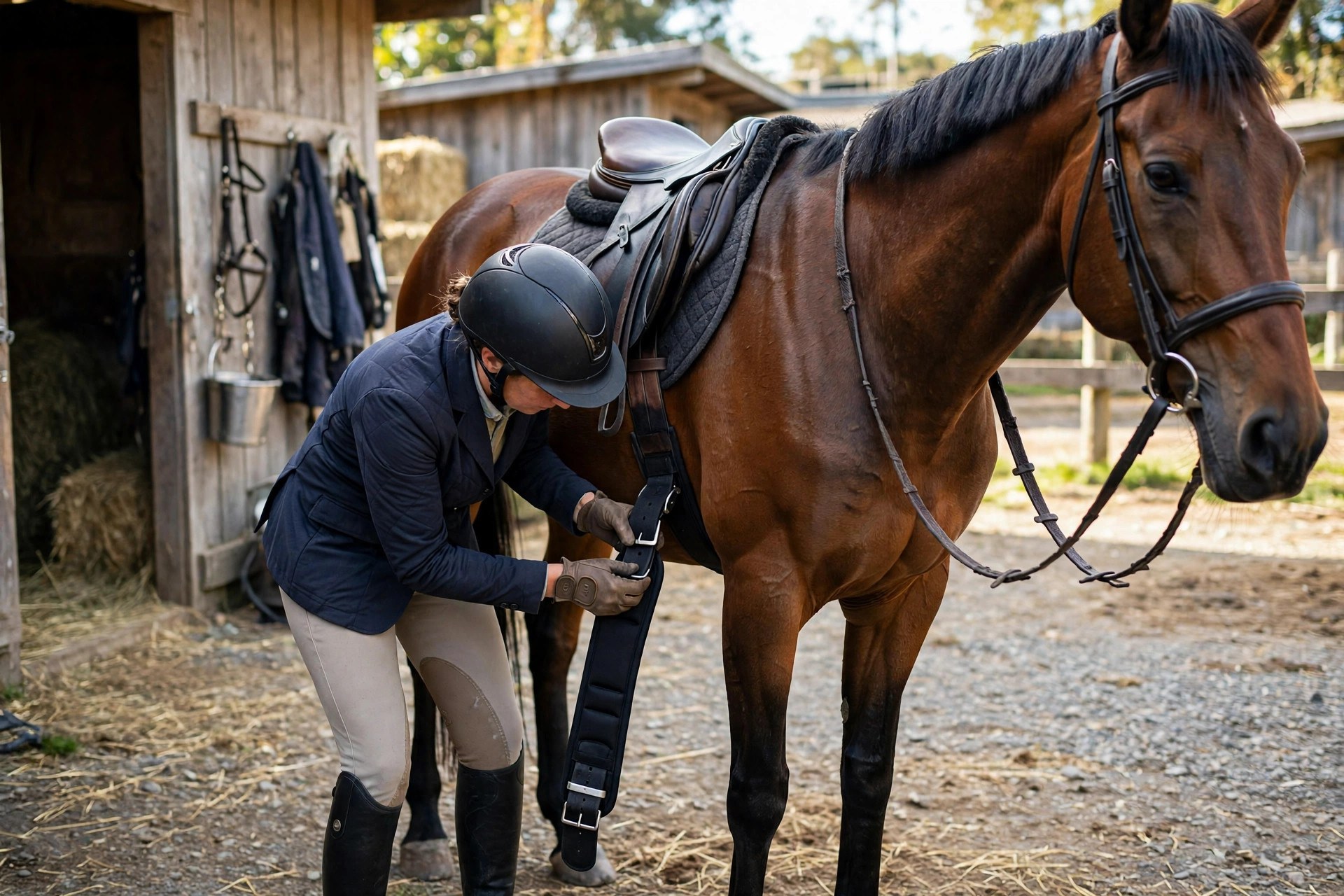
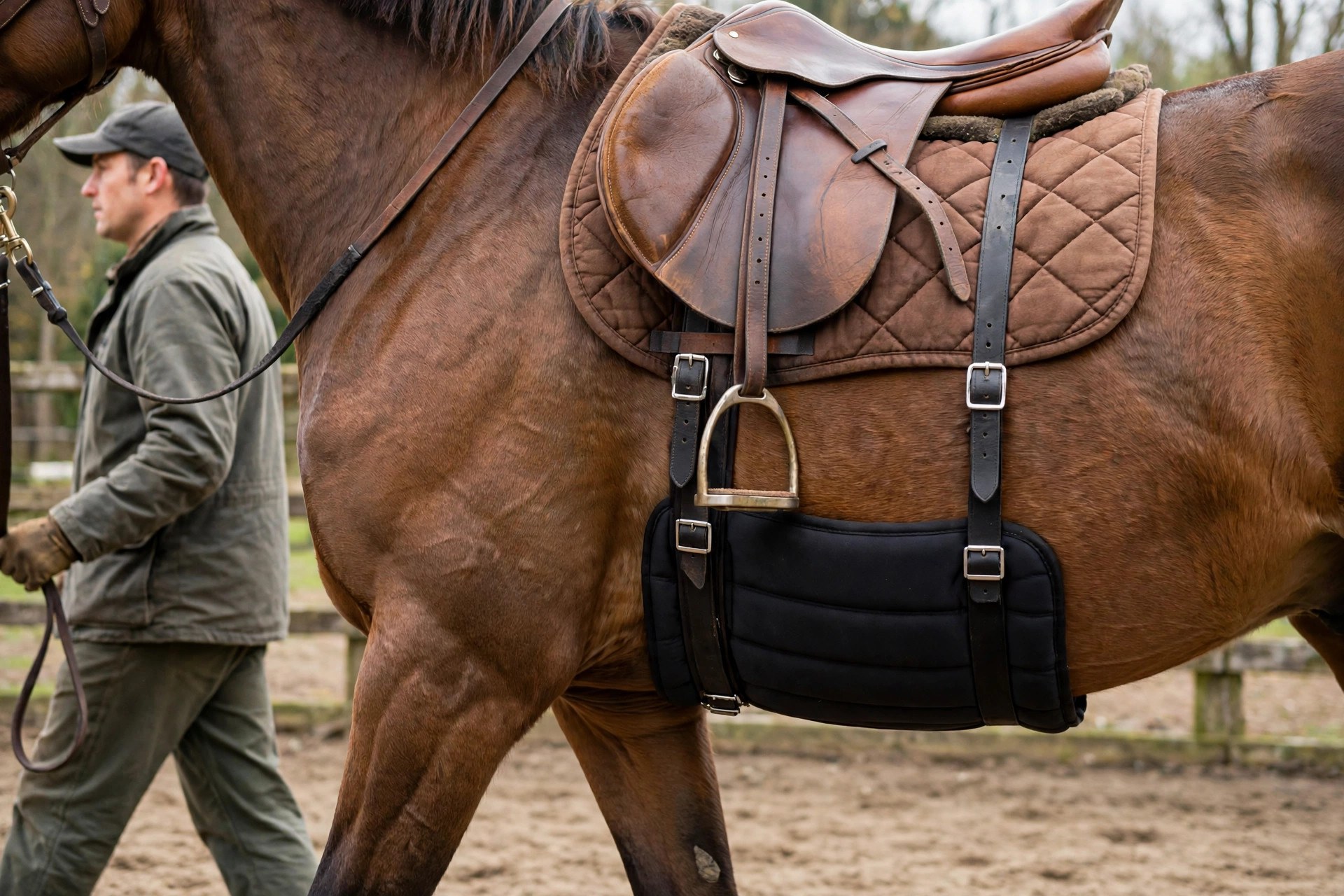
A neoprene horse girth is a wide, padded strap of laminated neoprene (SBR, SCR or CR foam + fabric), usually 5 mm thick, that passes under the horse's barrel behind the front legs and buckles to the saddle on both sides. The foam spreads the pressure over a broad area, grips the coat so the saddle resists slipping, and cushions the girth area against rubbing and chafing — and after the ride it rinses clean and dries fast, which is why so many yards have made it their everyday girth. Send us your design drawing and size chart, and we will confirm the best material and thickness.
We manufacture custom neoprene horse girths in our own factory in China, where we have made neoprene products for 15 years. We cut the foam, laminate the fabric face and stitch the finished girths under one roof, so a change to the shape, the hardware or the size run can be checked on a sample before bulk production starts.
A girth works against a barrel that never holds still: it expands with every breath and shifts as the horse moves. That is why girth material matters. A narrow or hard strap concentrates the tension into one line; a wide neoprene body spreads it, and the foam gives a little with each breath instead of fighting it. Yards usually meet neoprene first in leg protection — our custom neoprene horse leg boots are cut from the same laminated foams — and the girth is the same thinking applied to the saddle: soft, wide, washable.
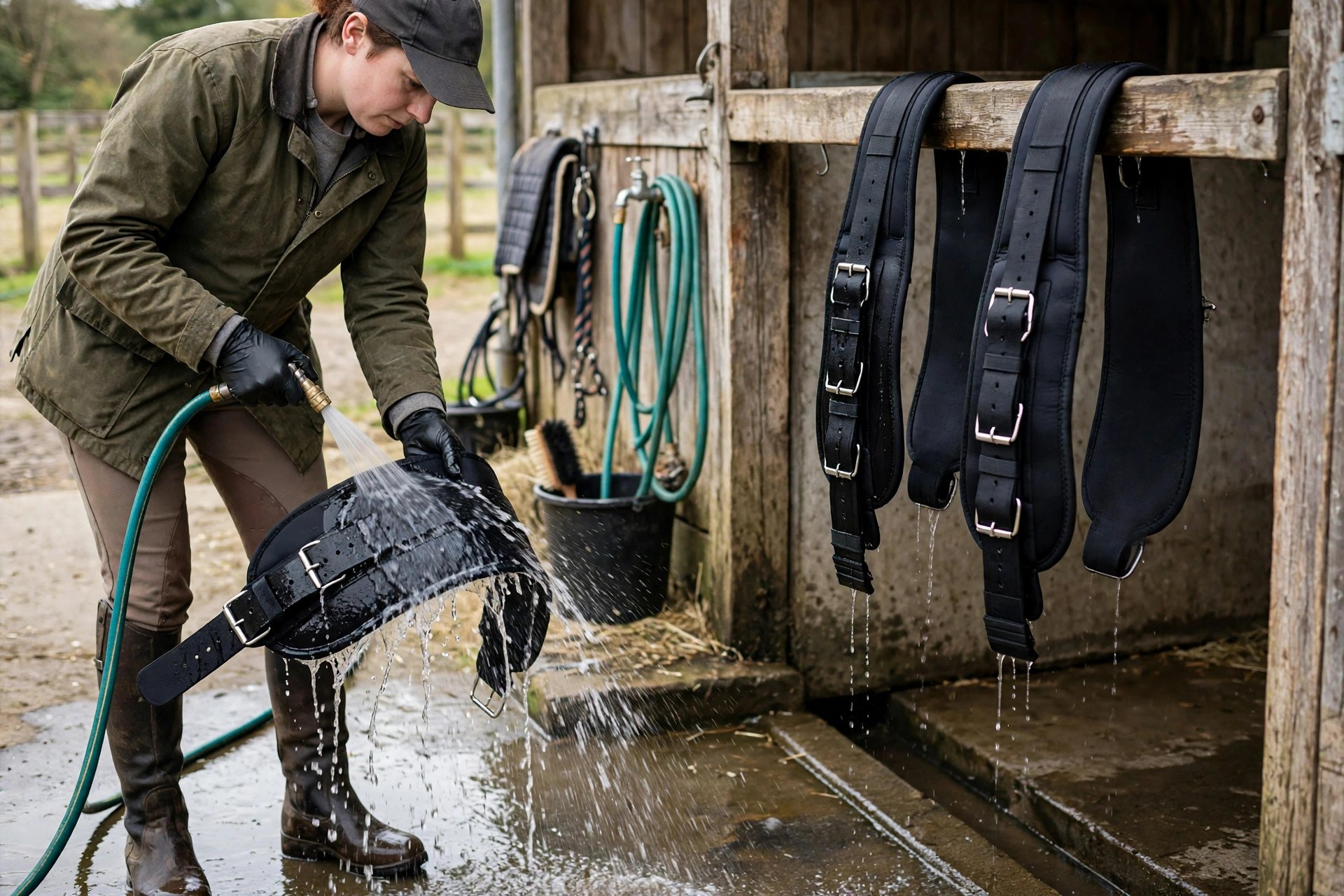
Neoprene earns its place here over leather and fleece for practical reasons. Leather girths need oiling and careful storage, and fleece holds sweat and dries slowly; a neoprene girth goes under the hose after a muddy ride and is dry on the rail by morning. The surface also grips: riders notice the saddle sits steadier, especially on round-barrelled horses where a smooth leather girth can creep. It sits in the same everyday yard range as our neoprene horse bell boots — working tack that is used daily, washed often and replaced without drama.
The hardware decides how the girth feels at saddling time. Stainless-steel roller buckles run smoothly over the saddle straps, so the rider can even up the tension hole by hole on both sides; elastic at one or both ends lets the girth give as the horse breathes; and a centre D-ring takes the attachments riders actually use — side reins, draw reins and martingale clips. If you are comparing factories before placing a range, our guide to sourcing neoprene equestrian gear sets out what to check.
5 mm is the standard for most neoprene horse girths. It gives clear padding against rubbing while the girth still flexes with the barrel, which is why most of the girths we make are cut in 5 mm. For the full range, see our neoprene sheet thickness guide.
| Thickness | Best for | Trade-off |
|---|---|---|
| 3 mm | Light schooling girths and buyers who want the closest feel | Least padding of the three; dries the fastest |
| 5 mm | Most girths — schooling, dressage, jumping and everyday riding | Best balance of cushioning, grip and flexibility |
| 7 mm | Maximum cushioning, and contoured shapes that need a fuller body | Thickest and firmest feel; takes longest to dry |
Size by the barrel, not by the horse's height alone. Measure around the barrel at the girth groove, just behind the front legs, and order the length that lets the buckles sit clear of the elbow on both sides. We make every size to order to your size chart — long girths for standard saddles and short dressage girths for monoflap saddles — so a pony, cob and full run all come from the same chart your other tack uses.
SBR and SCR are the standard choices for most girth ranges, and CR is the choice for premium lines. SBR (styrene-butadiene rubber) is the firm, light foam that holds the girth's shape at the lowest cost. CR (chloroprene rubber) is softer and more elastic, so the girth follows the barrel's movement closely and springs back after thousands of tightenings. SCR sits between the two on cost and stretch, and it is what most equestrian ranges choose.
The numbers show why the two foams feel different: our CR foam measures 3–5° Shore C hardness, 276.32 kg/m³ density, 860 kPa tensile strength and 550% elongation, while our SBR foam measures 10–15° Shore C, 158.34 kg/m³, 256 kPa and 185%. CR is the softer, springier foam; SBR is the firmer, lighter one. On the horse, that means a CR girth gives more as the barrel expands, while an SBR girth keeps a crisper shape through a season of daily use.
| SBR | CR | |
|---|---|---|
| Cost | Lower cost; the usual choice for everyday yard ranges | Costs more than SBR |
| Feel on the barrel | Firm body that keeps its shape | Soft and elastic; gives as the horse breathes |
| Daily saddling and washing | Good; holds up through daily use and hosing down | Better; springs back after repeated stretching and fastening |
For shapes, hardware and ordering, see our custom neoprene horse girths product page.
Tack brands — a girth line in your shapes and size chart, beside your boots and pads.
Equestrian retailers and tack shops — long and dressage girths in black and brown that wash, dry and sell as everyday tack.
Saddle makers — girths cut to match your saddles, including short versions for monoflap dressage designs.
Yards, riding schools and stables — own-label girths that survive daily use and hosing, in the sizes your horses wear.
When neoprene is NOT the right choice
Tell us which of these your girths need, and we will build the sample to your drawing.
Does a neoprene girth stop a saddle slipping?
It helps the saddle sit steadier: the wide foam body spreads the pressure and the surface grips the coat, so the saddle resists creeping forward or back. Fit and even tension on both sides still matter most.
How do I clean a neoprene girth?
Rinse it under the hose or wipe it down after the ride and hang it to dry — no oiling, no special products. That quick care is the main reason yards choose neoprene for everyday girths.
How do I size a girth?
Measure around the barrel at the girth groove, just behind the front legs, and choose the length that keeps the buckles clear of the elbow on both sides. We make every size to order to your size chart, in long and short dressage versions.
What is the minimum order?
200 pieces per design as a general minimum, adjustable to your actual order.
Can I get a sample first?
Yes — we support sampling, usually in 5–7 days. Send us your design drawing and the size chart you need.
How long does bulk production take?
Usually 15–18 days after sample approval, depending on the quantity and customisation.
We make custom neoprene horse girths to your size chart, your shape and your branding, and we check the fit on a sample before bulk production. The general minimum order is 200 pieces per design, adjustable to your actual order; sampling is supported, usually in 5–7 days, and bulk production usually takes 15–18 days after sample approval.
Request a Quotation
To help us review your inquiry, please send:
Website: https://www.neoprenecustom.com/ Email: kevin@neoprenecustom.com
A girth is judged in the first minute of saddling up, by how it buckles and how the horse stands. Send us your size chart and we will make you a sample to try.
Contact: Kevin
Phone: 13417385320
Tel: 0734-87965514
Email: kevin@neoprenecustom.com
Add: Intersection of Zhangjialing Road and Science and Technology Road, Guiyang Industrial Park, Guiyang Town, Qidong County, Hengyang City, Hunan Province./Dongguan Factory(GUANXIN): Shixin Street, Fushan Village, Liaobu Town, Dongguan, Guangdong Province.