
Custom Neoprene Baby Bibs: How to Choose Size, Waterproofing and Safe Materials
A good custom neoprene baby bib is a 2 mm closed-cell neoprene bib, about 25 cm wide and 30 cm long, with a fold-out crumb-catcher pocket and a soft Velcro neck closure. It keeps clothes dry through every meal, rinses clean in seconds, and we make it to order in any size, colour and print.
What Is a Neoprene Baby Bib — and Why It Beats Cotton and Silicone
A neoprene baby bib is a bib made from closed-cell chloroprene rubber foam, laminated with fabric on one or both faces. The foam is full of tiny sealed gas bubbles. Those bubbles block milk, juice and water, so the bib stays dry inside even after the messiest meal, and they give the bib a soft body that holds its shape without a stiff frame. Cotton bibs soak through in minutes and stay damp. Silicone bibs are waterproof, but they are stiff, heavy, and their rigid pocket bangs against the high-chair tray. Neoprene is the only one of the three that is soft, light and waterproof at the same time.
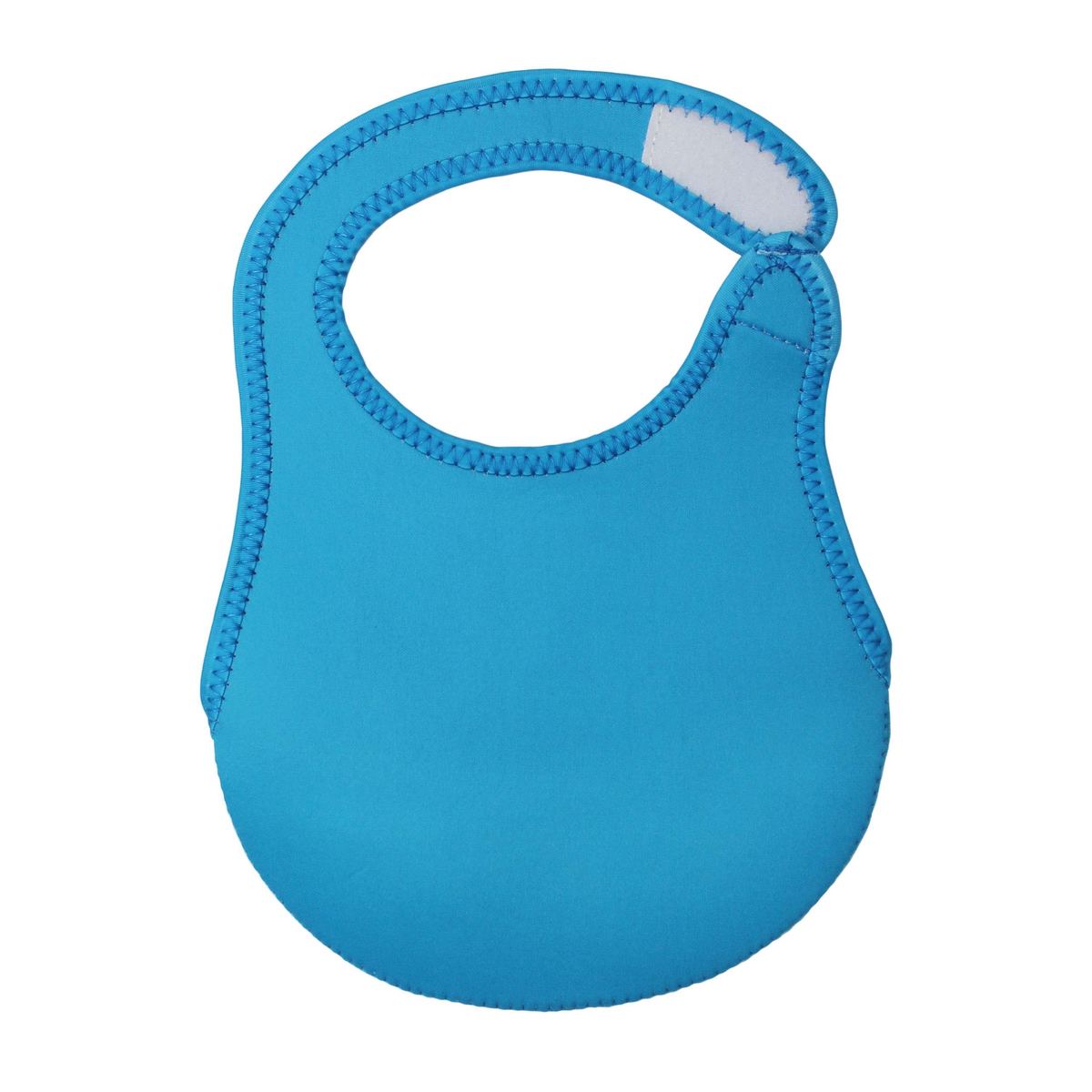
A turquoise-blue neoprene baby bib — the smooth matte surface, overlock stitching and Velcro neck closure.
The material is the same CR neoprene foam sheet we use across our wetsuits and sports supports — see our ultimate guide to neoprene sheets for how the foam is made. Bulk buyers are baby brands, baby retailers, nursery suppliers and corporate gift buyers. A printed bib turns a basic feeding accessory into a branded product, and it pairs with our custom neoprene baby bottle sleeves as a matching baby set.
How Thick Should the Bib Be?
2 mm is the standard for a baby bib. Below 1.5 mm, the bib is floppy — it has no body, it folds over at the neck, and it will not hold a crumb-catcher pocket open. Above 3 mm, the bib gets stiff and heavy, and a baby will pull it off. At 2 mm the bib is soft enough to bend with the baby's chest and firm enough to hold its shape through a whole meal.
Our factory splits foam from 1.5 mm to 45 mm, so any thickness is possible — but for baby bibs we use a soft SBR grade. Our SBR 5–7° foam is our soft grade for sewn accessories: tensile strength 247 kPa and elongation 199% on its technical data sheet. That stretch is what lets the bib flex at the neck strap hundreds of times without cracking, and spring back flat after every wash. See our neoprene sheet thickness guide for how to pick the right mm for any product.
Thickness is only half the story. The foam must be closed-cell. Open-cell foam is softer and cheaper, but it absorbs milk and juice, holds the smell, and tears more easily at the seams. Ask your supplier which foam they use — and ask for the data sheet, not just a claim.
What Size Fits Your Baby?
Order by age, then check the neck. The bib should cover the chest from neck to waist, and the neck opening must fit over the baby's head or adjust to it. A bib that is too short lets food run straight onto the clothes. A bib that is too long gets in the way of the high-chair tray. Measure the chest width and the neck circumference before you order — the neck matters more than the length, because a baby outgrows the neck first.
| Age | Bib Size (W × L) | Neck Opening | Best For |
|---|---|---|---|
| 3–6 months | 20 × 25 cm | 22–26 cm | First tastes, dribble |
| 6–12 months | 25 × 30 cm | 26–30 cm | Weaning, first meals |
| 12–24 months | 28 × 33 cm | 30–33 cm | Self-feeding, messy eaters |
| 2–3 years | 30 × 35 cm | 32–35 cm | Toddlers, nursery meals |
One size with an adjustable neck covers most of the range — the best-known neoprene bibs fit babies from about 6 months to 3 years on a single size, because the neck adjusts instead of the bib. If you sell to nurseries, stock two sizes: the 6–12 month size for babies and the 12–24 month size for toddlers. Tell your supplier the age range your customers buy for, and the size follows from that.
Safe Materials: What to Check Before You Order
Check the materials before you check the price — this is a baby product. The fabric face should carry OEKO-TEX Standard 100 certification, which tests textiles for harmful substances — see the Oeko-Tex standard reference. Our foam is RoHS and REACH compliant, which limits hazardous substances in the material. Look for bibs labelled BPA-free, phthalate-free and latex-free — the best-known neoprene bibs carry all three labels, so ask your supplier for the same. A bib with no test data is a guess, not a specification.
No small detachable parts. A baby pulls at everything, so nothing on the bib should come off in small pieces. Use Velcro or large snaps for the neck — never small buttons, beads or loose decorations. Check that the neck closure is sewn through the foam and the fabric, not glued on, and that the stitching is tight enough that a baby cannot pick it loose. If a decoration can be pulled off with two fingers, it does not belong on a baby bib.
Soft edges matter too. The bib sits against a baby's neck and chest for the whole meal, so the edges must be finished with overlock stitching or bound with soft piping — no rough cut edges, no scratchy seams. Print on the outside face only: the inside face touches the baby's skin, so keep inks and prints away from it. If your supplier cannot tell you what the fabric face is certified to, find another supplier.
Closures and Pockets: Velcro, Snaps and the Crumb Catcher
Velcro for adjustability, snaps for durability. A Velcro neck closure adjusts to any neck size in seconds, and a parent can fasten it with one hand while holding the baby with the other. The trade-off is lint: Velcro collects fluff in the wash and grips less over time. Snaps last longer and stay clean, but they only fit the neck sizes they were set for. For most buyers, Velcro is the right choice — one size fits 6 months to 3 years because the neck adjusts instead of the bib.
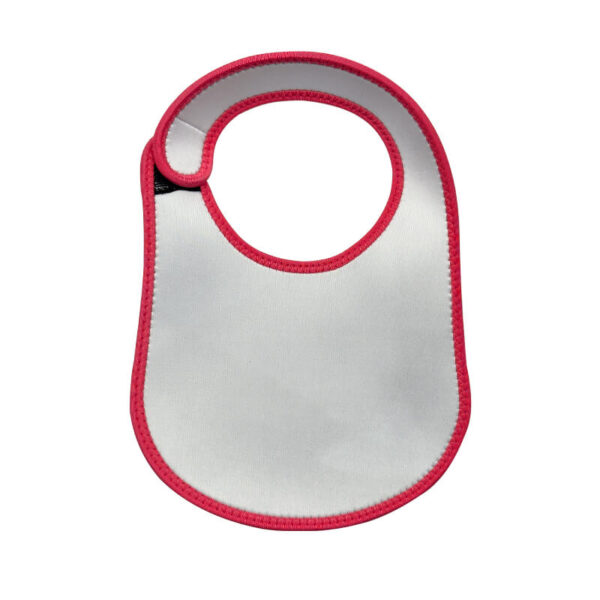
A light grey neoprene baby bib with red piping — the smooth matte body and a neck that adjusts with Velcro.
The crumb-catcher pocket is the feature that sells the bib. The best-known neoprene bib on the market, the Bibetta Ultrabib, popularised the fold-out pocket: a piece of neoprene sewn flat to the front of the bib that folds out into an open tray to catch food. The pocket should be sewn flat and fold out easily — not a stiff rigid pocket that bangs the table. A pocket 2–3 cm deep is enough to catch most of the mess, and because the neoprene is springy, the pocket holds its open shape and folds flat again for washing.
Check that the pocket does not gape open when the baby leans forward. The neoprene's own stiffness should hold the pocket in shape — if the pocket flops open, the foam is too thin or the stitching is too loose. Ask your supplier how the pocket is sewn, and whether it folds flat for packing.
Waterproof, Washable and Easy to Clean
The foam is waterproof. The bib as a whole is water-resistant. Closed-cell neoprene does not absorb milk, juice or water — spills bead and run off the surface, and the baby's clothes stay dry underneath. Our waterproof vs water-resistant guide explains the difference: the foam blocks liquid, but the seams around the neck and the pocket can let liquid through if the bib sits in a puddle of spilled milk. For a normal meal, the bib keeps everything dry.
Rinse, wipe, air dry — most of the time that is enough. Rinse the bib under a tap after every meal and wipe it with a damp cloth. For a deep clean, machine wash at 30 °C with mild detergent. Hang it up to air dry, away from direct sun. Do not tumble dry on high heat and do not leave it in direct sun for days — heat damages the foam and UV ages neoprene faster than anything else.
A neoprene bib dries faster than a cotton bib because the foam holds no water — only the fabric face gets wet. A rinsed bib is dry enough to use again in a few hours, while a cotton bib stays damp and starts to smell. That is why nurseries buy neoprene: one bib per child per day, washed overnight, dry by morning.
Your Trusted Custom Neoprene Baby Bib Manufacturer
Stop buying plain bibs that soak through in one meal, stain after a week, or fall apart at the neck strap. We are a specialized custom neoprene factory making baby bibs, bottle sleeves, and baby gear for brands worldwide.
When you partner with our factory for custom OEM bibs, you get 2–3 mm closed-cell neoprene, sizes from 3 months to 3 years, Velcro or snap closures, fold-out crumb-catcher pockets, Pantone-matched colours, and full-colour print. Our colour matching and printing guide explains how we match Pantone colours and print full-colour designs on neoprene.
Do you want to launch a branded line of neoprene baby bibs? We accept custom OEM orders with full branding options, tailored sizes, and low minimum order quantities.
- True 2–3 mm closed-cell neoprene, waterproof and soft against baby's skin.
- Food-safe labelling: OEKO-TEX fabric face, BPA-free, phthalate-free, latex-free.
- Low Minimum Order Quantities (MOQ) for custom brand runs.
Learn more about our OEM production capabilities on our official website: https://source.neoprenecustom.com
Ready to design a custom baby bib? Contact our team directly: kevin@neoprenecustom.com
Frequently Asked Questions (FAQ)
Q: What size baby bib should I order?
A: 25 × 30 cm fits most babies from 6 to 12 months — the weaning age when bibs sell best. A 20 × 25 cm bib suits 3–6 months, and a 28 × 33 cm bib suits 12–24 months. One size with an adjustable Velcro neck covers 6 months to 3 years.
Q: Are neoprene baby bibs safe for babies?
A: Yes, when the materials are checked: the fabric face should carry OEKO-TEX Standard 100, the foam should be RoHS and REACH compliant, and the bib should be labelled BPA-free, phthalate-free and latex-free. There should be no small detachable parts — Velcro or large snaps only, sewn through the foam.
Q: Are neoprene baby bibs waterproof?
A: The foam is waterproof — closed cells do not absorb milk, juice or water. The bib as a whole is water-resistant, because the seams around the neck and pocket can let liquid through if it sits in a spill. For a normal meal, the baby's clothes stay dry.
Q: How do I clean a neoprene baby bib?
A: Rinse it under a tap after every meal and wipe it with a damp cloth — most of the time that is enough. For a deep clean, machine wash at 30 °C with mild detergent and air dry. Do not tumble dry on high heat — heat damages the foam.
Q: How can we order custom colours and logos?
A: Send your bib sizes, Pantone colours, and logo file to kevin@neoprenecustom.com for a quotation. We print the full-colour design on the outside face of the bib, keeping the inside face — the side that touches the baby's skin — print-free.