
Custom Neoprene Gym Bags: Size, Compartments and Waterproofing Guide
A good neoprene gym bag is a 3 mm closed-cell neoprene duffel in 40–60 litres, with a separate shoe compartment, a wet pocket, and padded straps. It keeps gym clothes dry, stops wet towels soaking everything else, and carries 10 kg of kit without digging into your shoulder. We make it to order in any size, colour and logo.
What Is a Neoprene Gym Bag — and Why It Beats Nylon and Canvas
A neoprene gym bag is a soft duffel or tote made from closed-cell chloroprene rubber foam, laminated with fabric on one or both faces. The foam is full of tiny sealed gas bubbles. Those bubbles cushion the bag's contents, block water, and give the bag a soft structure that holds its shape without a frame. Nylon gym bags are light but thin — they tear at the seams, soak through in rain, and offer no cushion for a water bottle or a pair of headphones. Canvas is tougher but heavy, and it absorbs sweat and rain, then holds the smell. Neoprene does neither.
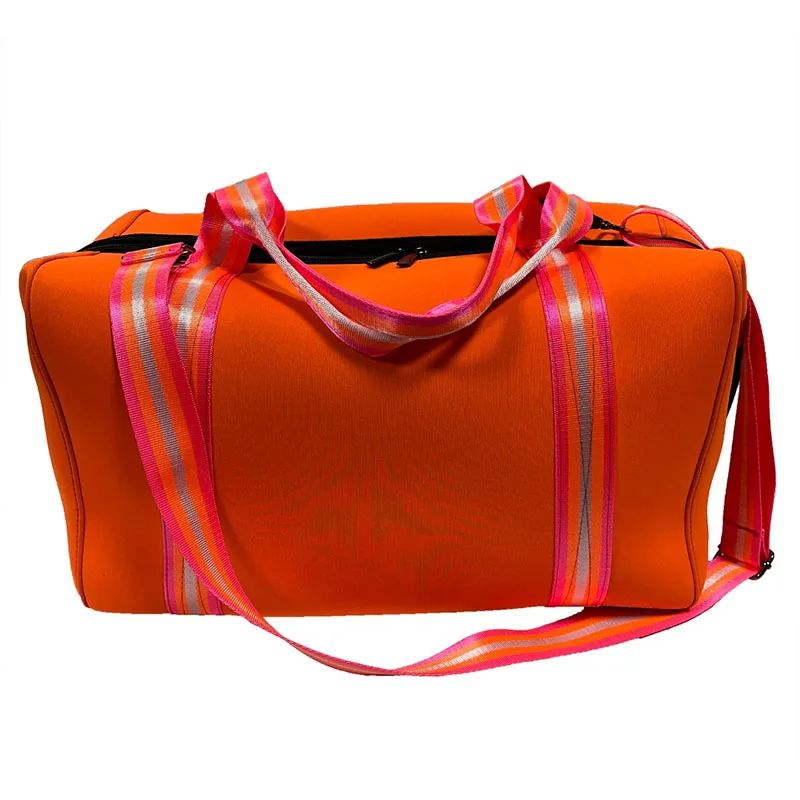
An orange neoprene gym duffel — the smooth matte body, striped handles and top zipper, ready for the gym.
The material is the same CR neoprene foam sheet we use across our wetsuits and sports supports — see our ultimate guide to neoprene sheets for how the foam is made. A neoprene gym bag is a soft bag that wipes clean after every session, holds its shape in a locker, and cushions everything inside it.
Bulk buyers are gym brands, sports retailers, corporate wellness programmes and event organisers. A printed bag turns a basic gym duffel into a branded product, and one size range covers a whole customer base.
How Big Should the Bag Be? Match the Litres to the Kit
Match the litres to the kit, not to the price. A bag that is too small means shoes ride on top of clean clothes. A bag that is too big means the kit slides around and the bag looks empty. Measure the kit first: shoes, change of clothes, towel, bottle, and any extras like boxing gloves or a yoga mat.
| Size | Litres | Typical Dimensions | Fits | Best For |
|---|---|---|---|---|
| S | 30 L | ~45 × 25 × 25 cm | Shoes + 1 change + towel | Light sessions, kids |
| M | 45 L | ~55 × 28 × 28 cm | Shoes + 2 changes + towel + 1 L bottle | Most gym-goers |
| L | 60 L | ~65 × 30 × 30 cm | Shoes + 2 changes + towel + bottle + gloves | Heavy kit, weekend trips |
The middle size suits most people. A 45-litre duffel holds a full kit for one session and still fits as cabin baggage — IATA recommends a maximum cabin size of 56 cm × 45 cm × 25 cm, so a 55 cm duffel fits the length limit. If your customers fly with gym kit, the 45-litre size is the one to sell.
Measure the shoes too. A men's size 13 shoe is about 30 cm long, and the shoe compartment must fit that length. Tell your supplier the shoe size your customers wear, not just "a shoe pocket" — a pocket that fits a size 8 will not fit a size 13.
Compartments: Shoe Pocket, Wet Pocket and Laptop Sleeve
Three compartments matter most: a shoe pocket, a wet pocket, and a laptop sleeve. A shoe pocket keeps dirty trainers away from clean clothes — it should be vented, so the shoes air out instead of stewing. A wet pocket holds a wet towel or swimsuit in a waterproof lining, so the rest of the kit stays dry. A laptop sleeve holds a 13–15 inch laptop in a padded pocket, so the bag doubles as a work bag.
The wet pocket lining is the detail to check. Our waterproof vs water-resistant guide explains the difference: the foam blocks water, but a wet pocket needs a sealed lining — PEVA foil or a welded waterproof pocket — or the water seeps through the seams into the main compartment. Ask your supplier what the wet pocket is lined with, and whether the seams are sealed.
Do not overdo the pockets. A bag with 10 pockets looks clever in a photo and frustrates in use — every pocket is a seam that can fail and a place to lose things. Three good compartments beat ten small ones. The main compartment should open wide, so the whole kit is visible at a glance.
Waterproof or Just Water-Resistant? What the Bag Really Keeps Out
The foam is waterproof. The bag is water-resistant. Closed-cell neoprene does not absorb water — rain beads and runs off the surface. But a gym bag has zippers and seams, and those let water in. A bag left in heavy rain will get damp inside at the zipper line, even though the foam itself stays dry.
Under IEC 60529, IPX7 means immersion in water up to 1 metre deep for 30 minutes, and IPX8 means continuous immersion deeper than 1 metre — see the IP code reference. A stitched neoprene gym bag cannot claim IPX7. A bag with a sealed roll-top closure and welded seams can be tested, but a zipper bag cannot. Do not let a supplier promise IPX7 on a zippered duffel.
The insulation works the same way it does in our cooler bags. Our factory's own thermal test — a 5 °C drink and one ice pack in a 30 °C room for 4 hours — showed a 5 mm neoprene bag with a foil lining held the drink at 7 °C, while a cheap 2 mm bag let it warm to 22 °C. See the full test in our neoprene lunch bag thermal performance article. For a gym bag, that insulation means a chilled bottle stays cold through a 2-hour session if the bottle pocket is foil-lined.
Straps and Handles: How to Carry 10 kg Without Hurting Your Shoulder
A full gym bag weighs 5–10 kg, and the strap is what carries it. A thin strap digs into the shoulder after 10 minutes. A good strap is wide — 38–50 mm — padded with neoprene, adjustable, and non-slip on the underside. The padding should be thick enough to spread the load, not just a thin cover over webbing.
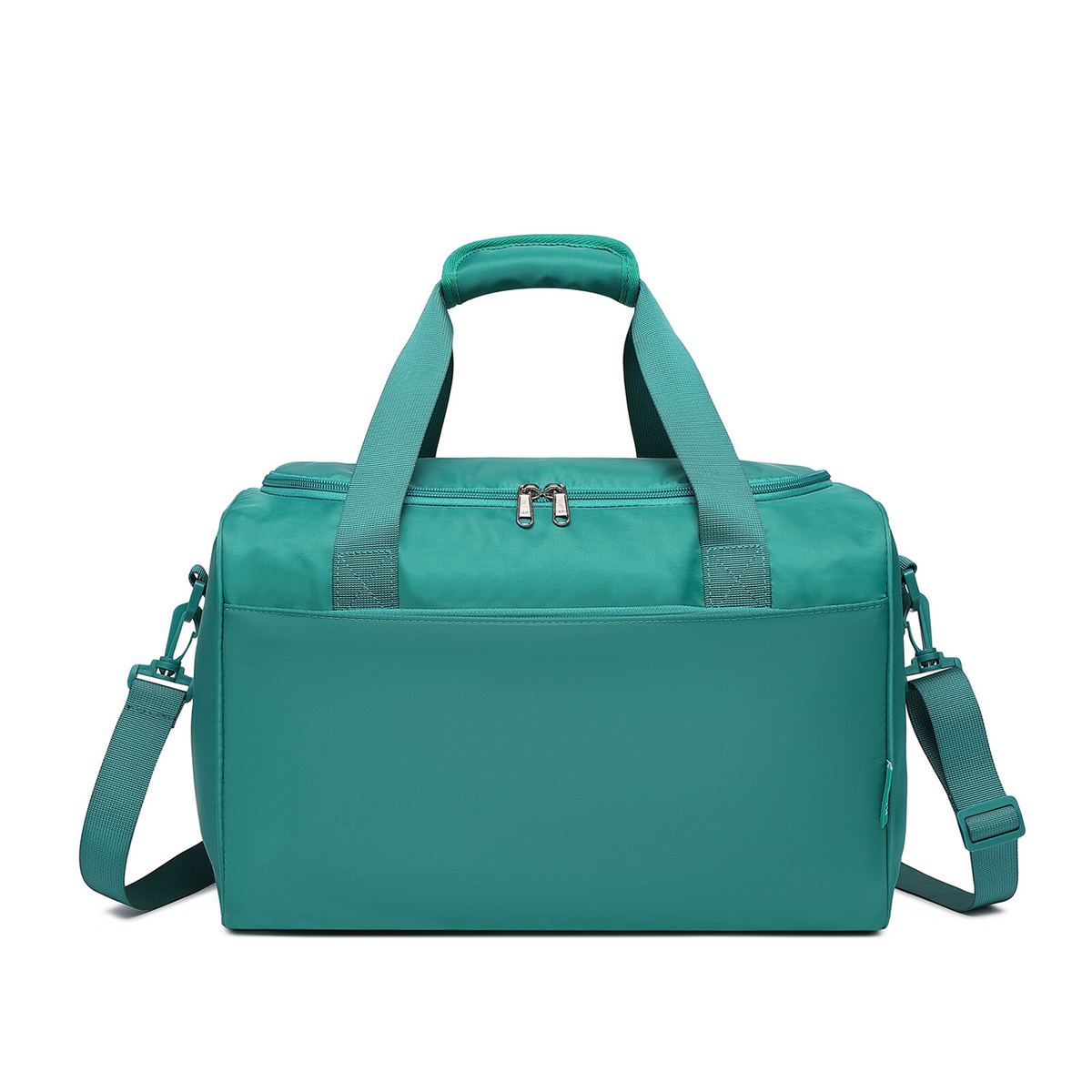
A teal neoprene gym duffel — the smooth matte body with webbing handles and a padded carry grip.
The strap shape matters as much as the padding. Our ergonomic shoulder straps article explains the physics: an S-curve pad follows the shoulder muscle and distributes weight evenly, while a straight strap concentrates the load on one point. A 7 mm high-density neoprene pad absorbs shock and spreads a 10 kg load across the shoulder. Ask your supplier for the strap width and the pad thickness, not just "padded strap".
Grab handles matter too. Two short handles that join together with a wrap let you carry the bag by hand, and they should be long enough to fit over a coat sleeve. A detachable shoulder strap is the flexible option — clip it on for the walk to the gym, take it off when the bag goes in a locker.
How Thick Should the Neoprene Be?
3 mm is the standard. Most neoprene gym bags are listed at 3 mm. That thickness is a balance: thick enough to cushion a water bottle and hold the bag's shape, thin enough to fold flat in a locker when empty. Below 2 mm, the bag is a dust cover — it holds shape poorly and cushions nothing. Above 5 mm, the bag gets heavy and stiff, and it will not fold.
Our factory splits foam from 1.5 mm to 45 mm, so any thickness is possible — but for gym bags we use a soft SBR grade. Our SBR 5–7° foam is our soft grade for sewn accessories: tensile strength 247 kPa and elongation 199% on its technical data sheet. That stretch is what lets the bag bend and fold without cracking at the seams. See our neoprene sheet thickness guide for how to pick the right mm for any product.
Thickness is only half the story. The foam must be closed-cell. Open-cell foam is softer and cheaper, but it absorbs sweat and water, holds the smell, and tears more easily. Ask your supplier which foam they use — and ask for the data sheet, not just a claim.
Your Trusted Custom Neoprene Gym Bag Manufacturer
Stop buying plain gym bags that tear at the handles, soak through in rain, or fall apart after one season. We are a specialized custom neoprene factory making gym bags, duffels, and sports accessories for brands worldwide.
When you partner with our factory for custom OEM gym bags, you get 3 mm closed-cell neoprene, 30–60 litre sizes, shoe and wet compartments, padded straps, Pantone-matched colours, and full-colour print. Our colour matching and printing guide explains how we match Pantone colours and print full-colour designs on neoprene.
Do you want to launch a branded line of neoprene gym bags? We accept custom OEM orders with full branding options, tailored sizes, and low minimum order quantities.
- True 3 mm closed-cell neoprene, waterproof foam and soft structure.
- Shoe, wet and laptop compartments, padded 38–50 mm straps.
- Low Minimum Order Quantities (MOQ) for custom brand runs.
Learn more about our OEM production capabilities on our official website: https://source.neoprenecustom.com
Ready to design a custom gym bag? Contact our team directly: kevin@neoprenecustom.com
Frequently Asked Questions (FAQ)
Q: What size gym bag do I need?
A: 45 litres fits most gym-goers — shoes, 2 changes of clothes, a towel and a 1-litre bottle. A 30-litre bag suits light sessions; a 60-litre bag suits heavy kit or weekend trips. Measure the kit, not the bag.
Q: Are neoprene gym bags waterproof?
A: The foam is waterproof — closed cells do not absorb water. The bag as a whole is water-resistant, because zippers and seams let water in. A stitched bag cannot claim IPX7; only a sealed roll-top bag with welded seams can be tested for it.
Q: Will sweaty clothes make the bag smell?
A: No — closed-cell neoprene holds no liquid and no odour, unlike canvas or open-cell foam. Rinse the bag, wash the fabric face with mild soap, and air dry. A rinsed bag is dry enough to use again in about 2 hours.
Q: How much weight can the straps hold?
A: A full gym bag weighs 5–10 kg, and a 38–50 mm padded neoprene strap carries that without digging in. A 7 mm high-density neoprene pad spreads the load across the shoulder. Check the strap width and pad thickness before ordering.
Q: How do I order custom colours and logos?
A: Send your sizes, Pantone colours, and logo file to kevin@neoprenecustom.com for a quotation. We print the full-colour design on the fabric face of the bag.