
Custom Neoprene Scuba Tank Covers: How to Choose Size, Padding and Fit
A good custom neoprene scuba tank cover is a 3 mm closed-cell neoprene sleeve that slides over an aluminium or steel cylinder, with a zipper or slip-on closure. It protects the tank from scratches and dents, shades it from the sun, and we make it to order in any size, thickness and colour.
What Is a Scuba Tank Cover — and Why It Beats a Bare Tank
A scuba tank cover is a sleeve made from closed-cell chloroprene rubber foam, laminated with fabric on one or both faces, that slides over a scuba cylinder and stays on during the dive. The foam is full of tiny sealed gas bubbles. Those bubbles cushion the tank against knocks on the boat deck, on the dock and in the car, and they shade the metal from direct sun. A bare tank gets scratched every time it is loaded, and a scratched tank is a tank that starts to corrode.
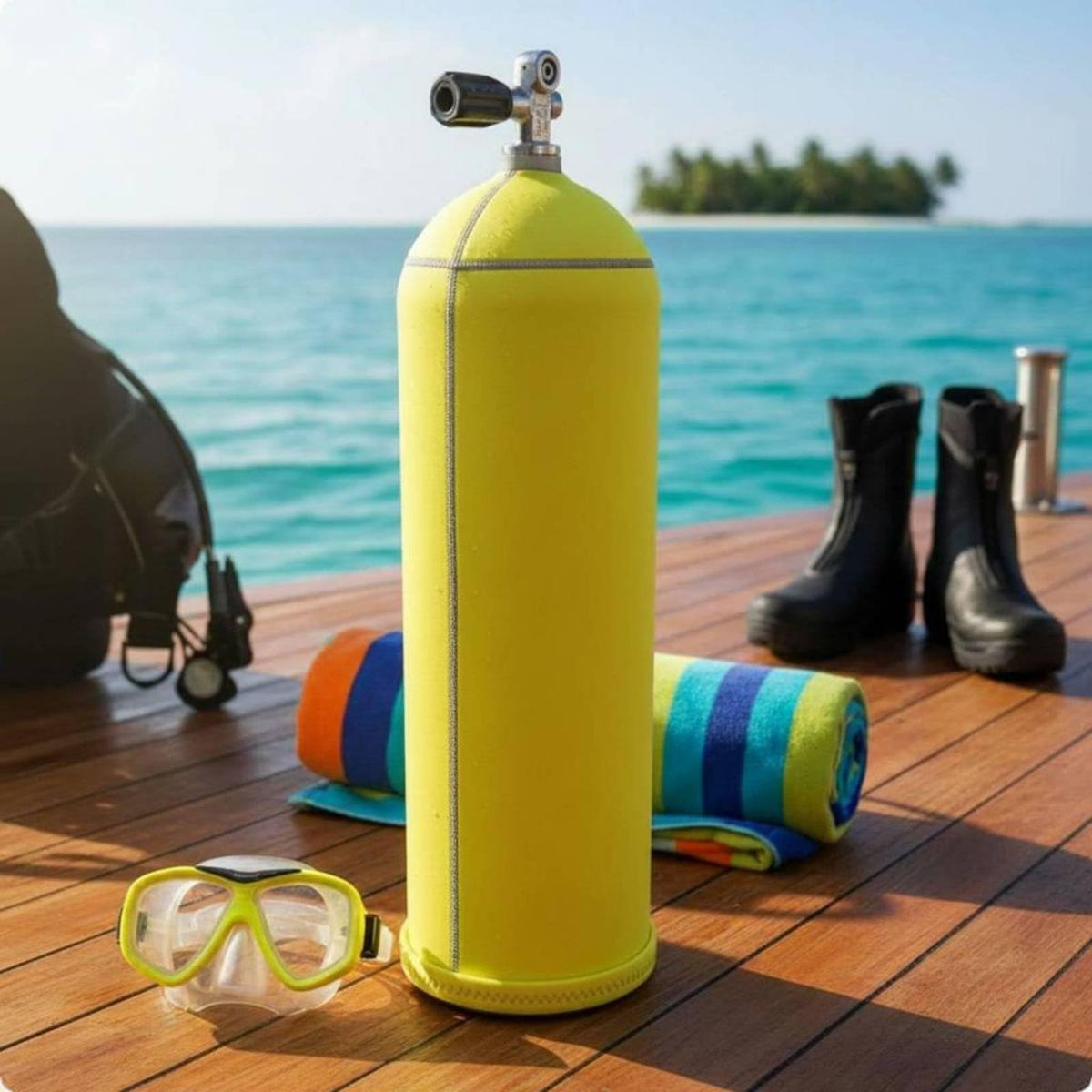
A scuba tank in a yellow neoprene cover on the dock — the smooth matte sleeve protects the cylinder and shades it from the sun.
The material is the same CR neoprene foam sheet we use across our wetsuits and sports supports — see our ultimate guide to neoprene sheets for how the foam is made. Bulk buyers are dive centres, dive schools, liveaboard operators and dive shops. A printed cover turns a basic accessory into a branded product, and one size range covers a whole rental fleet.
One thing a cover does not do: it does not replace a tank inspection, and it does not replace a tank boot. A tank still needs its regular hydrostatic test and visual inspection, and the rubber boot still protects the base. The cover protects the body of the cylinder — nothing more, and nothing less.
How Thick Should the Padding Be?
3 mm is the standard for a tank cover. At 3 mm the cover cushions the tank against knocks on a boat deck and holds its shape when the tank is handled. At 2 mm the cover is a light sleeve — it stops scratches but cushions little when the tank is dropped on a hard surface. At 5 mm the cover is heavy-duty: it is the right choice for rental fleets and dive boats, where tanks are stacked and dragged every day, but it adds weight and bulk.
Our factory splits foam from 1.5 mm to 45 mm, so any thickness is possible — but for tank covers we use a soft SBR grade. Our SBR 5–7° foam is our soft grade for sewn accessories: tensile strength 247 kPa and elongation 199% on its technical data sheet. That stretch is what lets the cover slide over the cylinder and grip it without splitting at the seams. See our neoprene sheet thickness guide for how to pick the right mm for any product.
Thickness is only half the story. The foam must be closed-cell. Open-cell foam is softer and cheaper, but it absorbs seawater, holds the smell, and tears more easily at the seams. Ask your supplier which foam they use — and ask for the data sheet, not just a claim.
What Size Fits Your Tank?
Order by diameter first, then by length. The cover must grip the cylinder — a cover that is too loose slides around and lets sand in, and a cover that is too tight will not slide on at all. Measure the tank diameter with a tape around the body, and the length from the base to the shoulder, without the valve. The valve stays outside the cover.
| Tank | Diameter | Length (no valve) | Cover Size | Best For |
|---|---|---|---|---|
| Aluminium 80 cu ft (11.1 L) | 184 mm | 660 mm | 65 × 19 cm | Most recreational divers |
| Aluminium 63 cu ft (8.5 L) | 184 mm | 530 mm | 52 × 19 cm | Smaller divers, stage tanks |
| Steel 10 L | 171 mm | 540 mm | 53 × 18 cm | European dive schools |
| Steel 12 L | 171 mm | 640 mm | 63 × 18 cm | Most European divers |
| Steel 15 L | 204 mm | 650 mm | 64 × 21 cm | Long dives, cold water |
The 80 cu ft aluminium tank is the volume product — it is the standard rental tank in most of the world, so the 65 × 19 cm cover is the size to stock first. If you sell to European dive centres, add the 12 L steel size. Tell your supplier the tank diameter and length, not just the litres — two 12-litre tanks from different makers can differ in diameter, and the cover is cut to fit the diameter.
Zipper, Slip-On or Velcro? How the Closure Changes the Cover
Zipper for easy removal, slip-on for the cleanest fit, Velcro for adjustability. A zipper runs down the side of the cover — unzip it, wrap it around the tank, zip it up. It is the easiest to fit and remove, and the best choice for rental fleets that change covers between tanks. The trade-off is the zipper itself: a cheap zipper corrodes in salt water and can scratch the tank. A slip-on cover has no closure at all — the neoprene stretches over the cylinder and grips it. It is the cleanest and cheapest, but it only fits the tank size it was cut for. A Velcro closure adjusts to a range of diameters, so one cover fits several tank sizes, but the Velcro collects sand and grips less over time.
Most dive centres order the zipper version, because it is the cover a customer already knows and trusts. Most promotional buyers order the slip-on sleeve, because it prints the biggest logo at the lowest cost. If you order zippers, ask for a #8 or #10 zipper with a fabric pull, and check the zipper teeth are covered by a fabric gutter inside — a strip of fabric that sits between the teeth and the tank, so the metal never touches the cylinder.
Base Protection and the Tank Boot
The cover protects the body. The boot protects the base. A tank boot is the rubber cup that fits over the bottom of the cylinder, so the tank can stand upright on a boat deck without rolling. The cover stops at the boot — it does not replace it. If your tanks stand on deck without boots, they roll, and no cover will save them. Ask your supplier whether the cover is cut to sit above the boot, or to cover the boot as well.
Check the bottom edge of the cover. It should be finished with overlock stitching or a bound hem, so it does not fray when the tank is dragged across a deck. A reinforced base — a second layer of neoprene at the bottom — is worth ordering for rental fleets, because the bottom edge takes the most wear. A cover that frays at the base lets sand and salt in, and the sand grinds the tank every time the cover moves.
Colours and Identification: Why Dive Centres Order Bright Covers
Colour is how a dive centre tells its tanks apart. A bright cover — yellow, red, blue — is easy to spot on a crowded boat deck, and it turns a plain aluminium cylinder into a branded product. Some centres colour-code by gas: one colour for air, another for nitrox, another for oxygen. Others print the centre's logo and the tank size on the cover, so the crew can read the size at a glance.
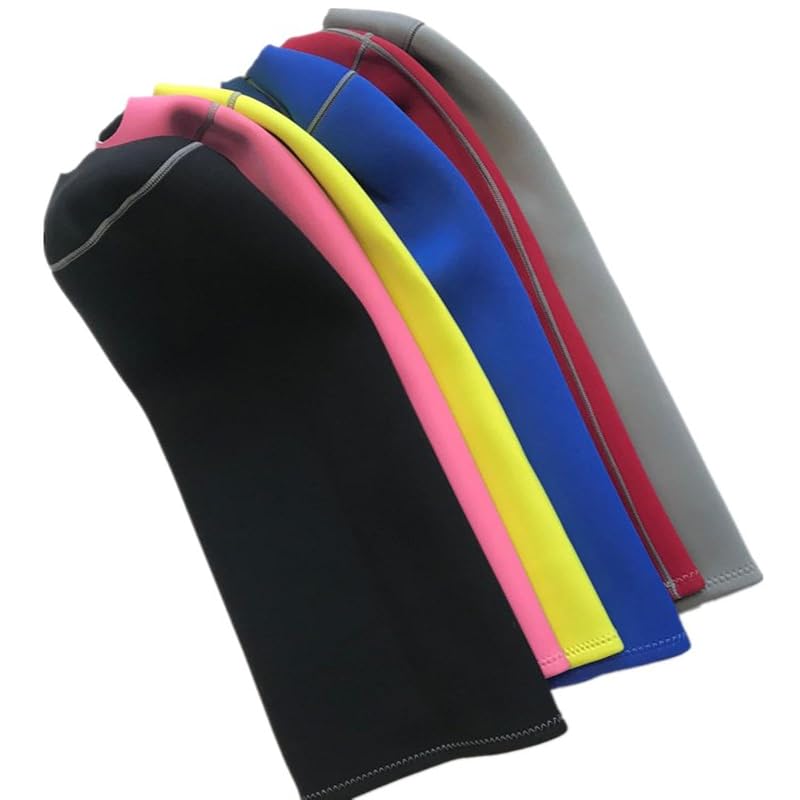
Neoprene tank covers in six colours — black, pink, yellow, blue, red and grey — the same sleeve in every colour a dive centre needs.
The foam is waterproof. The cover as a whole is water-resistant. Closed-cell neoprene does not absorb water — seawater beads and runs off the surface. Our waterproof vs water-resistant guide explains the difference: the foam blocks water, but the zipper and the seams let water in if the tank sits in a puddle on deck. For normal dive use, that does not matter — the cover dries fast because the foam holds no water.
Rinse, soap, air dry — no heat. Rinse the cover in fresh water after every dive day to wash off salt and sand, then hand wash in cool water with mild soap. Hang it up to air dry, away from direct sun. Do not machine wash and do not tumble dry: heat damages the foam and shrinks the fabric face. Do not leave it in direct sun for weeks — UV ages neoprene faster than anything else. A rinsed cover is dry enough to use again the next day, because the foam holds no water.
Your Trusted Custom Neoprene Scuba Tank Cover Manufacturer
Stop buying plain covers that split at the zipper, slide off the tank, or fade after one season in the sun. We are a specialized custom neoprene factory making tank covers, wetsuits, and dive accessories for brands worldwide.
When you partner with our factory for custom OEM covers, you get 2–5 mm closed-cell neoprene, sizes for aluminium and steel tanks from 8.5 L to 15 L, zipper, slip-on or Velcro closures, reinforced bases, Pantone-matched colours, and full-colour print. Our colour matching and printing guide explains how we match Pantone colours and print full-colour designs on neoprene.
Do you want to launch a branded line of neoprene scuba tank covers? We accept custom OEM orders with full branding options, tailored sizes, and low minimum order quantities.
- True 2–5 mm closed-cell neoprene, waterproof foam and a soft, grippy fit.
- Sizes for aluminium 80 cu ft and steel 10, 12 and 15 litre tanks — cut to your diameter.
- Low Minimum Order Quantities (MOQ) for custom brand runs.
Learn more about our OEM production capabilities on our official website: https://source.neoprenecustom.com
Ready to design a custom tank cover? Contact our team directly: kevin@neoprenecustom.com
Frequently Asked Questions (FAQ)
Q: What size tank cover do I need?
A: Measure the tank diameter and length without the valve. A 65 × 19 cm cover fits the standard aluminium 80 cu ft (11.1 L) tank, and a 63 × 18 cm cover fits a steel 12 L tank. Order by diameter first — two tanks with the same litres can differ in diameter.
Q: Is 3 mm or 5 mm neoprene better for a tank cover?
A: 3 mm is the standard — it cushions knocks on a boat deck and holds the cover's shape. Use 2 mm only for a light scratch sleeve, and 5 mm for rental fleets and dive boats, where tanks are stacked and dragged every day.
Q: Zipper or slip-on — which is better?
A: A zipper is easiest to fit and remove, so it is best for rental fleets that change covers between tanks. A slip-on cover has no zipper to corrode and fits cleanest, but it only fits the tank size it was cut for. For beach and boat use, order the zipper version with a fabric gutter inside.
Q: Does a tank cover replace the tank boot or the tank inspection?
A: No. The cover protects the body of the cylinder; the rubber boot still protects the base, and the tank still needs its regular hydrostatic test and visual inspection. A cover is protection, not a substitute for either.
Q: How can we order custom colours and logos?
A: Send your tank sizes, Pantone colours, and logo file to kevin@neoprenecustom.com for a quotation. We print the full-colour design on the fabric face of the cover.