NEOPRENE FACTORY: TIANCHI TECHNOLOGY CO., LTD.
Language:
 ∷
∷

∷
 ∷
∷
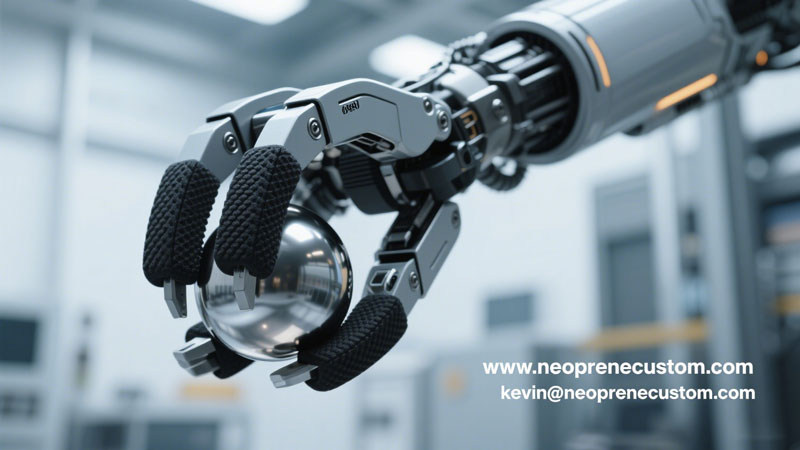
In today's era dominated by automation and smart manufacturing, industrial robots have become an indispensable force on the production line. However, have you ever pondered a seemingly minor yet critically important question? When a multi-million-dollar robot arm performs a precision operation, what ensures it can securely and flawlessly grip objects of varying shapes and materials? The answer lies in the "anti-slip gloves" hidden beneath the metal jaws—high-performance foam materials. Among them, SBR (Styrene-Butadiene Rubber) foam is emerging as the premier choice for enhancing robotic gripping stability and accuracy, thanks to its unique combination of properties.
Isn't it fascinating how a small foam component can have such a profound impact on the entire automation process?
I. The Invisible Challenges on the Automation Line: Slippage, Vibration, and Damage
Imagine these scenarios: on a high-speed electronics assembly line, a robot needs to grip a smooth glass screen; in an automotive assembly plant, a robotic arm must handle heavy, painted metal parts; in the food packaging industry, a robot has to pick up soft, fragile pastries. All these tasks face common challenges:
Slippage Risk: When rigid metal grippers make direct contact with smooth or irregular surfaces, insufficient friction can easily lead to slippage. This results in inaccurate positioning, dropped parts, and even production line shutdowns.
Vibration Impact: Vibrations generated during the robot's start-stop, acceleration, and deceleration phases are transmitted through the gripper to the workpiece. For operations requiring high-precision alignment, this minuscule vibration can be the difference between success and failure.
Workpiece Damage: While a stronger clamping force can prevent slippage, it also risks leaving scratches, dents, or other damage on delicate or high-value workpiece surfaces, causing irreversible losses.
Faced with these dilemmas, must we make a painful compromise between "not gripping tight enough" and "gripping too tight"? Absolutely not. This is precisely where SBR foam demonstrates its core value.
II. Unveiling SBR Foam: The Ideal "Anti-Slip Glove" for Industrial Robots
SBR foam, short for Styrene-Butadiene Rubber foam, is a synthetic rubber elastomer with a closed-cell or open-cell structure. What "genetic" makeup makes it the perfect partner for robot grippers?
Ultra-High Coefficient of Friction: The Cornerstone of Anti-Slip Performance
Is there anything more crucial than a "secure grip"? The surface of SBR foam has a natural coefficient of friction far superior to that of metal or hard plastics. When used as the contact surface of a gripper, it's like equipping the robot with a pair of high-performance anti-slip gloves. Whether dealing with greasy metal components, smooth plastic casings, or irregular castings, SBR foam significantly increases contact friction. This allows for a firm grip with minimal clamping force, fundamentally solving the problem of slippage.
Excellent Vibration Damping and Cushioning: The Guardian of Precision Operations
How are the shocks and vibrations from a moving robot arm absorbed? The secret lies in the microscopic structure of SBR foam. Its countless tiny, closed cells act like thousands of miniature air cushions, effectively absorbing and dissipating vibrational energy from the mechanical arm and cushioning the impact of the initial grip. This means the workpiece remains stable even during high-speed movements, while also preventing surface damage that could result from rigid contact.
Outstanding Abrasion Resistance and Durability: A Guarantee of Cost-Effectiveness
As a production tool, service life and maintenance costs are paramount. Is SBR foam "durable" enough? The answer is a resounding yes. SBR rubber itself is renowned for its excellent abrasion resistance, commonly used in high-wear products like car tires. When applied to robot grippers, it can withstand millions of gripping cycles without significant wear or particulation, ensuring production continuity and stability. This drastically reduces the frequency and cost of replacing gripper pads.
Good Resistance to Oil and Chemicals: Adapting to Harsh Industrial Environments
Industrial environments are often challenging, filled with oils, coolants, and cleaning agents. Can SBR foam maintain its performance in such conditions? It exhibits good resistance to moderately aggressive oils and a wide range of chemicals, preventing it from swelling, hardening, or degrading easily. This ensures its long-term reliability across various complex working conditions.
III. Why "Standard" SBR Foam Falls Short: Customization is King
Given the excellent properties of SBR foam, couldn't we just buy standard sheets off the market and cut them ourselves? For companies truly pursuing ultimate performance and efficiency, the answer is no. The reason is simple: every automation application is unique.
What is the shape of the workpiece you need to grip? Is it curved, flat, or grooved?
What are the temperature and humidity conditions of your production environment?
What are your requirements for gripping accuracy and speed?
Only a customized SBR foam solution can perfectly answer these questions. And we, at neoprenecustom.com, are the experts in this field. We are not just material suppliers; we are your dedicated custom fabrication partner, deeply understanding your every nuanced requirement.
Our Customization Services Include:
Precise Thickness and Hardness Selection: From ultra-soft to semi-rigid, and from 1mm to several centimeters thick, we can provide the SBR foam that best suits your clamping force and cushioning needs. Need to grip heavy objects? Choose a higher hardness and thickness. Handling delicate electronic components? A softer foam with better resilience is your go-to.
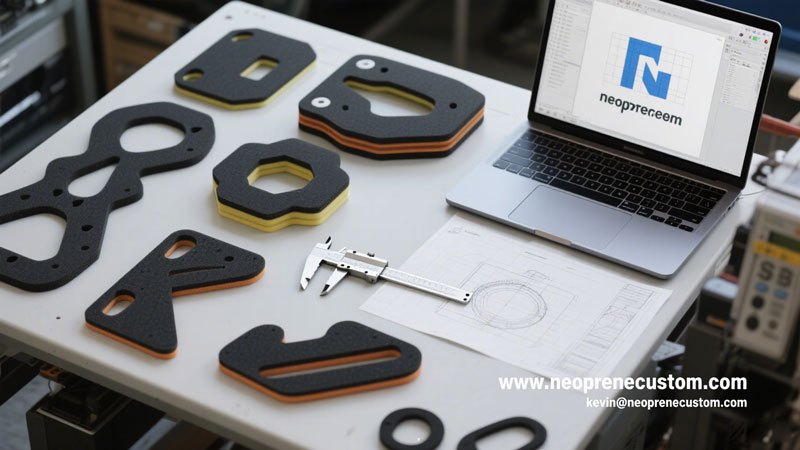
Complex Shape Die-Cutting and Forming: Your gripper isn't flat? No problem. Using advanced CNC cutting and die-cutting technology, we can process SBR foam into any complex 2D or 3D shape based on your CAD drawings or samples, ensuring a perfect, seamless fit with your robot gripper.
Multi-Functional Lamination: Need enhanced durability? We can laminate SBR foam with high-abrasion fabrics like Nylon or durable polyesters. Need a built-in mounting solution? We can apply a specific pressure-sensitive adhesive (PSA) backing, allowing you to install it as easily as a sticker. Facing a unique chemical environment? We can apply special surface coatings for added protection.
Choice of Open-Cell vs. Closed-Cell Structure: Require excellent sealing and water resistance? Closed-cell SBR is your answer. Need some breathability and a softer touch? We can provide open-cell SBR foam.
We understand that a perfect robot gripper pad is worth more than the material itself. It is the culmination of experience, technology, and a deep understanding of the application. Want to learn more about how we can transform your unique needs into a highly effective and reliable SBR foam solution? Feel free to visit our official website at https://neoprenecustom.com, or send your drawings and requirements directly to our technical expert, Kevin, at kevin@neoprenecustom.com. Kevin and his team will provide you with a one-on-one professional consultation.
IV. Beyond Robot Grippers: More Possibilities for SBR Foam in Automation
The appeal of SBR foam extends far beyond serving as "anti-slip gloves." Its vibration damping and sealing properties make it ubiquitous in automation equipment:
Equipment Vibration Damping Pads: Placed under servo motors and conveyor drives to absorb vibrations, reduce noise, and extend equipment life.
Precision Instrument Sealing Gaskets: Fabricated into various gasket shapes using its closed-cell structure and good elasticity for equipment enclosures and sensor housings, providing dust and water protection.
Anti-Slip Conveyor Surfaces: Laminated onto conveyor belts to increase friction, preventing products from sliding during inclined transport.
Protective Linings for Jigs and Fixtures: Used as the contact surface between workpieces and fixtures in positioning and assembly stations, providing a secure hold while protecting the product's appearance.
Conclusion: Choosing the Right "Gloves" for Your Robot is an Investment in the Future
Let's return to our initial question: what ensures the precision and stability of an industrial robot's operation? The answer is now crystal clear. It's not the cold metal, but the meticulously designed and customized layer of SBR foam. It quietly and powerfully resolves the core pain points of slippage, vibration, and damage.
Aren't you ready to upgrade your automation equipment with this critically important pair of "anti-slip gloves"? Choosing a professional custom fabricator like neoprenecustom.com means you're not just selecting a piece of foam; you're choosing a long-term partner capable of boosting your production efficiency, ensuring product quality, and reducing operational costs.
Take action now. Contact kevin@neoprenecustom.com and let's discuss how custom SBR foam can unleash the full potential of your automated production line.
Contact: Kevin
Phone: 13417385320
Tel: 0734-87965514
Email: kevin@neoprenecustom.com
Add: Intersection of Zhangjialing Road and Science and Technology Road, Guiyang Industrial Park, Guiyang Town, Qidong County, Hengyang City, Hunan Province./Dongguan Factory(GUANXIN): Shixin Street, Fushan Village, Liaobu Town, Dongguan, Guangdong Province.
 Kevin
Kevin Kevin
Kevin
 Tianchi