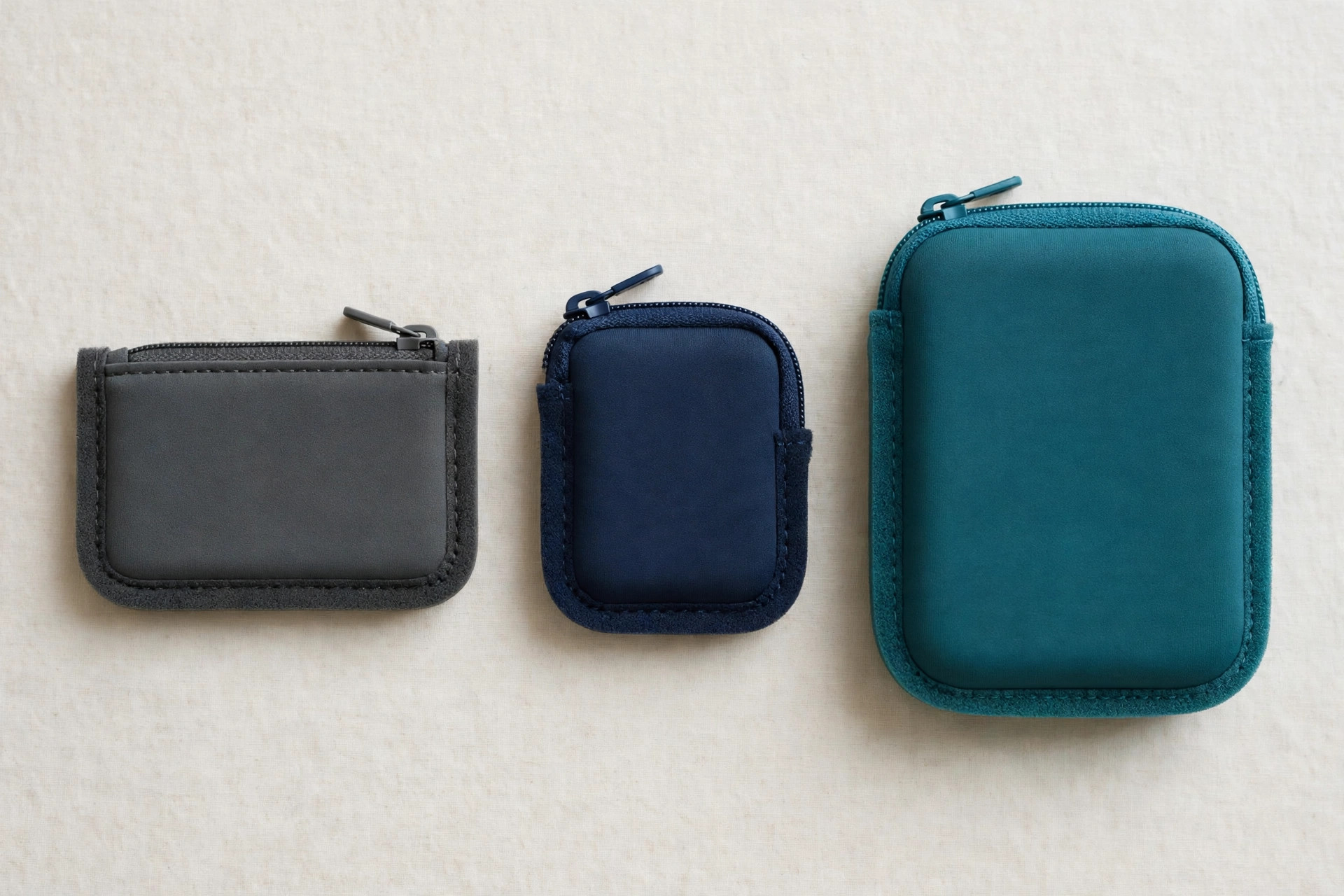
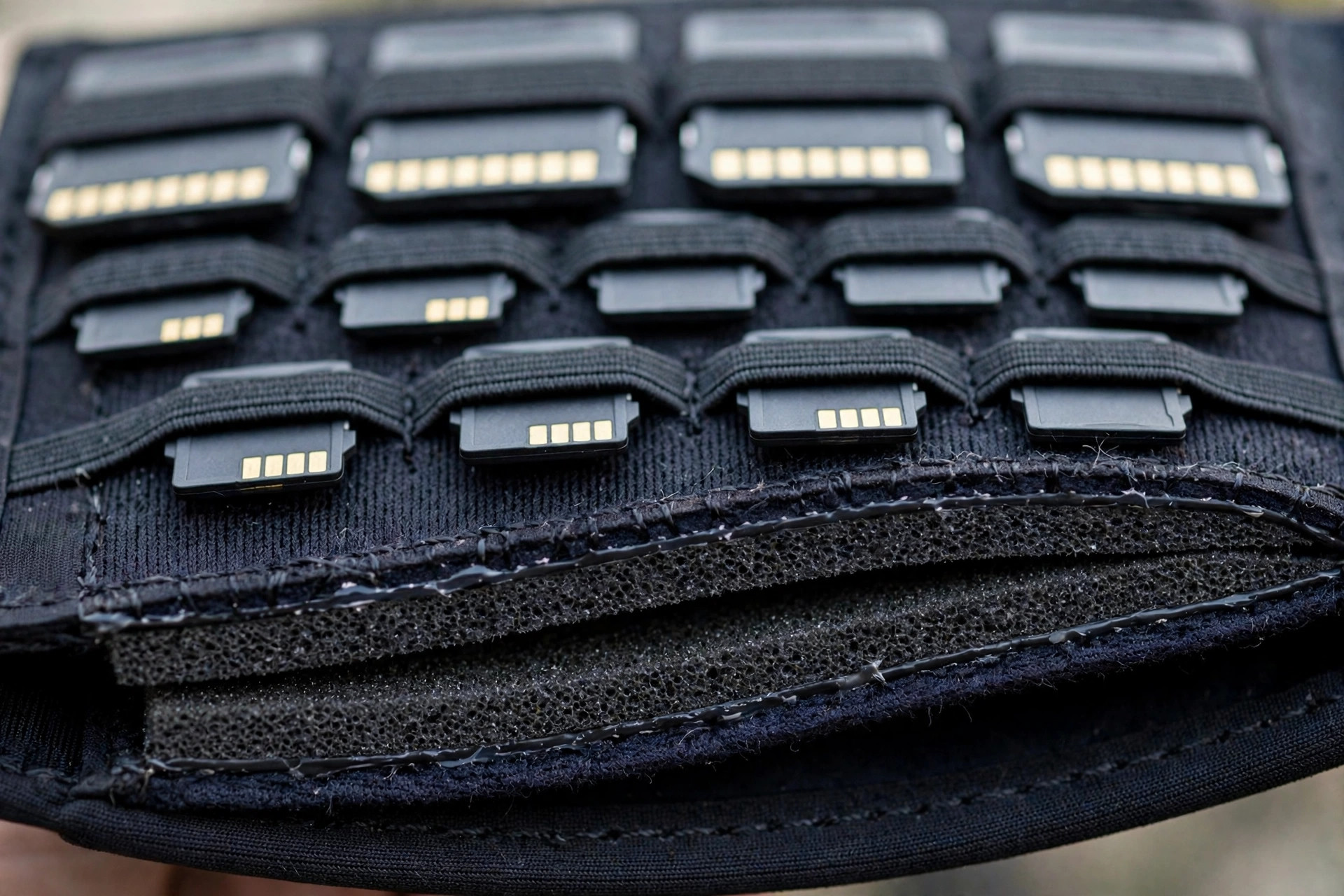
Neoprene small electronics cases are the family of slim, padded cases cut from laminated neoprene (SBR, SCR or CR foam + fabric) that organise the small devices and accessories people carry every day: SD card holders with a slot for every card, USB drive cases that keep drives apart, charger cases that hold a charger brick and its cable together, and adapter cases that keep a travel adapter and its plugs in one place. The foam cushions the contents against knocks, the soft lining keeps screens and casings scratch-free, and the fabric face carries the brand's print. Send us your design drawing and the size of the device the case is for, and we will confirm the best material and thickness.
We manufacture custom neoprene small electronics cases in our own factory in China, where we have made neoprene products for 15 years. We cut the foam, laminate the fabric face and stitch the finished cases under one roof, so a change to the size, the slot layout or the print can be checked on a sample before bulk production starts.
The problem these cases solve is the bottom of the bag. Memory cards, drives, chargers and adapters are small, valuable and easy to lose, and loose in a pocket or a laptop bag they scratch each other, tangle their cables and take the knocks every time the bag is set down. A padded case gives each item its own place: our neoprene SD card holders give every SD and microSD card its own elastic slot behind a zip, so a full card is never mixed up with an empty one and cards never rub face to face. The foam springs back after it is pressed, so the holder keeps its shape and the slots stay easy to reach after months of daily use.
The same construction runs through the rest of the family. Our neoprene USB drive cases open flat on a zip, with elastic slots sized to one drive each and room for a label window or a printed number beside each slot, so a buyer can tell at a glance which drive holds which files. Because the cases are light and the fabric face wipes clean, they sell as everyday carry for office and IT buyers as much as to photographers.
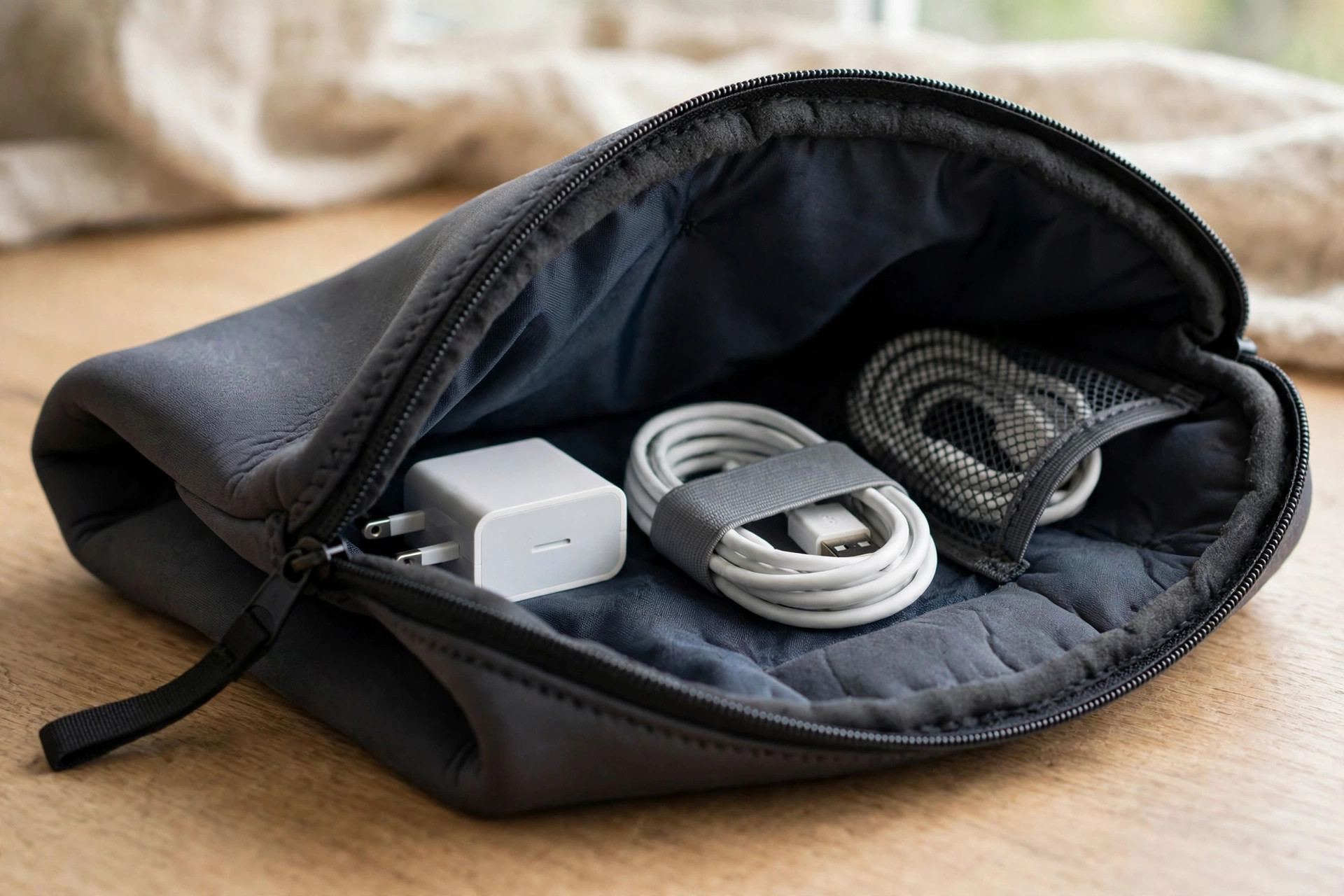
Chargers and adapters are the travel end of the range. Our neoprene charger cases hold the charger brick beside an elastic loop that keeps its cable coiled instead of tangled, with a mesh pocket for a spare cable, and our neoprene adapter cases keep a travel adapter in a padded pocket with a flat slot for its plugs, so the pins cannot scratch a phone or tablet packed beside them and the whole kit comes out of the suitcase in one piece. Bought in matching colours and print, the four cases read as one set on the shelf — which is how most of our buyers range them.
3 mm is the working standard for most small electronics cases. It gives a real cushion wall in a case that still slips into a camera bag pocket, a laptop sleeve or a suitcase corner, which is why most of the SD holders, USB cases and adapter cases we make are cut in 3 mm. For the full range, see our neoprene sheet thickness guide.
| Thickness | Best for | Trade-off |
|---|---|---|
| 3 mm | SD card holders, USB drive cases and adapter cases — the slim everyday standard | Least padding; organisation and scratch protection matter more than impact protection |
| 5 mm | Charger cases and fuller cases carried loose in a work bag or checked luggage | Best balance of cushioning, shape and easy carrying |
| 7 mm | Larger charger and multi-device cases where the contents are heavy or fragile | Thickest and bulkiest; more case than most small accessories need |
Measure the contents, not the catalogue. For a card holder, tell us the card count — how many SD and how many microSD slots. For a drive, charger or adapter case, send the length, width and depth of the device itself, plus anything that travels with it: the cable, the spare plugs, the extra battery. The case is cut to your dimensions, with the slots, elastic loops and pockets laid out for what your buyers actually carry, and a sample is checked against the real device before bulk production.
SBR is the standard choice for most small electronics cases, because a gadget case's working life is inside a bag, a drawer or a suitcase, where the firmer, lighter, lower-cost foam does everything the job asks. CR (chloroprene rubber) earns its higher price on cases that live a harder life — a photographer's card wallet in and out of a kit bag in all weathers, season after season — where its softer stretch and weather resistance show. SCR, a blend of the two, sits between them where a range wants a softer hand-feel than SBR at a lower cost than CR.
The figures behind the two foams show why they feel different: our CR foam measures 3–5° Shore C hardness, 276.32 kg/m³ density, 860 kPa tensile strength and 550% elongation, while our SBR foam measures 10–15° Shore C, 158.34 kg/m³, 256 kPa and 185%. CR is the softer, springier foam; SBR is the firmer, lighter one. On a small case, that means a CR case stretches a little over a full load and hugs it, while an SBR case is cut closer, holds a crisper shape and keeps the slots standing open.
| SBR | CR | |
|---|---|---|
| Cost | Lower cost; the standard for most small cases | Costs more than SBR |
| Sun and weather resistance | Fair; best carried inside a bag or used indoors | Better; the choice for kit carried outdoors in all weathers |
| Feel | Firm and light, holds a crisp shape and open slots | Soft and elastic, stretches over a full load and hugs it |
Whichever foam the range is built on, the four cases share one construction — laminated foam, a soft nylon jersey lining that does not catch on card edges or plug pins, bound edges and a zip — so a mixed order of card holders, drive cases, charger cases and adapter cases comes off the same line in the same colours and print, and reads as one product family when it reaches your shelf.
Electronics and gadget brands — a matching case family sold alongside the devices, or bundled in the box as the branded extra.
Camera shops and photography retailers — SD and microSD card holders ranged with the cards and camera bags your customers already buy.
Travel accessory brands and retailers — charger and adapter cases that complete a travel kit and travel with the customer on every trip.
Promotional and corporate gift buyers — printed USB drive and charger cases handed out at events, where the case keeps the logo in daily use long after the event.
When neoprene is NOT the right choice
Tell us which of these your small electronics cases need, and we will build the sample to your drawing.
Which material is best for small electronics cases?
SBR is the standard for most cases — firm, light and lower cost, and a case spends its life inside a bag. CR is the upgrade for cases carried outdoors in all weathers, and SCR blends the two. All three are laminated with fabric such as nylon jersey, which lines the inside so contents slide in without catching.
Will the case fit my device?
Yes — every case is made to your dimensions. Send the device's length, width and depth (or the card count for a card holder) and tell us what travels with it, and mixed sizes and layouts can share one order.
Can you print our logo on the cases?
Yes. Sublimation gives full-colour artwork across the whole case, screen print gives a bold name or logo, and a woven label or rubber patch gives a quieter finish. The same artwork and colours can run across the whole case family.
What thickness should I choose?
3 mm for slim card holders, drive cases and adapter cases; 5 mm for charger cases and fuller cases carried loose in a bag; 7 mm only for larger or heavier contents. We will confirm the thickness on your sample.
What is the minimum order?
200 pieces per design as a general minimum, adjustable to your actual order.
Can I get a sample first, and how long does bulk production take?
Yes — we support sampling, usually in 5–7 days, and the sample is checked against the real device. Bulk production usually takes 15–18 days after sample approval, depending on the quantity and customisation.
We make custom neoprene small electronics cases to your device size, your slot layout and your print, and we check the fit on a sample with the real contents before bulk production. The general minimum order is 200 pieces per design, adjustable to your actual order; sampling is supported, usually in 5–7 days, and bulk production usually takes 15–18 days after sample approval.
Request a Quotation
To help us review your inquiry, please send:
Website: https://www.neoprenecustom.com/ Email: kevin@neoprenecustom.com
A small case is judged in the hand, not on the page. Send us the device the case is for and we will make you a sample that fits it. For the bigger end of the same family, see our neoprene power bank cases.
Contact: Kevin
Phone: 13417385320
Tel: 0734-87965514
Email: kevin@neoprenecustom.com
Add: Intersection of Zhangjialing Road and Science and Technology Road, Guiyang Industrial Park, Guiyang Town, Qidong County, Hengyang City, Hunan Province./Dongguan Factory(GUANXIN): Shixin Street, Fushan Village, Liaobu Town, Dongguan, Guangdong Province.