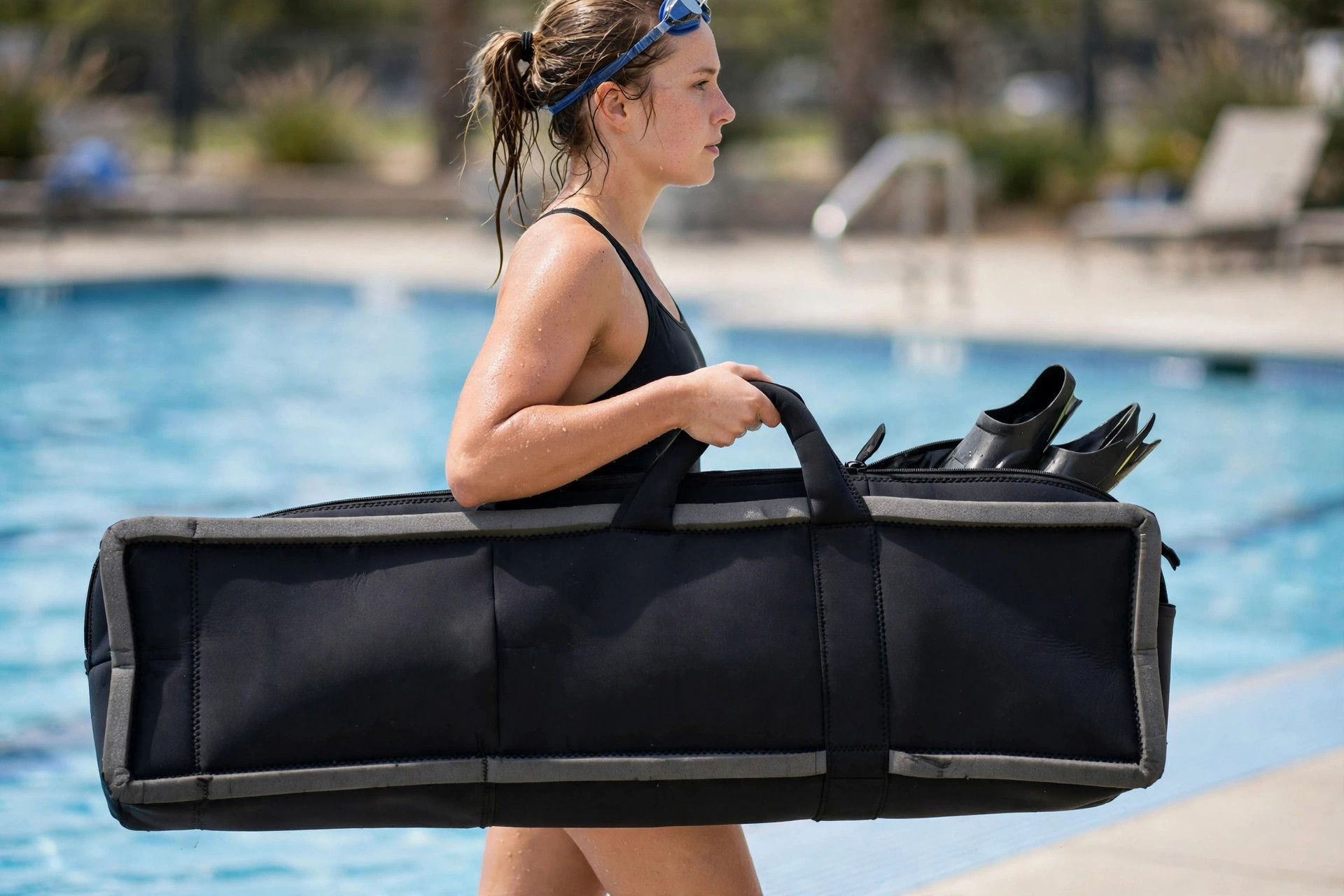
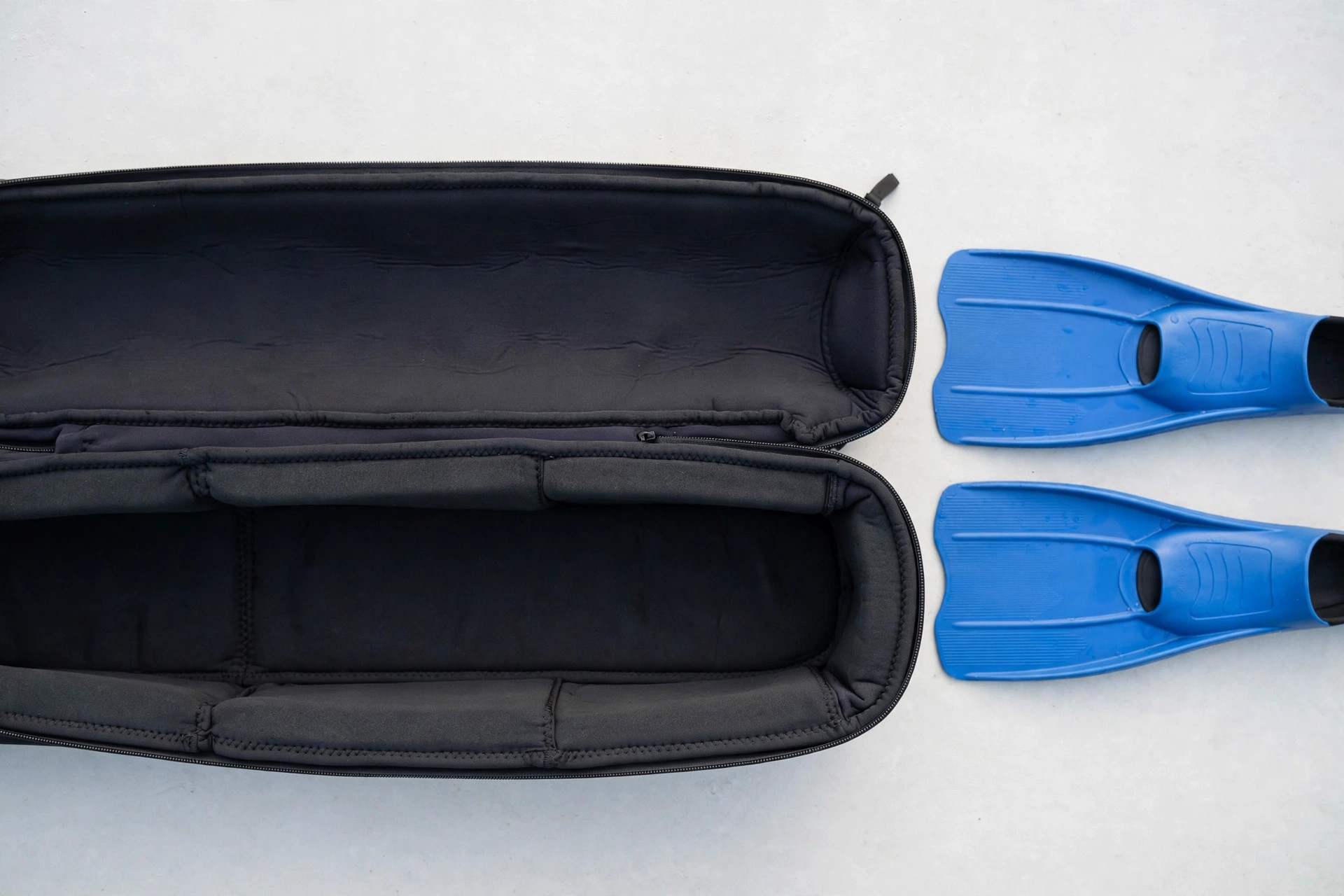
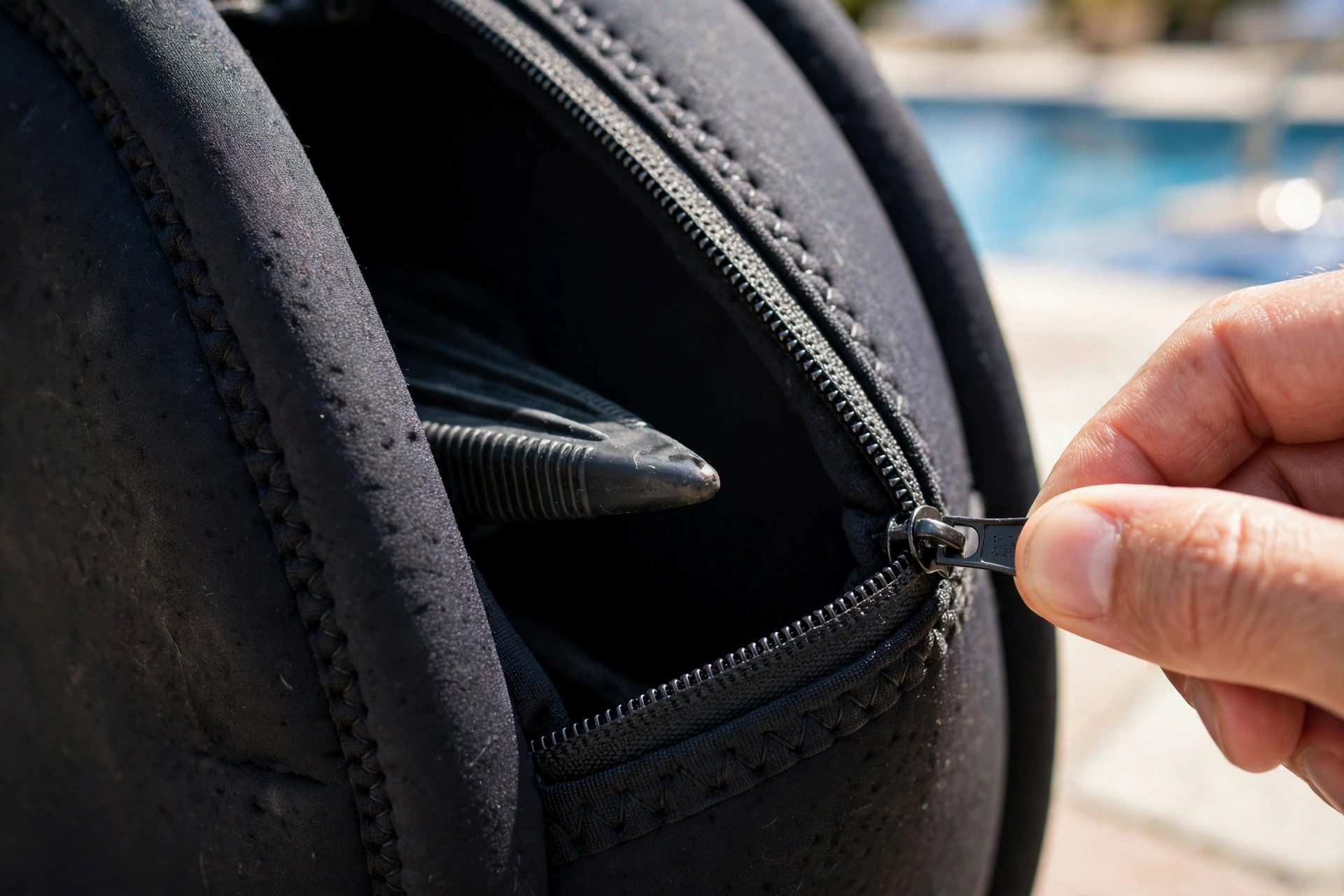
A neoprene fin bag is a long, zippered carry bag built from laminated neoprene (SBR, SCR or CR foam + fabric), shaped to the length of a pair of swim, snorkel or dive fins. The padded foam walls do three jobs at once: they cushion the fin blades against the knocks of a kit bag, a car boot and a boat deck; they keep a wet pair of fins in their own compartment instead of dripping over everything else; and they give a long, awkward piece of kit a handle and a shape that carries like a bag. Send us your design drawing and the fin sizes the bag must fit, and we will confirm the best material and thickness.
We manufacture custom neoprene fin bags in our own factory in China, where we have made neoprene products for 15 years. We laminate the foam, cut the panels and stitch the finished bags under one roof, so a change to the length, the handle or the print can be checked on a sample before bulk production starts.
Fins are the most awkward shape in the bag. Long, flat and rigid, they poke out of open totes, catch on everything, and their blades and foot pockets take the knocks that split rubber and crack edges — usually against the other hard kit they travel with. A shaped neoprene bag ends that: the pair slides into its own padded sleeve, the zip closes the length, and the fins travel as one protected item that can be grabbed, hung and stored without shedding water over the rest of the gear. After the swim the same bag works in reverse — wet fins go in, and the car seat and the dry clothes stay dry.
The foam is also the organisation. A fin bag with an outside pocket takes the mask and snorkel that belong with the fins, so the whole snorkel set travels as one unit from shelf to shore; dive versions run longer and wider for full-size blades, with a handle balanced at the carry point so a heavy pair hangs level. Because the bag is neoprene throughout, it rinses with the rest of the kit, shakes dry and does not go stiff or musty the way a lined fabric bag can between trips.
For dive and swim brands, the bag is the printed surface of the set: a full-length panel for the artwork, colours matched to the fins and masks in the range, and sizes from short swim-training fins to long freediving blades. It belongs to the same family as our neoprene dive bags — one material across the whole kit wall.
5 mm is the most popular thickness for neoprene fin bags. The walls have to pad a rigid blade properly and hold the bag's long shape open while the fins slide in — and 5 mm is where most of the bags we make land. For the full range, see our neoprene sheet thickness guide.
| Thickness | Best for | Trade-off |
|---|---|---|
| 3 mm | Short swim-training fins and light travel, where the bag folds away small | Least padding against hard knocks in a packed kit bag |
| 5 mm | The standard bag — snorkel and recreational dive fins, everyday travel | The balanced choice; neither the lightest nor the most padded |
| 7 mm | Long freediving blades and checked-luggage travel, where protection matters most | Bulkiest option; more than a pool-side bag needs |
Size the bag to the fin, by overall length and blade width. A fin bag that is an inch short is useless, so measure the longest fin in the range — including the foot pocket — and we will add the clearance the zip needs to close without forcing the blade. Most ranges run two or three lengths: swim, snorkel and long-blade.
SBR is the standard choice for most fin bags, because the firmer foam holds the bag's long shape, stands up to wet-kit handling and keeps the price where a set accessory needs it. CR (chloroprene rubber) earns its higher price on premium dive lines — it is softer and more elastic, so the bag flexes around an awkward load and feels richer, and it shrugs off the flexing a long bag gets at its carry point. SCR, a blend of the two, sits between them on both feel and cost.
The figures behind the two foams show why they behave differently: our CR foam measures 3–5° Shore C hardness, 276.32 kg/m³ density, 860 kPa tensile strength and 550% elongation, while our SBR foam measures 10–15° Shore C, 158.34 kg/m³, 256 kPa and 185%. On a fin bag, SBR's firmness keeps the walls standing so fins slide in easily; CR's stretch is what lets a fully loaded bag flex instead of fighting the carrier.
| SBR | CR | |
|---|---|---|
| Cost | Lower cost; the standard for most fin bags | Costs more than SBR |
| Shape and handling | Firm walls that hold the long shape and stand open for loading | Softer and more elastic; flexes around a full load |
| Best for | Swim and snorkel ranges at a working price | Premium dive and freediving lines where feel and flex sell |
For lengths, pocket layouts and printing, see our neoprene fin bags product page. The fins' smaller companions travel in our neoprene fin socks, worn inside the fin pocket itself.
Dive and snorkel brands — a fin bag sized to your own fin range, in your colours and print, sold as the set's carry case.
Swim retailers and clubs — bags for training fins in squad colours, with names and logos printed per team.
Resorts and dive centres — rental-fleet bags that keep pairs together, rinsed and stored as units.
E-commerce sellers — clear length specs matched to fin sizes, packed flat and light to ship.
When neoprene is NOT the right choice
Tell us which of these your fin bags need, and we will build the sample to your drawing.
What size fin bag do I need?
One that is longer than your longest fin. Measure the fin from the back of the foot pocket to the blade tip, and match it to the bag's internal length — we add the clearance the zip needs. If your range spans swim fins and long blades, order the two or three lengths rather than forcing one size.
Does the bag keep wet fins away from dry kit?
Yes — that is half its job. Wet fins go into their own zipped compartment, so the water stays with the fins instead of spreading through the car or the rest of the luggage. Open and air the bag when you get home, as with any wet kit.
Can the bag carry a mask and snorkel too?
With the outside pocket option, yes — the pocket is sized for a mask, with the snorkel alongside, so the whole snorkel set travels as one unit. Tell us at drawing stage and we will build the pocket in.
What is the minimum order?
200 pieces per design as a general minimum, adjustable to your actual order.
Can I get a sample first?
Yes — we support sampling, usually in 5–7 days. Send us your design drawing and the fin sizes the bag must fit.
How long does bulk production take?
Usually 15–18 days after sample approval, depending on the quantity and customisation.
We make custom neoprene fin bags to your fin sizes, colours and print, and we test the fit with the real fins before bulk production. The general minimum order is 200 pieces per design, adjustable to your actual order; sampling is supported, usually in 5–7 days, and bulk production usually takes 15–18 days after sample approval.
Request a Quotation
To help us review your inquiry, please send:
Website: https://www.neoprenecustom.com/ Email: kevin@neoprenecustom.com
A fin bag is judged in the car park, with wet kit and full hands. Send us your fin sizes and we will make a sample to be judged exactly there. For the regulator that travels with the fins, see our neoprene scuba regulator bags.
Contact: Kevin
Phone: 13417385320
Tel: 0734-87965514
Email: kevin@neoprenecustom.com
Add: Intersection of Zhangjialing Road and Science and Technology Road, Guiyang Industrial Park, Guiyang Town, Qidong County, Hengyang City, Hunan Province./Dongguan Factory(GUANXIN): Shixin Street, Fushan Village, Liaobu Town, Dongguan, Guangdong Province.