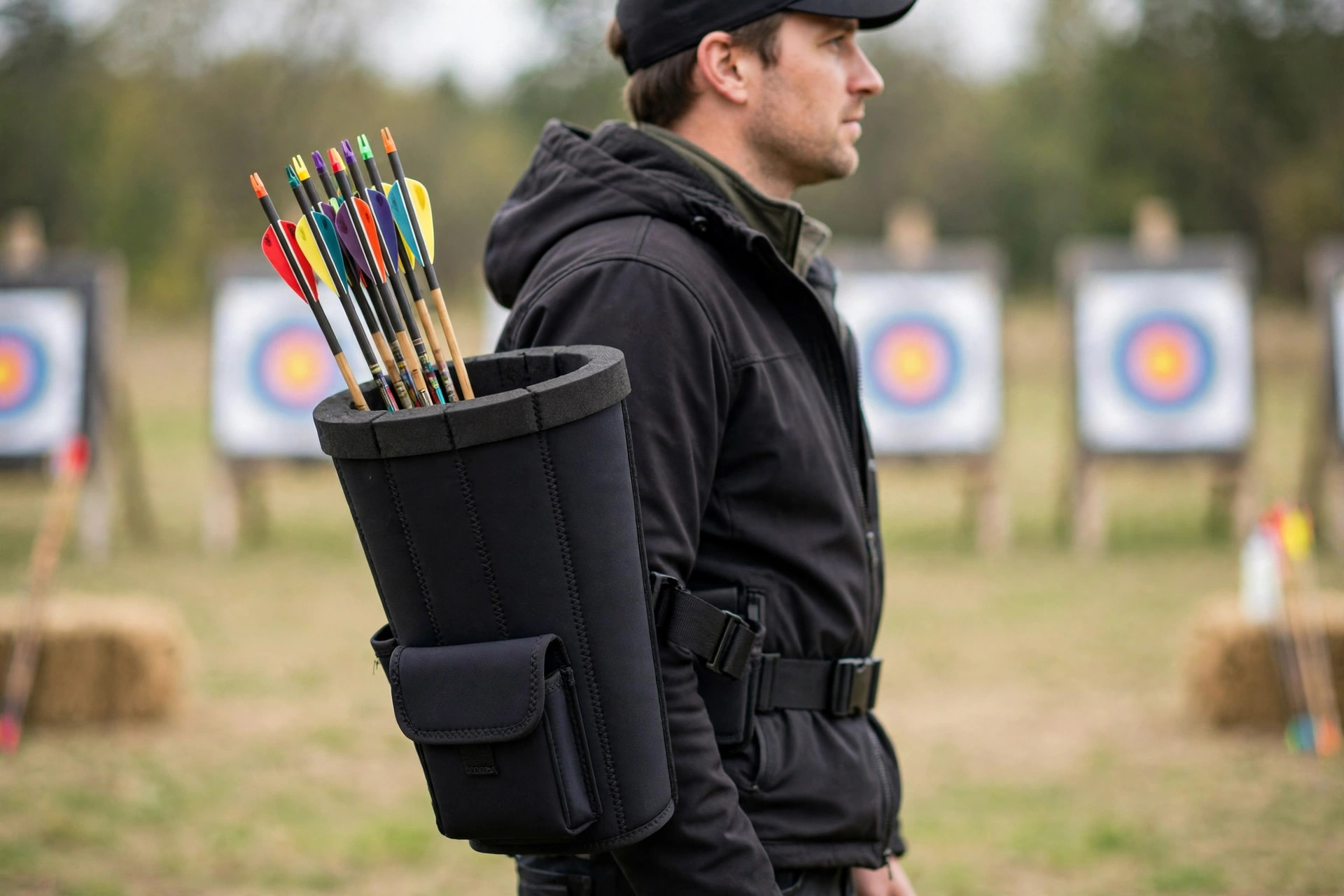
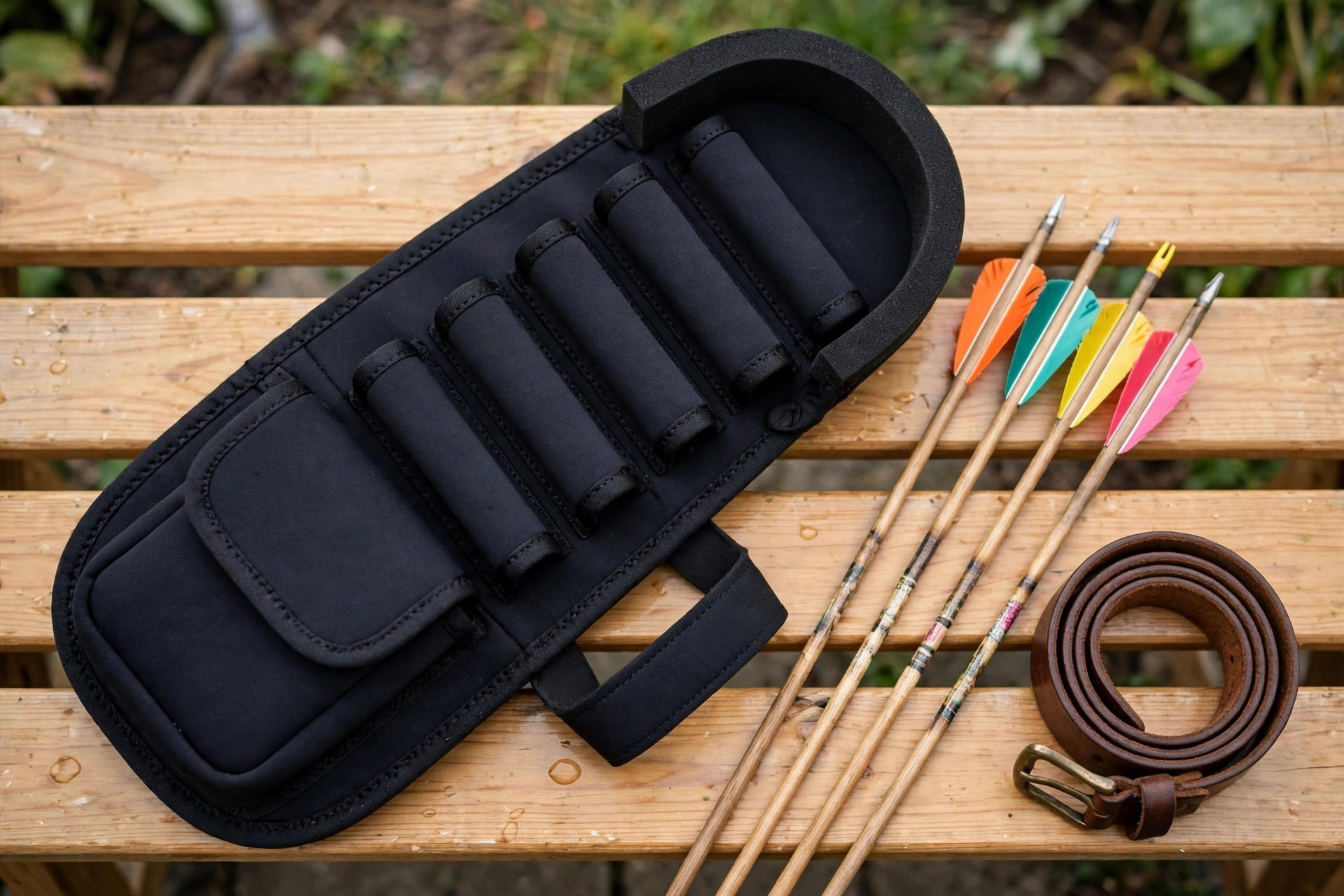
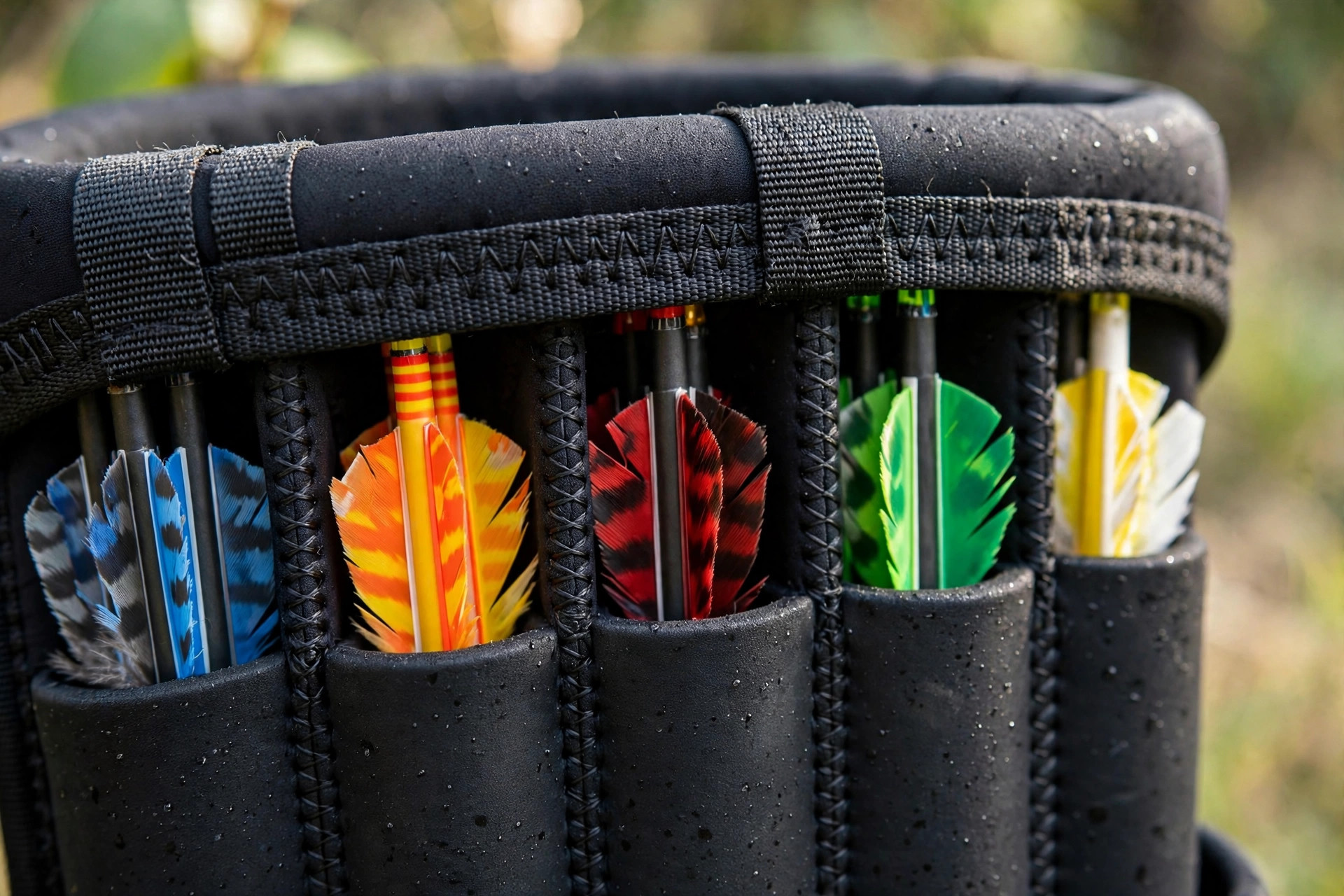
A neoprene archery quiver is a hip-worn arrow holder built from laminated neoprene (SBR, SCR or CR foam + fabric): a shaped body with divided tubes or pockets that carry arrows points-down at the hip, hung from the archer's belt or its own strap. The foam is what sets it apart from a leather or nylon quiver — it grips the arrow shafts gently so they ride quietly, pads the hip where the quiver hangs all day, and flexes with the wearer walking a field course instead of swinging stiffly from the belt. Send us your design drawing and the arrow count and length the quiver must carry, and we will confirm the best material and thickness.
We manufacture custom neoprene archery quivers in our own factory in China, where we have made neoprene products for 15 years. We laminate the foam, cut the panels and stitch the finished quivers under one roof, so a change to the tube layout, the pocket arrangement or the belt fitting can be checked on a sample before bulk production starts.
Arrows announce a bad quiver. Shafts rattling against each other and against a hard quiver body are noise on the shooting line and a distraction walking between targets, and hard tubes chip and scuff shafts and fletchings over a season. Neoprene answers with contact: the divided tubes are lined and separated by foam, so each arrow sits in its own padded channel, held lightly by the material itself rather than clamped or left loose to knock. Fletchings clear each other, points stay down and covered by the quiver body, and the whole set rides in silence.
The hip is the other half of the design. A quiver hangs in one place for hours — shooting, walking, scoring, bending for arrows — and a rigid body digs in at every step. A neoprene body shapes to the hip, the padded back panel spreads the hang weight, and the belt loop or clip is positioned so the quiver sits at the draw angle the archer wants, tubes tilted for a clean pull. Pockets for a release aid, tab, pencil and scorecard sit on the outer face, because a field quiver is also the archer's pocket for everything the round needs.
For archery brands and pro shops, the quiver is a visible colourway item: club colours, a printed logo on the outer panel and a matched layout across target, field and youth sizes. The same foam-and-stitch construction protects the bow itself in our neoprene archery bow covers, so a brand can build one material story across the whole kit bag.
5 mm is the most popular thickness for neoprene archery quivers. The body has to hold the tube divisions open so arrows slide in and out cleanly, while still flexing at the hip — and 5 mm is where most of the quivers we make land. For the full range, see our neoprene sheet thickness guide.
| Thickness | Best for | Trade-off |
|---|---|---|
| 3 mm | Light youth and beginner quivers carrying a few arrows | Softest tube divisions; arrows sit less positively |
| 5 mm | The standard field and target quiver — divided tubes, full pocket layout | The balanced choice; neither the lightest nor the firmest |
| 7 mm | Maximum padding and the firmest tube structure for long field rounds | Bulkiest at the hip; more than a target-line quiver needs |
Size the quiver by arrow count and arrow length. The tube depth must cover the shaft so the points stay inside the body, and the division count sets how many arrows ride separately — most field quivers carry three to six. Tell us the arrow lengths your customers shoot and the layout they expect, and we will pattern the body depth and tube divisions to match.
SBR is the standard choice for most archery quivers, because the firmer foam holds the tube divisions open and the body shape set, stands up to outdoor use and keeps the price where a club or retail range needs it. CR (chloroprene rubber) earns its higher price on premium lines — it is softer and more elastic, so the quiver settles against the hip more comfortably over a long round and feels richer in the hand. SCR, a blend of the two, sits between them on both feel and cost.
The figures behind the two foams show why they behave differently: our CR foam measures 3–5° Shore C hardness, 276.32 kg/m³ density, 860 kPa tensile strength and 550% elongation, while our SBR foam measures 10–15° Shore C, 158.34 kg/m³, 256 kPa and 185%. On a quiver, SBR's firmness keeps the arrow channels defined; CR's softness is what the hip feels at the end of a long day.
| SBR | CR | |
|---|---|---|
| Cost | Lower cost; the standard for most quivers | Costs more than SBR |
| Structure and feel | Firm body; tube divisions stay open and defined | Softer and more elastic; settles against the hip |
| Best for | Club, school and retail ranges at a working price | Premium lines where comfort over long rounds sells |
For tube layouts, pocket arrangements and belt fittings, see our neoprene archery quivers product page. The optics that share the field bag are protected by our neoprene rangefinder cases.
Archery brands — your own quiver in your tube layout, colours and print, matched to your bow covers and cases.
Pro shops and ranges — club and rental-fleet quivers that survive daily handling and rinse clean.
Clubs and schools — colour-coded quivers by group or level, in youth and adult sizes.
E-commerce sellers — a clear arrow-count and length spec, packed flat with a belt included or as body only.
When neoprene is NOT the right choice
Tell us which of these your archery quivers need, and we will build the sample to your drawing.
How many arrows does a neoprene hip quiver hold?
Most carry three to six arrows, each in its own foam-divided tube. The division count is set at pattern stage, so tell us how your customers shoot — a target set, a field round — and we will lay the tubes out to match.
Why neoprene instead of leather or nylon?
Because of contact and comfort. The foam grips each shaft lightly so arrows ride without rattling, the padded body flexes at the hip instead of digging in, and the whole quiver rinses clean after a wet field round. It is a different feel from a hard tube or a stiff leather body — softer, quieter, lighter.
Does it fit both left- and right-handed archers?
Yes — the body is patterned for the hip it hangs on, so order left-hip and right-hip versions as your range needs. Tell us the split when you send the drawing.
What is the minimum order?
200 pieces per design as a general minimum, adjustable to your actual order.
Can I get a sample first?
Yes — we support sampling, usually in 5–7 days. Send us your design drawing, arrow count and the arrow lengths the quiver must carry.
How long does bulk production take?
Usually 15–18 days after sample approval, depending on the quantity and customisation.
We make custom neoprene archery quivers to your tube layout, arrow lengths, colours and print, and we check the draw from a real belt before bulk production. The general minimum order is 200 pieces per design, adjustable to your actual order; sampling is supported, usually in 5–7 days, and bulk production usually takes 15–18 days after sample approval.
Request a Quotation
To help us review your inquiry, please send:
Website: https://www.neoprenecustom.com/ Email: kevin@neoprenecustom.com
A quiver is judged at the last target of a long round, by whether the arrows are still riding quietly. Send us your layout and we will make a sample to be judged exactly there. For the gun-side of the field shelf, see our neoprene rifle & shotgun cases.
Contact: Kevin
Phone: 13417385320
Tel: 0734-87965514
Email: kevin@neoprenecustom.com
Add: Intersection of Zhangjialing Road and Science and Technology Road, Guiyang Industrial Park, Guiyang Town, Qidong County, Hengyang City, Hunan Province./Dongguan Factory(GUANXIN): Shixin Street, Fushan Village, Liaobu Town, Dongguan, Guangdong Province.