
Custom Neoprene Tool Bags: How to Choose Size, Pockets and Carry Style
A good custom neoprene tool bag is a 3 mm closed-cell neoprene bag or roll with elastic pockets sized to your tools, a reinforced base and a padded carry handle. It protects sharp tool edges, keeps wrenches and screwdrivers in order, and we make it to order in any size, colour and print.
What Is a Neoprene Tool Bag — and Why It Beats Canvas and Leather
A neoprene tool bag is a bag or roll made from closed-cell chloroprene rubber foam, laminated with fabric on one or both faces, built to carry hand tools — wrenches, pliers, screwdrivers, sockets and spanners. The foam is full of tiny sealed gas bubbles. Those bubbles cushion sharp edges, so tools do not cut through the bag or clatter against each other, and they give the bag a soft structure that holds its shape without a stiff frame. A canvas bag soaks up oil and rain and wears through at the corners. A leather bag is heavy, expensive, and stiff in cold weather. Neoprene is the only one of the three that is soft, light, water-resistant and easy to wipe clean at the same time.
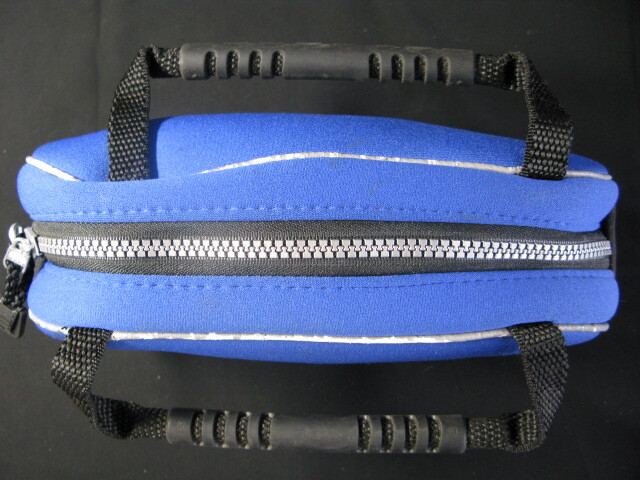
A bright blue neoprene tool bag — the smooth matte face, white piping and zipper closure.
The material is the same CR neoprene foam sheet we use across our wetsuits and sports supports — see our ultimate guide to neoprene sheets for how the foam is made. Bulk buyers are tool brands, automotive workshops, electricians, HVAC installers and corporate gift buyers. A printed bag turns a basic tool carrier into a branded product, and one size range covers a whole trade.
How Thick Should the Padding Be?
3 mm is the standard for a tool bag. Below 2 mm, the bag is a dust cover — it stops scratches but cushions nothing when a heavy wrench drops onto the bottom. At 3 mm, the foam cushions tool edges and holds the bag's shape in a van or a toolbox. Above 5 mm, the bag gets stiff and bulky, and the pockets will not close flat around the tools. For most tool bags we use 3 mm, and 2 mm for a slim wrench roll that must fold flat.
Our factory splits foam from 1.5 mm to 45 mm, so any thickness is possible — but for tool bags we use a soft SBR grade. Our SBR 5–7° foam is our soft grade for sewn accessories: tensile strength 247 kPa and elongation 199% on its technical data sheet. That stretch is what lets the bag flex around a full set of tools instead of cracking at the seams. See our neoprene sheet thickness guide for how to pick the right mm for any product.
Thickness is only half the story. The foam must be closed-cell. Open-cell foam is softer and cheaper, but it absorbs oil, water and grease, holds the smell, and tears more easily at the seams. Ask your supplier which foam they use — and ask for the data sheet, not just a claim.
What Size Fits Your Tools?
Order by the longest tool, then by the tool count. Measure the longest wrench or screwdriver in the set, then count how many tools the bag must hold. A bag that is too short leaves tool handles sticking out of the top. A bag that is too big lets the tools slide around and clatter. Add 3–5 cm to the longest tool for the seams and the closure.
| Bag Type | Bag Size | Tool Count | Longest Tool | Best For |
|---|---|---|---|---|
| Small wrench roll | 30 × 40 cm unrolled | 8–12 tools | Up to 25 cm | Electricians, home DIY |
| Medium tote | 40 × 25 × 20 cm | 15–25 tools | Up to 35 cm | Mechanics, HVAC installers |
| Large roll | 50 × 45 cm unrolled | 25–40 tools | Up to 45 cm | Auto mechanics, site work |
| XL duffel | 55 × 30 × 30 cm | 40+ tools | Up to 50 cm | Contractors, full kits |
If you sell to one trade, the medium tote is the volume product — it fits most hand-tool sets and stacks neatly in a van. If you sell to auto mechanics, add the large roll, because a full wrench set will not fit in a tote. Tell your supplier the longest tool and the tool count — the bag is cut to fit both.
Pockets and Layout: Rolls, Pouches and Open Totes
Pick the layout by how the tools are used, not by how the bag looks. A tool roll lays flat and shows every tool at a glance — the best choice for a mechanic who reaches for one wrench at a time. A tote with deep pockets carries a mixed set and lets you grab from the top — the best choice for a tradesman who carries the bag from job to job. A zippered pouch keeps small parts — bits, sockets, screws — from spilling out in the van.
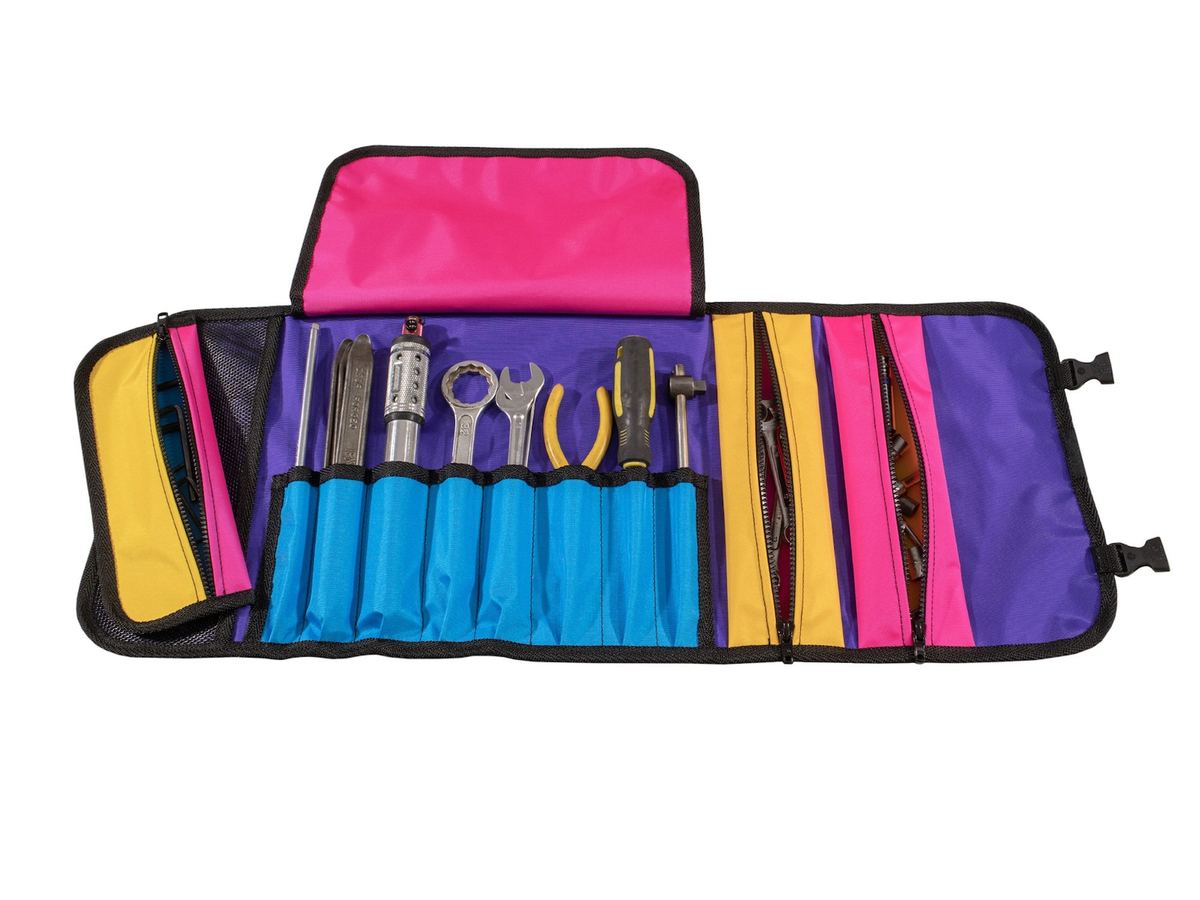
An open tool roll, laid flat — every wrench, plier and screwdriver in its own pocket, visible at a glance.
Elastic loops hold each tool in its own pocket, so the tools do not clatter and the edges do not cut the fabric. The loops should grip the tool firmly but let it slide out with one hand — too tight and the tool jams, too loose and it falls out when the roll is carried. Ask your supplier how the loops are sized: one loop width per tool size, or adjustable loops that fit a range.
Do not overdo the pockets. A bag with 30 pockets looks clever in a photo and frustrates in use — every pocket is a seam that can fail and a place to lose things. One row of elastic loops for the main tools, one zippered pocket for small parts, and one open pouch for the tools in daily use is enough. The main compartment should open wide, so the whole set is visible at a glance.
Waterproof or Just Water-Resistant? What the Bag Really Keeps Out
The foam is waterproof. The bag is water-resistant. Closed-cell neoprene does not absorb water or oil — rain beads and runs off the surface, and an oil spill wipes off with a cloth. But a tool bag has zippers and seams, and those let water in. A bag left in heavy rain will get damp inside at the zipper line, even though the foam itself stays dry.
Our waterproof vs water-resistant guide explains the difference: the foam blocks liquid, but the seams and the zipper cannot be sealed like a dry bag. Do not let a supplier promise a waterproof rating on a zippered tool bag. What matters in practice is the workshop floor, not the test tank — a bag that wipes clean after an oil spill and keeps rain off the tools in the back of a van.
Rinse, wipe, air dry — no heat. Wipe the bag with a damp cloth after every job, wash it with mild soap and cool water when it is dirty, and air dry away from direct sun. Do not machine wash and do not tumble dry: heat damages the foam and shrinks the fabric face. Do not leave it in direct sun for days — UV ages neoprene faster than anything else. A wiped bag is dry enough to use again in a few hours, because the foam holds no water.
Carry Style: Handles, Shoulder Strap or Backpack?
Pick the carry by the walk, not by the look. Short webbing handles carry the bag from the van to the job. A padded shoulder strap — 38–50 mm wide, padded with neoprene — carries it across a workshop or a building site. Backpack straps carry a heavy kit on both shoulders, so they are the best choice for a long walk to the job, and they keep the hands free for a ladder.
The base is the detail to check. A tool bag sits on concrete, gravel and wet ground, so the base must be reinforced — a second layer of neoprene, or a waterproof rubberised panel — or the bottom wears through in months. Ask your supplier what the base is made of, and whether it stands up on its own when loaded. A bag that tips over every time you set it down spills the tools.
Grab handles matter too. Two short handles that join together with a wrap let you carry the bag by hand, and they should be long enough to fit over a work glove. A detachable shoulder strap is the flexible option — clip it on for the walk to the job, take it off when the bag goes in a toolbox.
Your Trusted Custom Neoprene Tool Bag Manufacturer
Stop buying plain bags that tear at the corners, soak up oil, or let the tools clatter and cut through the fabric. We are a specialized custom neoprene factory making tool bags, tool rolls, and work accessories for brands worldwide.
When you partner with our factory for custom OEM bags, you get 2–5 mm closed-cell neoprene, elastic tool loops, zippered parts pockets, reinforced bases, padded handles and straps, Pantone-matched colours, and full-colour print. Our colour matching and printing guide explains how we match Pantone colours and print full-colour designs on neoprene.
Do you want to launch a branded line of neoprene tool bags? We accept custom OEM orders with full branding options, tailored sizes, and low minimum order quantities.
- True 2–5 mm closed-cell neoprene, oil- and water-resistant, soft on the hands.
- Elastic tool loops, zippered parts pockets and reinforced bases — the three details that keep a bag working.
- Low Minimum Order Quantities (MOQ) for custom brand runs.
Learn more about our OEM production capabilities on our official website: https://source.neoprenecustom.com
Ready to design a custom tool bag? Contact our team directly: kevin@neoprenecustom.com
Frequently Asked Questions (FAQ)
Q: What size tool bag do I need?
A: Measure the longest tool, add 3–5 cm for the seams, then count the tools. A small roll fits 8–12 tools up to 25 cm; a medium tote fits 15–25 tools up to 35 cm; a large roll fits 25–40 tools up to 45 cm. The medium tote is the volume product for most trades.
Q: Is 2 mm or 3 mm neoprene better for a tool bag?
A: 3 mm is the standard — it cushions heavy wrenches and holds the bag's shape. Below 2 mm the bag is a dust cover; above 5 mm it gets stiff and bulky. Use 2 mm only for a slim wrench roll that must fold flat.
Q: Tool roll or tote — which is better?
A: A roll lays flat and shows every tool at a glance, so it suits a mechanic working at a bench. A tote carries a mixed set and lets you grab from the top, so it suits a tradesman moving from job to job. For small parts, add a zippered pouch either way.
Q: Are neoprene tool bags waterproof?
A: The foam is waterproof — closed cells do not absorb water or oil. The bag as a whole is water-resistant, because zippers and seams let water in. Rain beads off the surface, and an oil spill wipes off with a cloth.
Q: How can we order custom colours and logos?
A: Send your bag sizes, Pantone colours, and logo file to kevin@neoprenecustom.com for a quotation. We print the full-colour design on the fabric face of the bag.