
Custom Neoprene Sunglasses Cases: How to Choose Fit, Padding and Closure
A good custom neoprene sunglasses case is a 2–3 mm closed-cell neoprene pouch, about 17 cm long, with a soft lining, a zipper closure and a clip for your bag. It stops lenses scratching, cushions frames against drops, and we make it to order in any size, colour and print.
What Is a Neoprene Sunglasses Case — and Why It Beats a Hard Case
A neoprene sunglasses case is a soft pouch made from closed-cell chloroprene rubber foam, laminated with fabric on one or both faces. It holds one pair of glasses, cushions them against knocks, and stops the lenses scratching against keys and coins in a bag. A hard case protects against crushing, but it is bulky, it rattles, and it takes up the same space in a bag whether it is full or empty. A neoprene case is flat when empty, soft when full, and it moulds around the glasses inside.
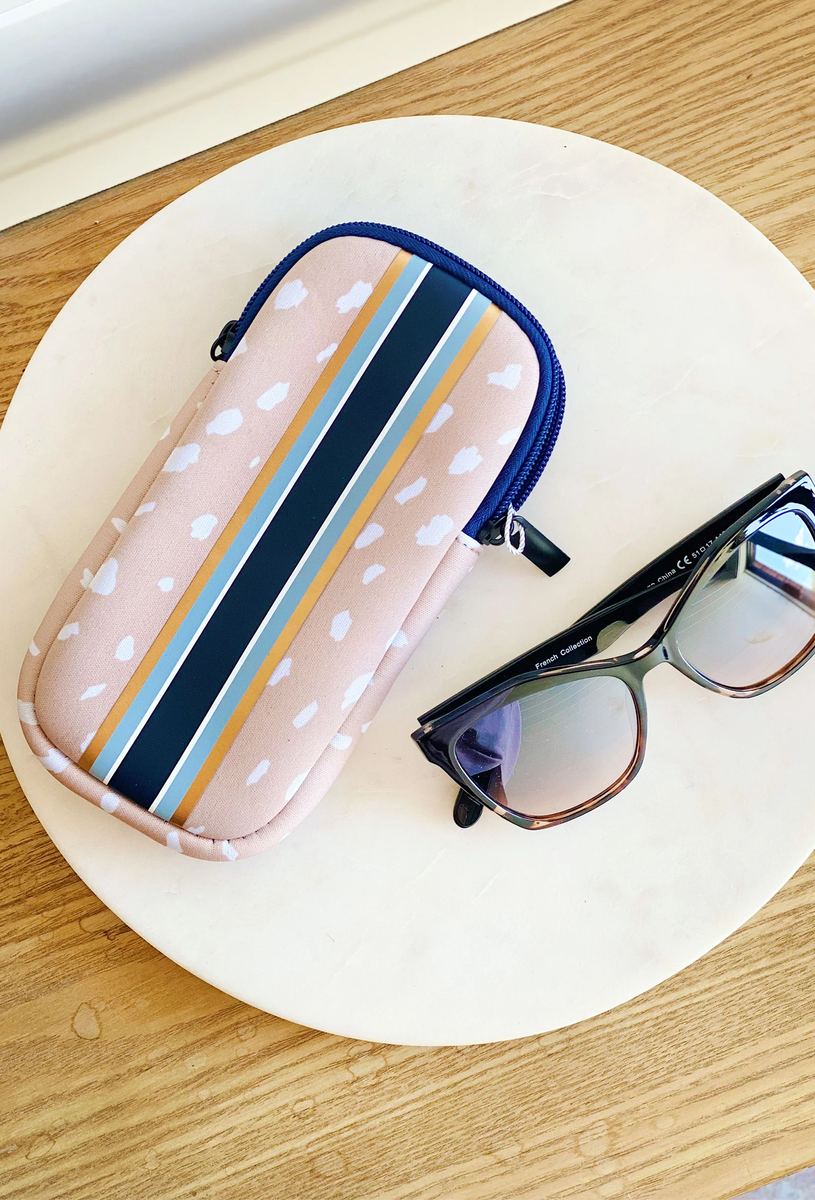
A pink neoprene sunglasses case beside the glasses it protects — the smooth matte face, navy zipper and striped band.
The foam is full of tiny sealed gas bubbles. Those bubbles cushion the glasses when the bag is dropped, and they block water and dust, so the case stays dry inside even at the beach. The material is the same CR neoprene foam sheet we use across our wetsuits and sports supports — see our ultimate guide to neoprene sheets for how the foam is made.
Bulk buyers are eyewear brands, optical chains, resorts, beach shops and corporate gift buyers. A printed case turns a basic accessory into a branded product, and one size range covers a whole customer base.
How Thick Should the Padding Be?
2–3 mm is the standard for a soft case. Below 2 mm, the case is a dust cover — it stops scratches but cushions nothing when the bag is dropped on a table. At 3 mm, the case cushions a drop and holds its shape in a bag. Above 4 mm, the case gets stiff and bulky, and the zipper strains around the curve. For most sunglasses cases we use 3 mm, and 2 mm for a slim slip-in sleeve.
Our factory splits foam from 1.5 mm to 45 mm, so any thickness is possible — but for sunglasses cases we use a soft SBR grade. Our SBR 5–7° foam is our soft grade for sewn accessories: tensile strength 247 kPa and elongation 199% on its technical data sheet. That stretch is what lets the case flex around the glasses instead of cracking at the seams. See our neoprene sheet thickness guide for how to pick the right mm for any product.
Thickness is only half the story. The foam must be closed-cell. Open-cell foam is softer and cheaper, but it absorbs sweat and water, holds the smell, and tears more easily at the seams. Ask your supplier which foam they use — and ask for the data sheet, not just a claim.
What Size Fits Your Glasses?
Order by the lens width, not by the brand. Measure the lens width in mm — it is printed on the temple arm — then the frame width across the front and the folded length. A case 1–2 cm longer than the folded glasses fits well; a case the exact length strains the zipper every time it closes.
| Glasses Type | Lens Width | Folded Length | Case Size | Best For |
|---|---|---|---|---|
| Standard | 50–55 mm | ~14 cm | 17 × 8 cm | Most sunglasses and reading glasses |
| Oversized | 58–62 mm | ~15 cm | 18 × 9 cm | Large fashion frames, aviators |
| Sport / wrap | 60–65 mm | ~15 cm | 19 × 9 cm | Curved sport frames, cycling glasses |
If you sell to one customer base, the 17 × 8 cm case is the volume product — it fits most adult glasses and stacks neatly in a display. If you sell sport glasses, add the wider 19 × 9 cm case, because a curved wrap frame will not fold flat into a standard case. Tell your supplier the lens width and the folded length — the case is cut to fit both.
Zipper, Drawstring or Slip-In? How the Closure Changes the Case
Zipper for security, drawstring for speed, slip-in for the lightest case. A zipper closes the case fully — nothing falls out, and dust and sand stay out. The trade-off is the zipper itself: a cheap zipper snags on the lining and can scratch a lens. A drawstring closes fast with one pull, but the top stays open a little, so sand gets in. A slip-in sleeve has no closure at all — the glasses slide in and the neoprene grips them. It is the lightest and cheapest, but the glasses can slide out in a bag.
Most eyewear brands order the zipper version, because it is the case a customer already knows and trusts. Most promotional buyers order the slip-in sleeve, because it prints the biggest logo at the lowest cost. If you order zippers, ask for a #5 or #8 zipper with a fabric pull, and check the zipper teeth are covered by a fabric gutter inside — a strip of fabric that sits between the teeth and the lenses, so the metal never touches the glass.
Soft Lining: What Keeps Lenses Scratch-Free
The lining matters more than the outside. A case with a rough lining scratches the very lenses it is meant to protect. A good case has a soft lining — brushed fabric or microfibre — on the inside face, so the lenses rest on something softer than themselves. The lining should run the full inside of the case, not just a patch at the bottom, and it should be stitched flat so no seam edge rubs the lens.
Coated lenses scratch first. An anti-reflective or mirror coating is thinner than a hair, and one grain of sand in a rough case will mark it. That is why the lining test is simple: rub the inside of the case with the back of your hand. If it feels rough on skin, it will scratch a coated lens. Ask your supplier what the lining is — brushed fabric, microfibre, or plain nylon — and check the fabric face carries OEKO-TEX Standard 100 certification, which tests textiles for harmful substances. Our foam is RoHS and REACH compliant, which limits hazardous substances in the material.
Clip, Carabiner and Water Resistance
A clip turns the case from something you carry into something you attach. A carabiner clip on the zipper pull lets the case hang from a bag strap, a belt loop or a beach bag, so the glasses are always within reach and never at the bottom of a bag. A fabric loop does the same job more quietly, and it will not scratch the bag. Ask for a plastic carabiner, not metal — metal scratches the glasses and the bag it clips to.
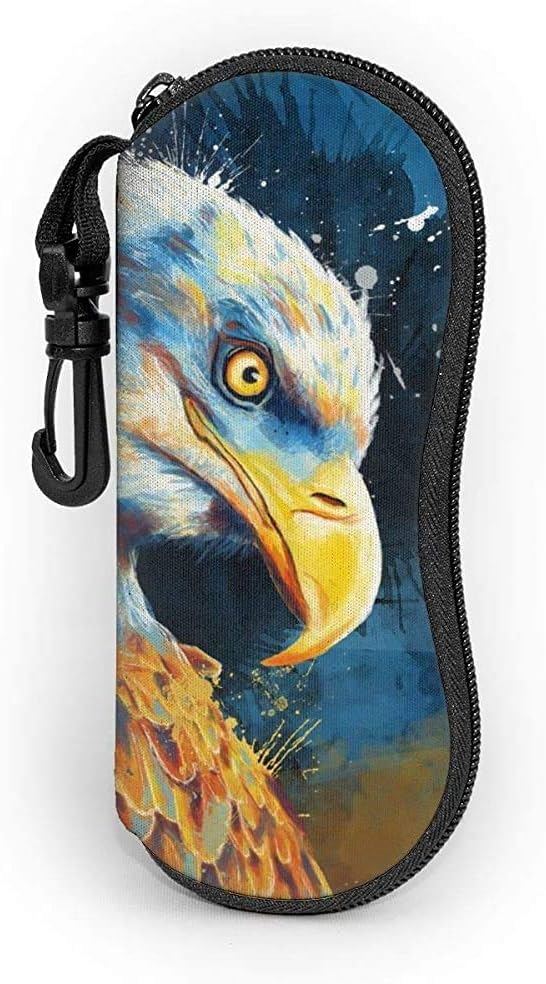
A printed neoprene sunglasses case with a carabiner clip — clip it to a bag strap and the case is always within reach.
The foam is waterproof. The case is water-resistant. Closed-cell neoprene does not absorb water — rain and splashes bead and run off the surface. Our waterproof vs water-resistant guide explains the difference: the foam blocks water, but the zipper and the seams let water in if the case sits in a puddle. For beach and boat use, a zippered case keeps sand and spray out — but it will not survive being dropped in the sea.
Rinse, soap, air dry — no heat. Rinse the case under a tap or wipe it with a damp cloth, wash it with mild soap and cool water, and air dry away from direct sun. Do not machine wash and do not tumble dry: heat damages the foam and shrinks the fabric face. Do not leave it in direct sun for days — UV ages neoprene faster than anything else. A rinsed case is dry enough to use again in a few hours, because the foam holds no water.
Your Trusted Custom Neoprene Sunglasses Case Manufacturer
Stop buying plain cases that scratch the lenses they should protect, split at the zipper, or lose the glasses at the bottom of a bag. We are a specialized custom neoprene factory making sunglasses cases, eyeglass pouches, and protective accessories for brands worldwide.
When you partner with our factory for custom OEM cases, you get 2–3 mm closed-cell neoprene, soft microfibre lining, zipper, drawstring or slip-in closures, carabiner clips, Pantone-matched colours, and full-colour print. Our colour matching and printing guide explains how we match Pantone colours and print full-colour designs on neoprene.
Do you want to launch a branded line of neoprene sunglasses cases? We accept custom OEM orders with full branding options, tailored sizes, and low minimum order quantities.
- True 2–3 mm closed-cell neoprene, soft lining and cushioned protection.
- Zipper, drawstring or slip-in closures with carabiner clips for bags and belts.
- Low Minimum Order Quantities (MOQ) for custom brand runs.
Learn more about our OEM production capabilities on our official website: https://source.neoprenecustom.com
Ready to design a custom sunglasses case? Contact our team directly: kevin@neoprenecustom.com
Frequently Asked Questions (FAQ)
Q: What size sunglasses case do I need?
A: 17 × 8 cm fits most standard glasses with a lens width of 50–55 mm. Oversized frames need 18 × 9 cm, and curved sport frames need 19 × 9 cm. Measure the lens width on the temple arm and add 1–2 cm for the zipper.
Q: Is 2 mm or 3 mm neoprene better for a sunglasses case?
A: 3 mm is the standard — it cushions a drop onto a table and holds the case's shape. Below 2 mm the case is a dust cover; above 4 mm it gets stiff and bulky. Use 2 mm only for a slim slip-in sleeve.
Q: Zipper or slip-in — which protects lenses better?
A: A zipper closes the case fully and keeps sand and dust out, so it protects better. A slip-in sleeve is lighter and cheaper, but the glasses can slide out in a bag. For beach and travel, order the zipper version.
Q: Are neoprene sunglasses cases waterproof?
A: The foam is waterproof, but the case as a whole is water-resistant — the zipper and seams let water in if the case sits in a puddle. Rain and splashes bead off the surface, and a zippered case keeps sand out at the beach.
Q: How can we order custom colours and logos?
A: Send your case sizes, Pantone colours, and logo file to kevin@neoprenecustom.com for a quotation. We print the full-colour design on the fabric face of the case.